Warren Gaskin
Fictional. Generated by AI — not a real person, and no likeness of one is intended.
58, court reporter in Honolulu · rolled by @colin.hasbrook · card — no film
History
who has worn him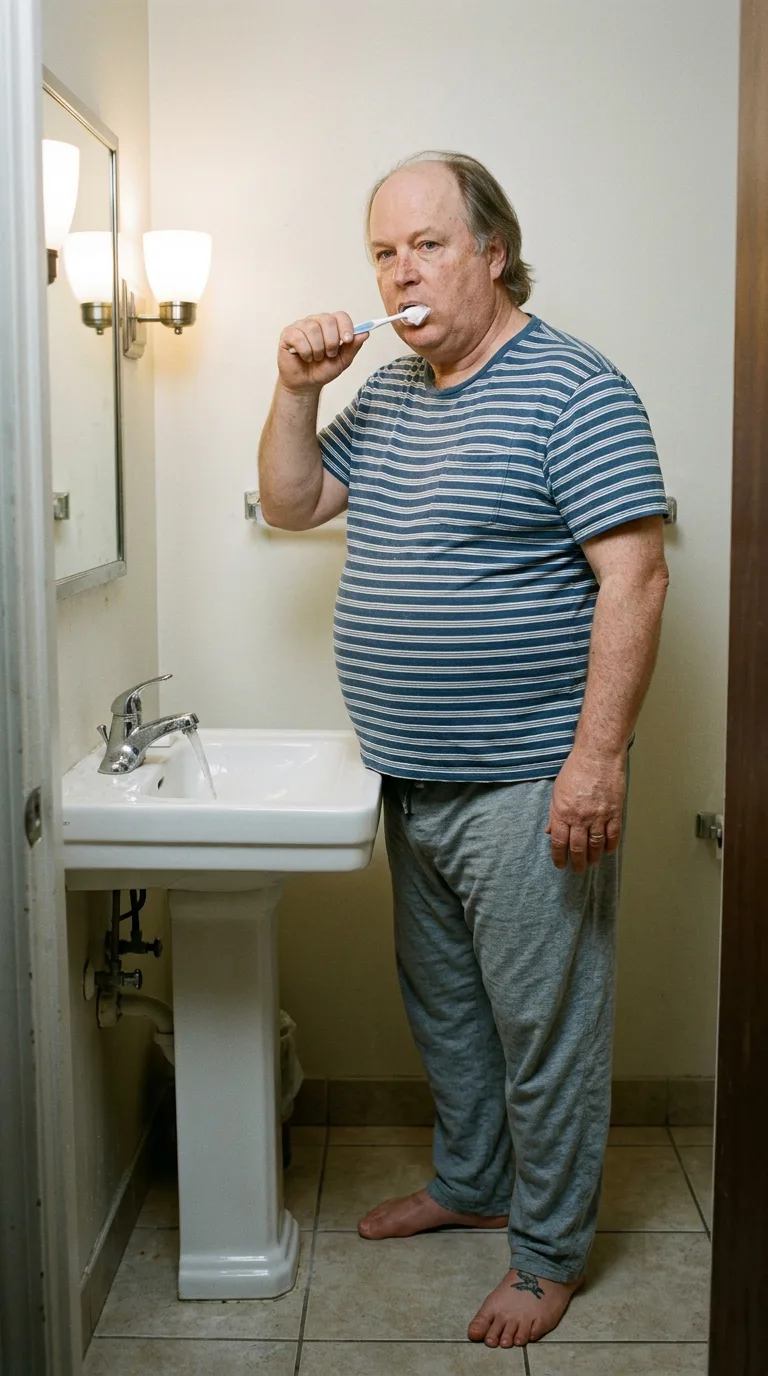
Rarest thing about him: Light brown — rare, 1 in 21
Season 0seed 1932637916 · engine v10
Character card
lineage 2NZHHJ
His body-swap story
@colin.hasbrook, wearing Gerald Dunmore, rolled the wheel on and woke up as Warren Gaskin, spent under a minute in him, then spun the wheel and woke up as Russell Anzalone
Gerald's wrists are what decide it.
You have been him fifty-one seconds, still standing where the last man left you, in a break room that smells like machine grease and burnt coffee, both braces cinched tight around the wrist bones, the ache already there before you've done anything to earn it. Fluorescent light. A time clock on the wall clicking toward the end of a shift that hasn't started. Fifty-one seconds ago you were somebody else entirely, and now you're a sixty-one-year-old man with tendons that scream every time he lifts a tote above shoulder height, and the last thing the body before him — Gerald himself, before you — ever really knew was the shape of that pain settling in for good. You didn't take him for the pain. You took him because the last one, the one before Gerald, was a locksmith in Tulsa with a bad hip, and Gerald was an upgrade in nothing except that he was different, and difference is the only currency you actually spend anymore. Four hundred fifty-four men, and the only thread through all of them is that you get bored of the last one faster than he ever got bored of his own life.
So your thumb finds the phone in a pocket that isn't a pocket you dressed yourself, and vessel.cards loads the way it always loads, patient, ordinary, a wheel and a price, and you pay it before Gerald's wrist brace finishes complaining, and you spin.
The bristles are already at the back left molar when you arrive, foam gone thin and grey at the corner of a mouth that isn't the mouth you expect — smaller, softer at the jaw, breathing easy through a nose dusted with freckles you can feel like a texture before you ever see them in the mirror in front of you. The tap runs. The stroke you're mid-way through finishes on its own, muscle doing what muscle does, and then you make it stop, and start it again on the other side, slower now, working the molars like there's a reason to be thorough about it at — you don't know what hour, except that the light through the window is the flat white of a morning that's already given up being cool. You rinse. You rinse again. You stand the brush up bristles-first in a glass that has clearly held a decade of the same brush, the water in it the grey of habit rather than dirt.
The toothbrush is the first thing that talks to you. Cheap, a grocery-store handle, and it gives you a flash of a hand — this hand, thicker at the knuckle than you're used to being — squeezing a tube in the dark of five a.m. so as not to wake somebody sleeping four feet away, because the machine on the nightstand hums through the apnea and if it stops humming Sunny wakes up scared. Sunny. The name arrives with the flash, unbidden, the way all of it will now: not given, found, the way your tongue finds a chipped tooth. Sunny married this man twenty-six years ago at a church with the doors open to the trade winds, and there is a whole service in the memory, brief as a photograph, her in ivory looking somehow amused at him rather than at the vows.
The shirt is next — you're not wearing it yet this second, but your hand brushes the doorknob, cool brass, and that alone unspools a Tuesday: him standing at the closet in the grey dawn light, pulling the same striped shirt off the same hanger because it's the one that doesn't ride up over the belly when he sits for eight hours, because sitting eight hours below a judge's bench with a stenotype machine wedged between his knees is what he has done five days a week for thirty-one years, in a courtroom with windows tall enough to let Honolulu's whole white glare in across the varnished rail. His hands — these hands, cracking each knuckle one after another without meaning to, an old tell his wife used to swat at across the dinner table — know a chorded keyboard the way another man's hands know a guitar, six keys at once, syllables collapsing into shorthand faster than thought. Wrist braces waiting on the dresser for the workday, the ones from the portrait, tan velcro, because the carpal ache never really leaves anymore, thirty-one years of it.
The floor tile under his bare feet gives you the house: posts holding it up off red dirt, tin roof that turns thunderstorms into gunfire, a yard baked pale by sun that never really apologizes. Two kids, grown now, gone to Oahu Community and to the mainland respectively, a boy who calls on Sundays and a girl who doesn't call enough and it eats at him more than he'd say out loud in the small Baptist-adjacent church where he sits third pew back most weeks he's not too tired. Sunny's photograph on the dresser, and behind it, folded so far back in a drawer it's practically fossil, a photograph of a woman who isn't Sunny — Denise, from before, from a life on the mainland he doesn't think about except in the particular quality of certain rainy mornings, and he has never once acted on missing her, only kept the picture the way you keep a scar you're proud you survived.
The wedding band is against your finger now, plain gold, and it gives you nothing dramatic, just weight — twenty-six years of a hand doing dishes and holding a mortgage and turning pages of a courtroom transcript no lawyer will ever read twice — ordinary and total, a marriage worn thin and smooth as a doorknob from all the small good hours nobody photographs.
You rinse the brush a last time. Foam gone. The house is quiet in the specific way it's quiet when Sunny's already left for her shift and it's just you and the tap and the mirror.
You look down at your own hand on the sink's edge — thick-fingered, freckled to the wrist, a plain ring catching the window light — and you turn it over once, like it might not answer to you, and it does.
You look up into the mirror and say, to no one, "There you are."