Walter Pruszynski
Fictional. Generated by AI — not a real person, and no likeness of one is intended.
60, line cook in San Francisco · rolled by @brian.okafor.lynch · card — no film
History
who has worn him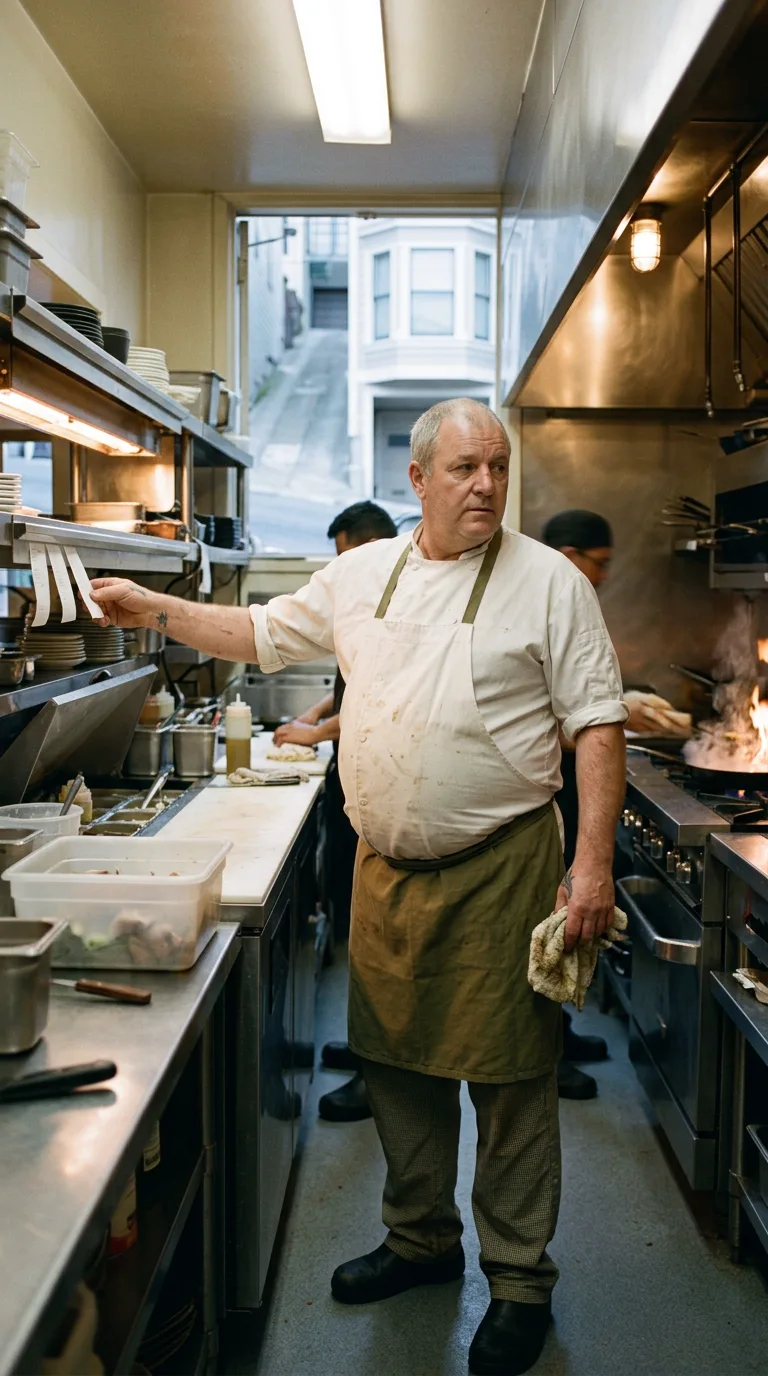
Rarest thing about him: Hand or neck (visible) — epic, 1 in 78
Season 0seed 393080138 · engine v10
Character card
lineage 79CGDV
His body-swap story
@brian.okafor.lynch, wearing Dominic Achebe, rolled the wheel on and woke up as Walter Pruszynski, spent 2 minutes in him, then spun the wheel and woke up as Devon Ashby
You are standing in a firehouse kitchen at two in the morning, Dominic's phone warm in Dominic's hand, and the trouble is you can already feel the shift change coming for him in five hours — the ladder truck, the captain's clipboard, the guys who will slap this back at eight and expect a man who slept. You have had him one minute and you already know you are not going to be here for the part where he has to be good at it. That was never really the draw. The draw was the screen, blue-white against your palm, the site that only asks for money and never asks why. You spin because Dominic is thirty-six and fireproof and there is nothing left to find out about him yet, and finding out is the only thing that has ever felt like yours. You thumb the wheel before you can talk yourself down from it. It spins the way it always spins, too fast to watch, and there is no countdown, no light, nothing so decent as a warning.
The rhythm breaks mid-reach. Your hand — his hand, a hand you did not have half a second ago — is holding a plastic quart container out toward a shelf of white china, fingers pinched around its rim, and the motion that was supposed to slide it into its slot on the rail goes wrong, overshoots, nearly clips the edge. You correct it. Slow. Deliberate. The way a man corrects something he has done ten thousand times without looking, when for one instant he suddenly has to look. Heat rolls off a flat-top three feet to your right. A cook behind you says something about the fire on pan two that doesn't fully land. Your body is heavy in a way Dominic's never was — thick through the middle, a weight that sits low and settles when you stop moving, which you have not, quite, stopped doing. Cold air breathes in off a window at the end of the galley, past a bay window and a steep black driveway, and you understand without being told that it is very late here too, and that lateness on this end of it means something different than it means for a fireman on a bunk in Chicago.
The apron strap presses a groove into your neck that has been there so long it isn't pain anymore, just information, and through that pressure the first thing comes back — not a memory so much as a fact with feeling attached: he tied this same strap this same way at four this afternoon, alone in the kitchen before the first ticket ever printed, humming nothing, thumbs working the knot behind his back on muscle memory alone, the small quiet satisfaction of a shift not yet ruined. The shirt against your back gives you the rest of it in order, the way clothes do, sleeve by sleeve: an elbow that clicks going into the right cuff, a button that's been loose eleven months and he keeps meaning to fix, the smell of bleach and old grease that never quite comes out no matter how many washes, a smell that is, at this point, simply the smell of himself. Your knees ache climbing in. Your feet already ache from the shoes, black clogs worn soft and gray at the heel, four hours in and eight left to go, and there's no complaint in it, just weather, just Tuesday.
The tribal ink on the back of your hand is warm from the flame nearby, and touching the container plastic brings a whole year up at once — 1987, a shop in the Mission, a girl named Carla who liked the design and is the reason it's there at all, and who is also, unhelpfully, the same Carla who left him eleven years later for a man with a boat, and who he still thinks about on slow Tuesdays when the ticket rail is quiet, wondering in an idle, unbothered way whether she's still in the city, whether she ever thinks about him crooked-nosed and getting old on a line, whether the boat worked out. The nose itself throbs faintly at the memory of the memory — a bar fight decades gone, a stool knocked sideways, a friend's wedding that ended in an ER waiting room and a story he still tells wrong on purpose because the true version isn't as funny. Church on Sundays when he makes it, which isn't every week, God patient with him about that the way God is patient about a lot of things. No wife. No kids, and some nights that sits on him like the apron strap, present and not painful, just there. Money he doesn't spend on much besides the mortgage on the flat above this exact garage kitchen and a truck he babies. A body that has cooked through two herniated discs and a torn rotator cuff and outlasted three sous chefs half his age, because quitting was never actually on the table, not once, not really.
You look down at the hand holding the container. It is not your hand — not Dominic's, not the fireman's clean dark knuckles you had thirty seconds and one body ago — it is thick and pale and inked and belongs to a man twenty-four years older than the last one, and you turn it once in the ticket-rail light like you're checking it's real, because it is, and it will be until you decide otherwise, which could be tonight or could be a year from now, nobody's decided that yet, not even you.
"Order up," you say, to nobody, in his voice, and it comes out steadier than you expected, and behind it, underneath it, something that isn't a decision yet — just the shape of the wheel, waiting, the way it always waits, for whenever you get bored of being good at this too.