Vincent Casas
Fictional. Generated by AI — not a real person, and no likeness of one is intended.
44, cop in Los Angeles · rolled by @colin.hasbrook · card — no film
History
who has worn him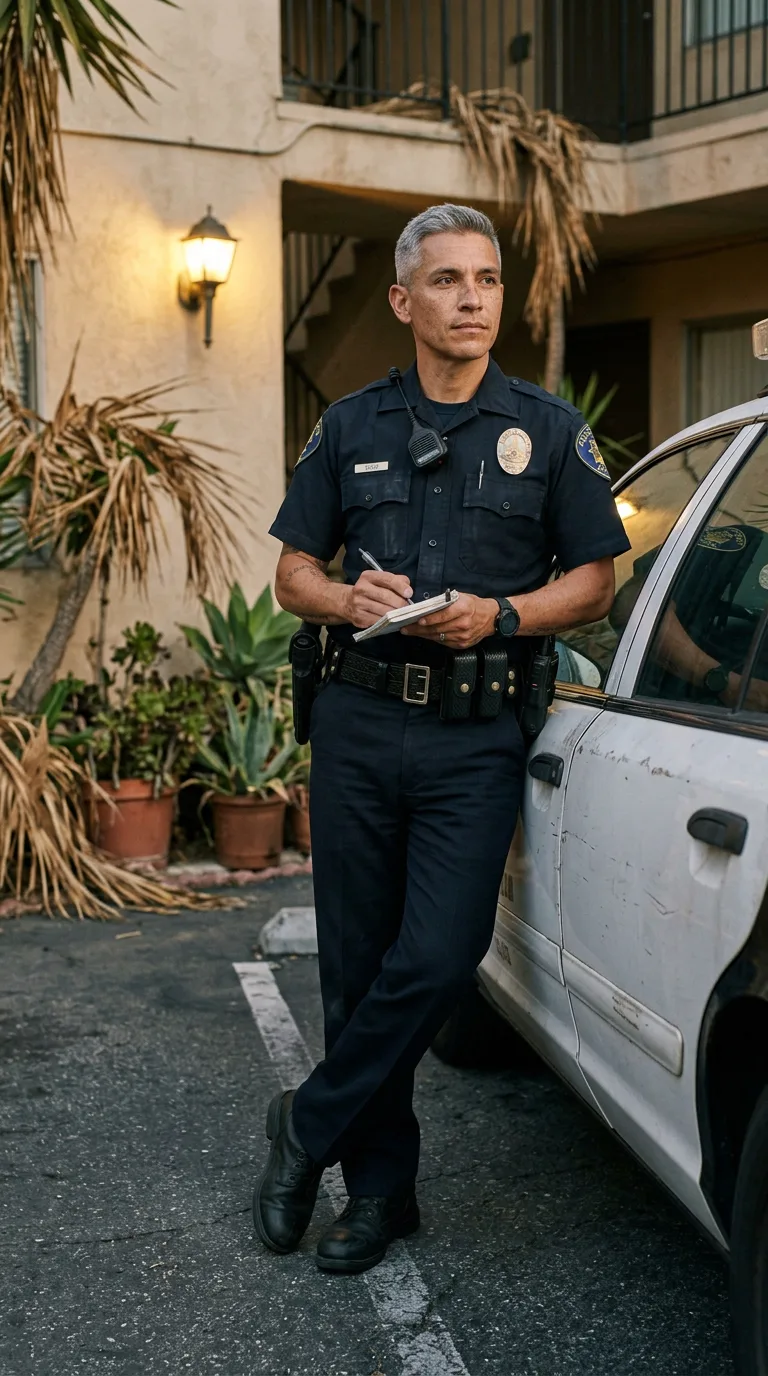
Rarest thing about him: Unitarian or liberal faith — epic, 1 in 118
Season 0seed 1254087367 · engine v10
Character card
lineage 2NZHHJ
His body-swap story
@colin.hasbrook, wearing Terry Whitcomb, rolled the wheel on and woke up as Vincent Casas, spent under a minute in him, then spun the wheel and woke up as Kyle Ahlgren
The flour is under Terry Whitcomb's nails when the site loads again on the cracked tablet propped against the mixer, and you feel his knees, his bad knees, complaining at the concrete floor of the shop he has stood in for thirty years. You have had him less than a minute and already you know why you're leaving. It isn't the ache. It's the smell — browning butter, proofing dough, the same four walls every dawn since Reagan — and how satisfied he is standing in it, how finished. A man content is a man wasted on you. You paid for this one hundred fifty-five times over precisely so you would never have to stay anywhere that smelled like a decision already made. You spin before the loaf timer goes off.
Two thousand three hundred miles west, at the same instant, in a light gone gold and dirty at the edges of a stucco courtyard, the pen stutters on the notepad.
He is writing the numbers off the license plate for the third time, unhurried, because he has written ten thousand plates in his life and his hand simply knows the shapes — 6, 3, 1, D — and then it doesn't. The 6 comes out wrong, looped backward like a child's, and he stops, frowns faintly at his own hand as if it had said something rude, and does it again, slow, correct. Then the next digit. Then the one after that, each one checked now, deliberate, a grown man relearning how to write his own name. He does not know why. He leans on the cruiser exactly where he was leaning, the pen still between two fingers, weight still on the same hip, and none of it moves except what's underneath.
The pen is the first thing. Bic, chewed slightly at the cap, and it gives you a flash of a thousand parking lots, a thousand notepads flipped shut with a thumb, and under that — steadier, older — a boy's hand wrapped around a much bigger pen at a kitchen table in Boyle Heights, a mother saying *slower, mijo, they have to be able to read it in court.* The badge against your chest is warm from his own body and it gives you the day he pinned it on the first time, twenty-two years old, hands not shaking then either, though everyone told him they would.
The uniform remembers the morning better than you do. Sleeve first — right arm, always right arm first, some superstition he inherited from a training officer twenty years dead — and the fabric is stiff the way it always is on a Monday, fresh from the dry cleaner's plastic, and his wife's voice is in it too, from the next room, half-asleep, telling him Marisol has a dentist appointment at four and can he pick her up, and him saying *yeah, yeah* around a mouthful of toothpaste. Three kids' names surface with the collar button — Marisol, Danny, the baby who isn't a baby anymore, whose name comes with a specific weight, a christening, a fever at two a.m. that turned out to be nothing. The belt is heavier than Terry's apron ever was; it sits on hips that carry it easily, muscle memory older than thought, the holster snap-check he does without looking, twice, always twice.
The tattoo on his forearm burns up through the sleeve like it's been waiting — *Valentina, 10-04-03* — and that one comes with no explanation attached, just an ache shaped like absence, the kind of thing a man doesn't narrate even to himself. You don't push on it. Some rooms in a house you don't open on the first night.
His body is small and wiry under all the gear, five-three, and you feel how the belt's weight is more than a third of him standing there, how his lower back has quietly hated this belt for a decade, how his knuckles want cracking right now, an old tic, both hands, thumb over each finger, a habit his wife used to swat at across the dinner table. His feet ache pleasantly in boots broken in exactly right. He is forty-four and strong in a compact, permanent way, freckles warm across his nose from decades in this light, and none of it belongs to fear — only to the small mutinies of a body that has done this exact motion, this exact evening, ten thousand times and doesn't expect to be watched doing it.
Behind it all, distant and low, a number lives in him that he never says aloud to anyone but his wife at the kitchen table with the bills spread out — the hole they are in, how far under, how long the ladder is — and it sits in his chest like Terry's ache sat in his knees, a familiar unglamorous weight he carries without display, because that's what carrying means to him.
You look down. The pen is still in his fingers, and for a second you turn it, testing the balance of a hand this small, this precise, so unlike the last one. You flex the fingers. They want to crack. You let them.
You lift your eyes off the notepad, into the low sun, past the dead palms, and you say, quiet, mostly to yourself: "Okay. Okay, keep going."
Nobody in the courtyard hears the second word as anything but a cop finishing a thought.