Vikram Sondhi
Fictional. Generated by AI — not a real person, and no likeness of one is intended.
53, bouncer in Los Angeles · rolled by @rohan.bhatt · card — no film
History
who has worn him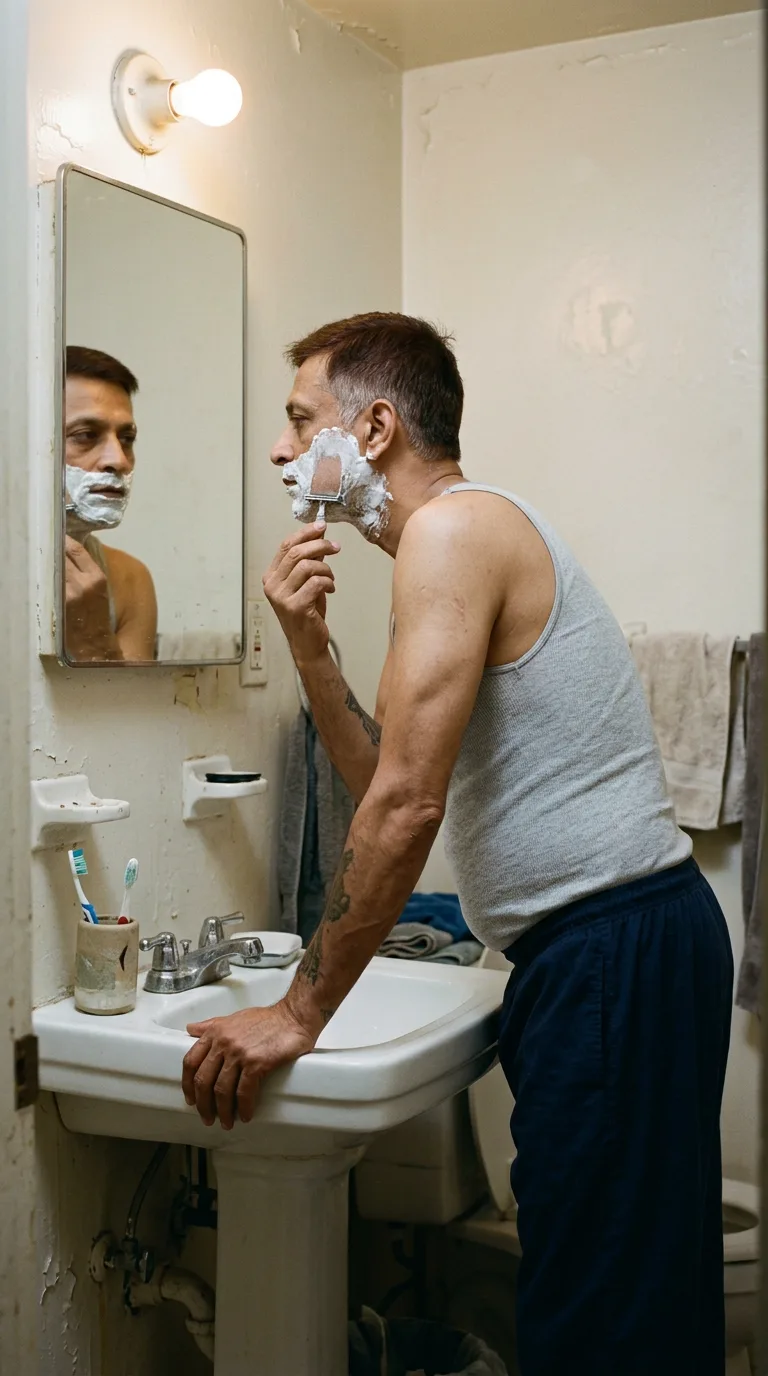
Rarest thing about him: South Asian — rare, 1 in 26
Season 0seed 1299177716 · engine v10
Character card
lineage SBZ9UF
His body-swap story
@rohan.bhatt, wearing Rohan Bhatt, rolled the wheel on and woke up as Vikram Sondhi, spent 1 minute in him, then spun the wheel and woke up as Connor Maslanka
You're standing in front of a mirror in an apartment that isn't yours, wearing a jacket photographers pay by the hour to put on you, and you already know you are going to spin again.
Seven minutes ago you were nobody, and then you were Rohan Bhatt — thirty-one, symmetrical, a face that agencies text about at midnight — and it should feel like winning. It doesn't. It feels like standing very still so nothing jostles loose. His life comes to you in scraps whenever you touch things, the way it's supposed to, but there's so little friction in it. Clean hands. A closet that smells like cedar. A phone with nothing urgent on it. You pick up his keys and get a flash of a rooftop shoot, wind machine, someone saying *beautiful, hold that*, and you think: is this all there is. You did not spin the wheel to be admired. You spun it to feel something with weight in it. This body has none. It has never been tired in a way that mattered.
So at whatever hour this is, in his kitchen, in the dark, you open vessel.cards on his laptop with his own soft hands and you pay again, and the wheel goes around, and Rohan Bhatt — wherever he actually is, whoever he actually was — stops existing in any way that matters, and you don't even feel the loss because you were never really carrying him. You were wearing him. There's a difference, and tonight you want to know what the other side of that difference is.
The razor is already moving when you arrive.
It scrapes up along a jaw that isn't smooth yet, up through foam, no hesitation at the corner of the mouth — a corner that should have hesitated, some old habit not yours to know about yet — and your hand just keeps going, faster on this second pass than the first must have been, and you feel the bathroom light buzz faintly above you, feel damp tile under bare feet, feel a body that is *heavier* than the one you left, thicker through the middle in a way that has nothing to do with strength, and something in the knee complaining faintly just from standing.
The mirror gives you back a stranger's face — brown eyes, gray coming in gray and stubborn at the roots under dye that's already a week past when it should've been redone, and a scar through one eyebrow, pale, old, healed so long ago it isn't even a memory yet, just a seam.
The razor is the first thing that opens him up.
It's cheap, disposable, and it comes with a whole decade of bathrooms — this one and others before it — and underneath that a single sharp image: a locker room, someone laughing, *you'd cut a man shaving in a hurricane, Vikram,* and the warmth of being teased by men who like you. You feel his hand's confidence in the stroke, the muscle memory of thousands of mornings, shaving around a job that starts at midnight and depends on looking clean and unbothered no matter what hour of the actual sun you're standing in. Working nights does something to a face. You feel that now, the way his mornings and evenings swapped bodies years ago and never swapped back.
The tank top against your back — his back, wider than yours was, soft over muscle that used to be harder — gives you a flash of a doorway, a rope, the particular cold of one a.m. outside a club on a boulevard that never fully goes dark. Voices. IDs held up to a flashlight. The particular pleasure of being the calm one, the one people apologize to. You feel how good he is at it, how his size does the talking so his voice never has to get loud. You feel, too, how his knees ache by 3 a.m., how the diabetes makes his feet go strange and prickling if he stands too long without moving, how there's a granola bar in his jacket pocket for exactly that, and how he forgets it's there until his hands are shaking a little near dawn.
The waistband of the sweatpants, worn soft, gives you a woman's name he doesn't say out loud anymore — Priya — and a whole year folds out of nothing: her laugh, an apartment they almost signed a lease on together, a fight about money that was really a fight about nerve, about whether he was ever going to be more than what he already was. She left for reasons that had nothing to do with cruelty and everything to do with patience running out. He still, some nights, on the walk to his car, thinks he sees her back in a woman half a block ahead, and it's never her, and some small part of him is always a little relieved and a little destroyed by that at the same time.
The mirror itself, chipped at one corner, gives you the morning ritual entire: how he stands, how he angles his chin, how he runs a thumb along his jaw afterward checking for rough patches, satisfied only when there are none. Small vanity in a man who'd tell you he doesn't have any. You feel his leg already going under him, a knee bouncing against nothing, a tremor that has outlived every reason it ever started for.
You feel his hands — broad, calloused at the base of each finger from a job that is mostly standing and occasionally isn't — and you feel, distantly, gratefully, how *used* they are. How they've done something. How tired is not the same thing as empty.
You look down at them.
They are not clean hands. They are not symmetrical, camera-ready hands. There is foam drying in the creases of the knuckles and a scar you didn't put there sitting quiet over one eyebrow when you glance up into the mirror, and for a second — one full second — you just watch this stranger's face hold still, the way a rope-line does at one in the morning when nothing is happening yet.
"Okay," you say, to no one, in a voice with more gravel in it than you've used in seven minutes. "Okay."
You don't know yet if that's relief.