Trevor Hasenour
Fictional. Generated by AI — not a real person, and no likeness of one is intended.
29, nurse in Small-town Ohio · rolled by @everett.dabney · card — no film
History
who has worn him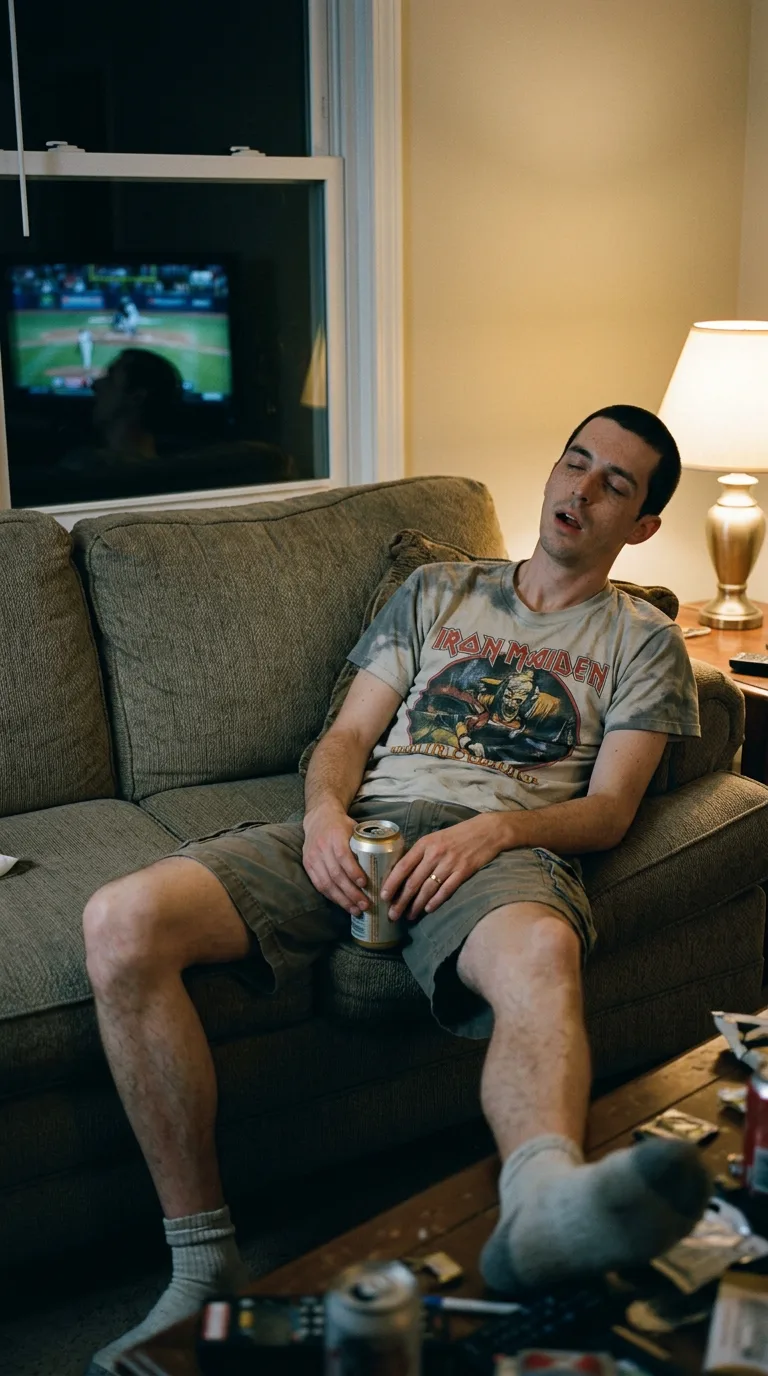
Rarest thing about him: Dyed black — epic, 1 in 77
Season 0seed 17351764 · engine v10
Character card
lineage 79CGDV
His body-swap story
@everett.dabney, wearing Desmond Achebe, rolled the wheel on and woke up as Trevor Hasenour, spent 3 minutes in him, then spun the wheel and woke up as Marcellus Deering
You are standing in a garage apartment in Atlanta that isn't yours, in a body that isn't yours either, two minutes into being Desmond Achebe, and already you know this one is wrong for you. It's not the size of him — the shoulders you could hang a door from, the forearms with weld-burn scars like old punctuation — it's that he's tired in a way that isn't fatigue, a tiredness that lives in the joints themselves, and you can feel, distantly, the ghost-ache of a double shift he pulled that you didn't pull, that some other version of tonight put into this body before you arrived in it. You spun for muscle. You spun for a man who could lift something. And now you're standing in his kitchen at 2 a.m. holding his phone, scrolling nothing, because the thing you actually wanted — to feel large, to feel unbreakable — turned out to have a cost tab you didn't read, a low hum of hurt that never quite goes away no matter whose skin it is. You wanted big. You did not want tired. So the wanting flips, the way it always does, fast and a little ashamed of itself: not more, just different. Something you haven't been. Something smaller, so the smallness itself would be the point — a body that costs less to carry. You open the site on his phone with his own thumbprint, feeling faintly criminal about that, and you spin.
The couch takes your weight before you know it's a couch. There's a can, half-warm, loose in a hand that is not the hand you had one thought ago — narrower, lighter, the fingers longer and the wedding band on it foreign and cold for exactly a second before it warms to you. A television is going through its late innings of something rerun and blue-lit. Your mouth was open. It is still open. Somewhere above you a stadium noise swells, a bat cracks, a crowd on a screen loses its mind over a play that happened hours ago and states away, and your — his — body startles half-awake at the sound the way a sleeping man startles at any sound, not from meaning, just noise, and your thumb finds the remote's volume rocker with a steadiness the rest of him doesn't have, because muscle memory doesn't get to be drunk even when the man is.
Freckles first — you feel them before you see them, that specific prickle-map across a nose that isn't broad, cheeks that are thin under a scrape of stubble he probably meant to shave off after his shift and didn't. Skinny. You notice it as an absence, the missing heaviness of Desmond's shoulders, and it should feel like a loss and instead it feels like exhaling. Then the shirt — Iron Maiden, soft with age and washing, and it gives you a flash: him at nineteen at a record show in Columbus with a friend who doesn't come around anymore, buying this exact shirt off a folding table for eight dollars, laughing about something already gone. The shorts against your legs, the sock on one foot and the bare skin of the other where the sock worked itself off sometime in the third inning — and under all of it, a low static hum that isn't tiredness like Desmond's was, it's something else, something systemic, joints that ache today for no reason a doctor's ever fully pinned down, a body that flares on its own schedule and has learned to just keep moving through it.
The ring is the key that opens the widest door. Left hand, plain band, and it brings back a hospital hallway smell before it brings back a face — fluorescent tube light, the particular quiet of 3 a.m. rounds, a woman he calls his wife saying his name across a kitchen in a voice worn thin with love and bill-math, and behind that, further back, another woman entirely — a summer, a porch, a decision he made that he still turns over some nights like a stone in his pocket, wondering about the smoother, unchosen life on its other side. There's a kid's drawing on a fridge somewhere in this house that isn't this house, a stick-figure family, his own scrub top from a nursing station this afternoon still smelling faintly of hand sanitizer under the beer smell now — he charted eleven patients today, adjusted somebody's drip at a bedside with hands that don't shake even when the rest of him falls apart quietly on the inside — and then, closer to the surface, the small mean habit: his thumbnail already worrying at the cuticle of his ring finger without him, without you, deciding to.
You look down at the hand. It is thin where Desmond's was broad, freckled where Desmond's had none, and the ring catches the TV's blue light like it's asking a question. You lift your eyes off it, into a room you didn't choose, toward a screen replaying a moment that already happened.
"Did I miss it," you say, to no one, in his voice, which is not a question so much as the sound of arriving.