Terrence Oduya
Fictional. Generated by AI — not a real person, and no likeness of one is intended.
42, line cook in Seattle · rolled by @colin.hasbrook · card — no film
History
who has worn him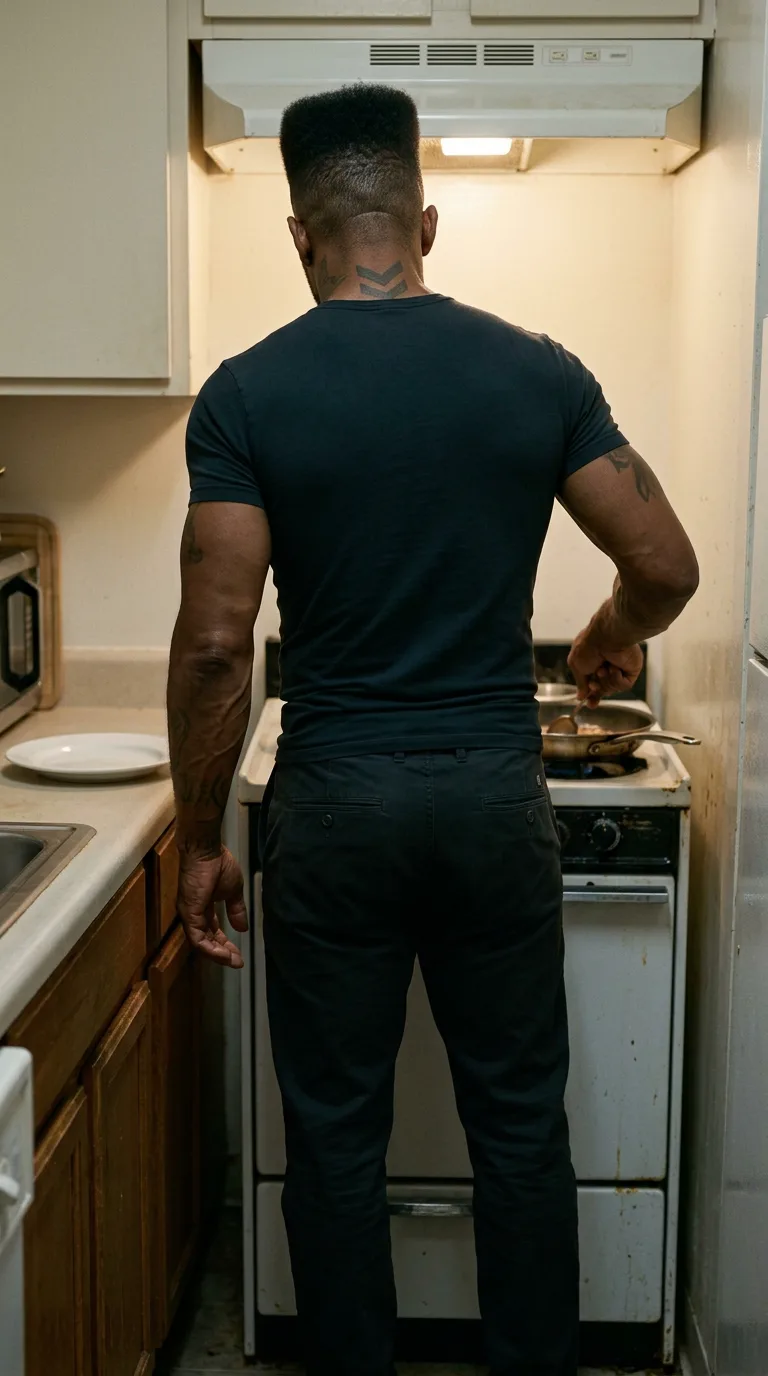
Rarest thing about him: Hand or neck (visible) — rare, 1 in 36
Season 0seed 982675656 · engine v10
Character card
lineage 2NZHHJ
His body-swap story
@colin.hasbrook, wearing Nathan Zaccardi, rolled the wheel on and woke up as Terrence Oduya, spent under a minute in him, then spun the wheel and woke up as Peter Salvaggio
You are pinning a hem when the boredom finally wins.
Nathan Zaccardi's knees ache from kneeling at the mannequin, and you feel it as your own now, the way you feel all of him after less than a minute — the give in his lower back, the reading glasses pushed up into gray hair, the smell of steam and chalk in this narrow San Francisco shop. He is good with his hands. That's the trouble. Good is boring when you have had two hundred and seven other pairs of hands and none of them stayed interesting past the first week. You set the pins down on the felt pad. You already know you're going back to the site before you've admitted it to yourself, the way you always do — a small itch at the base of the skull that isn't his and isn't quite yours either. You open the laptop balanced on the cutting table. The wheel is already loading, gaudy and patient, vessel.cards in low gold letters. You pay. You spin.
The stirring stops mid-circle.
It starts again the other way, and that's you now, small and dense and low to the ground in a way Nathan never was, your shoulders wider than your height should allow, heat off a gas burner two inches from your forearm. A wooden spoon in your right hand. A pan of something dark and savory going around and around under it. Your back is to a room you have never stood in. There's a plate already set on the counter to your left — white, chipped at the rim — and without deciding to, the body's hand reaches up into the cabinet and brings down a second plate and sets it down beside the first, close enough that they touch. You didn't do that. He did, a half-second behind you, some current still running in the wiring of him.
The apartment is small — you can feel that in the acoustics, in how close the walls are, in the way the exhaust fan over the stove roars too loud for the size of the room. It is deep into the afternoon and the light coming through the window over the sink is going gray-gold, and something about that light doesn't fit a man standing at a stove salting a pan — it's the wrong slant of day for a normal dinner, and a flash comes up through the spoon handle in your grip: closing time was an hour ago and he came straight home still keyed up from a Monday double, that particular hum in the muscles that only cooking off the clock will quiet.
The spoon is the first key. Through the worn wood you get his hand knowing this motion in its sleep — clockwise, always clockwise, some superstition he wouldn't call a superstition, learned off a sous chef at the first real kitchen that hired him at twenty. You get the line. Ticket rail humming, the particular violence of a Friday six-top, his voice low and flat calling back orders because loud never once got food out faster. You get the ache that lives permanently in his feet, in the balls of them, worn into the black shoes by the door.
The tattoo on his neck buzzes faintly against the collar of the t-shirt he's wearing, and that's a bigger door — three chevrons, and behind them: heat that isn't kitchen heat, a different kind of exhausted, men whose names come back to you soft and specific though you'll never say them out loud, the particular quiet of a barracks at four a.m., the reason he can stand a dinner rush without his hands shaking. He doesn't think about it much anymore. It sits on his neck the way old rank sits on some men, worn where people can see it and rarely explained.
The shirt against your back — you feel it now as him pulling it on this morning, alone, late start on a day off from the restaurant that wasn't actually a day off since he never really has those, one arm through the sleeve and a memory rising with it unbidden: a woman's laugh in a kitchen that isn't this one, an ex-wife's kitchen, years back, the two of them cooking badly together on purpose because it made the kids laugh. Two kids. You get their weight distinct from each other, one heavier in his arms, one who always wanted to stir. He doesn't see them enough. That thought comes with no drama attached, just weather, just the fact of a life. The ring finger on this hand remembers a ring that isn't there anymore and doesn't ache about it, exactly. Mostly.
Your body — his body — is short and dense with muscle built from twenty years of lifting cases and holding pans one-handed over open flame; your forearms carry old burn scars you can feel as texture more than pain, and your lower back holds the particular soreness of standing twelve hours on tile. Nothing hurts sharply. Everything hurts a little, all the time, in the specific way of a man who works with his body and has stopped noticing.
He salts the pan. He doesn't taste it. That's new — some flicker of you already loose in the wiring before you'd even fully arrived, a beat of inattention that isn't him, cooking for one and setting out two plates like his hands are one step ahead of a mind that used to make this exact dinner for four.
You look down at the hand holding the spoon — his hand, blunt fingers, tattoo faint blue-black across two knuckles, a burn scar pale along the side of the thumb.
You turn it over slowly, the way you always do, checking if it's really yours yet.
Then you look up, past the stove, toward nothing in particular, and say, quiet, mostly to the empty second chair: "Guess it's just me again."