Terrell Augustin Boyce
Fictional. Generated by AI — not a real person, and no likeness of one is intended.
36, train conductor in New York · rolled by @marco.villagrana · card — no film
History
who has worn him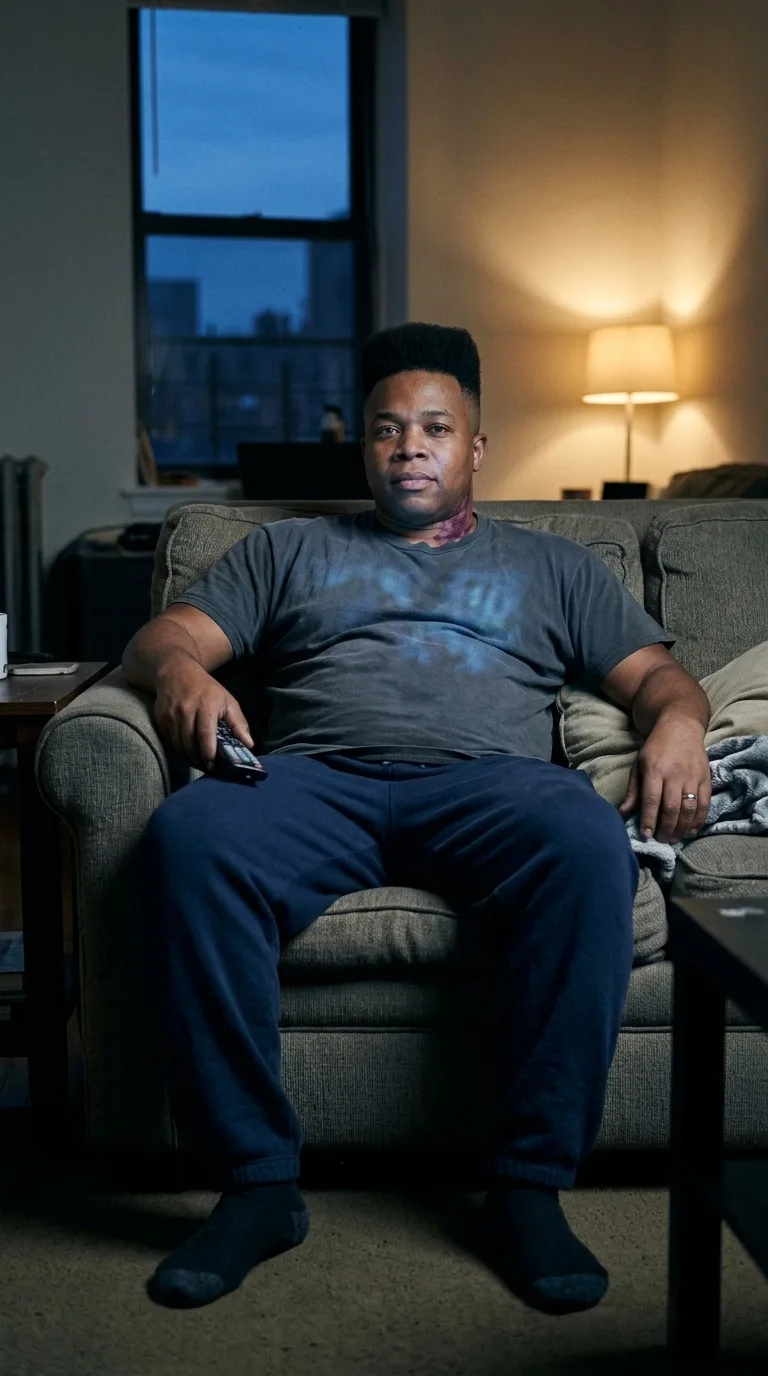
Rarest thing about him: A high-top fade — uncommon, 1 in 304
Face-off rating 1492 · not ranked yet
Season 1seed 832038168 · engine v11
Character card
lineage LJL8SV
His body-swap story
@marco.villagrana, wearing Warren Paul Dietrich, rolled the wheel on and woke up as Terrell Augustin Boyce, spent 3 minutes in him, then spun the wheel and woke up as Mateo Alejandro Reyes
You are standing in a paint booth in San Francisco with a respirator hanging at your throat, and you cannot stand his hands anymore.
It is nothing he did. The hands are good. They hold a gun steady for three hours and they never shake, and a man named Warren Paul Dietrich has lived in them for three minutes, and in those three minutes you have looked down at the overspray freckling his knuckles, blue and then silver, and thought: this is all there is. It is a lot of shoulder and one color at a time. The afternoon light comes in flat through the roll-up door. Somebody laughs near the compressor, and you do not know why, and you will never be told. Whatever sent you back was small. You do not name it. You set the gun on its hook, you step out of his weight, and you open the page with the wheel on it.
You pay. The wheel turns, ticking like a pen being clicked.
The show cuts to a bright frame.
You are sitting up straight on a couch in a dark room, and the remote is leaving your hand. You set it on the arm. Blue light moves over your face. There is a window with the last of the dusk in it, a lamp burning low in the corner, a radiator ticking. The breath in your chest is slow and wide, and a belly rests against the waistband like a held thing. Something on the screen is funny. You do not laugh. It was not yours to laugh at.
Then the couch gives you the first of him. The nubbed upholstery under your palm is the couch his wife chose, over his objection about the color. He lost, and he was glad to lose. The blanket beside your hand is gray and soft, and her feet go under it every night, and the cold of them against his shin is a small clean joy you feel in a shin that is not yours.
The shirt is old cotton, thin at the collar, and it opens the morning. He pulled it on after the uniform came off. First the double-breasted coat comes off its hook, brass buttons cold, the heavy wool of the peacoat. The chain of the ticket punch, the cap, black shoes polished the night before. Today he stood on a platform beside a stopped train, the step box down, and held a hand out to a woman with a stroller. He says "mind the gap" like a blessing. He has done it eleven years. There are mornings he is proud of that in a way he would never say aloud.
The sweatpants are soft at the knee. Your thumb finds the ring on the left hand and turns it, and the whole of her arrives. Her name is Denise. It is a kitchen, the two of them at the table, and the icon of the Theotokos on the shelf above the stove, gold gone dim. Pascha, midnight, candles passing down the pews until the church is one low fire, and he is thirty-one and crying and does not know why. He quit smoking for her, standing in the cold on this same stoop. The craving is still in his mouth like a tooth that remembers.
Your right hand wants something. Fingers curl on nothing, the thumb working. A pen. It clicks a pen when he thinks, in meetings, in the dark, on the train. You feel the missing click in your palm.
You touch your jaw. Smooth, freshly shaved, the skin warm. Your fingertips cross the wine-dark mark along the neck. It does not hurt. Children asked about it once, and he learned to say it was where the angels kissed him first. It is almost a joke. It is almost true.
His knees ache from the platform. His lower back has a low, patient complaint. He is thirty-six. The body is tired in the honest way of a man who stood all day for strangers, and under the tiredness it is strong and willing and warm.
You lift your hands into the screen's light and turn them over. Broad palms, a plain ring, short clean nails. They are not Warren's. They are not yours.
You look up. The room waits.
"Okay," you say, in a voice lower than the last one. "Okay. Hello."
The blue light goes on moving over his face. You do not know how long this lasts. Tomorrow you might still be him. In four minutes you might not.