Suresh Rajagopal
Fictional. Generated by AI — not a real person, and no likeness of one is intended.
59, prison guard in Boston · rolled by @colin.hasbrook · card — no film
History
who has worn him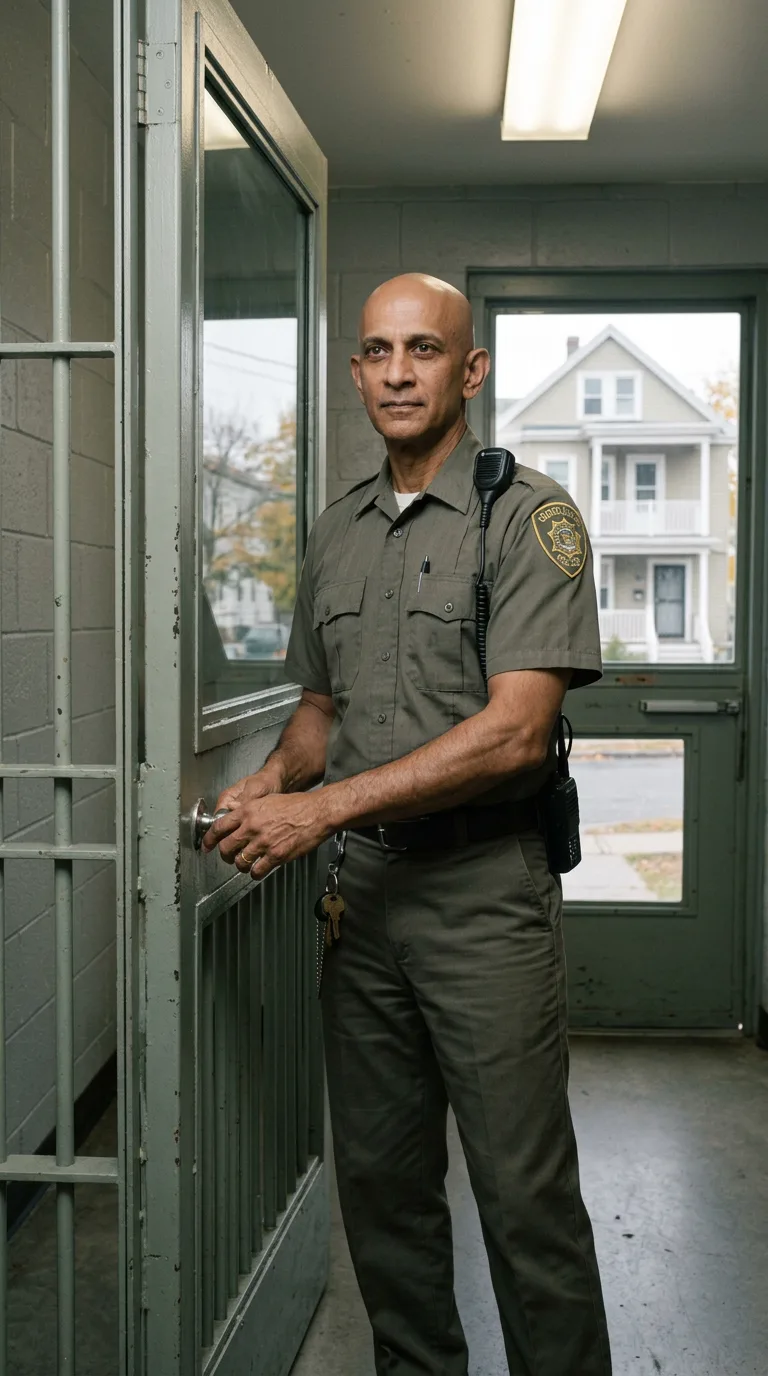
Rarest thing about him: 6'2" — epic, 1 in 193
Season 0seed 734738338 · engine v10
Character card
lineage 2NZHHJ
His body-swap story
@colin.hasbrook, wearing Tyler Bracco, rolled the wheel on and woke up as Suresh Rajagopal, spent under a minute in him, then spun the wheel and woke up as Nick Sorrentino
The bar isn't open yet, but you're standing behind it anyway, in a body you've had for two minutes, rinsing a shaker that some other bartender left dirty last night. The heterochromia catches in the mirror behind the bottles — one eye pale, one dark — and you still haven't gotten used to seeing that when you look up. Twenty-two, light brown hair, the kind of build that gets a second look. Fine body. Good body, even. You spent real money to feel it lift a case of well liquor without straining.
But two minutes in and you already know the shape of the next six hours: the lunch rush that isn't a rush, the regulars who tip in coins, closing out a register that's twralways elevendollars short. You didn't spin fifty-six times to stand behind a bar in the early afternoon light doing inventory. You spun because the wanting came back, the way it always does, faster than anyone would admit to. Somewhere out there is a better ten minutes. There's always a better ten minutes. You set the shaker down wet, walk to the office in the back where the register keeps the tablet, and you pull up the wheel again, the felt on the button worn smooth from fifty-five other decisions just like this one.
You spin. The wheel doesn't care what time it is where you're standing, or what time it is where you're going.
—
The gate is heavier than it looks and your hand already knows exactly how much push it needs, the specific give of a hinge greased six months ago and due again. You are turning a key that isn't yours, in a lock you've turned ten thousand times, and for half a second the key sticks the way it never sticks — wrong angle, wrong pressure — and you pull it back out and do it again, slow, the way you'd teach a rookie. It clicks. Behind you, fluorescent light hums along a corridor of painted cinderblock, green over grey, the color of every institutional hallway that was ever a good idea in 1974. Your shoulders are wider than you're used to. Your knees ache in a low, permanent way that has nothing to do with the last two minutes.
You are so tall. That's the first honest thought that's yours and not his — how far away the floor is.
Then the shirt against your back starts talking.
It's cotton-poly, government-issue, and it remembers being ironed this morning on a board set up in a kitchen that smells like cardamom and coffee at the same time, because his wife has her chai going before he's even awake most days, except today she was already at the table doing the crossword when he came down, still in her robe, and she'd said something about their daughter's flight from Hartford and he'd said something back around a mouthful of toast, and none of the words matter now, only the ease of it, thirty-one years of ease, the specific comfort of a kitchen where nobody has to explain themselves. His name comes with the shirt, printed on a tag sewn inside the collar in his wife's handwriting because the laundry mixes up the guards' uniforms otherwise: RAJAGOPAL. Suresh. The shirt remembers his arms going into the sleeves one at a time, right first, always right first, a habit older than the marriage.
The belt gives you the keys — their exact cold weight riding his hip, the janitor's-ring heaviness of them — and with the keys comes the sound they make walking a particular stretch of corridor, C-block, the one with the bad drain, and a memory that isn't a story so much as a temperature: twenty-six years of this job, most of it forgettable on purpose, because forgettable is what safe feels like from the inside. There was a bad year once, a stretch he doesn't let all the way up even now, a lockdown that went sideways and a man he had to restrain who was younger than his own son would have been if — no. Not that. That's not for right now. It surfaces and sinks again like something that lives at a depth this body has learned to swim above.
The wedding band on the left hand is warm from his skin, plain gold, and it hands you the whole marriage at once, too much to hold: Meena, thirty-one years, an anniversary dinner at a restaurant in Malden that they've gone back to nine times because the owner remembers their names. Before Meena there was Priya, briefly, decades ago, back when he still had all his hair — a girl he loved with the specific stupid intensity of twenty-three, who left for Chicago and married an accountant, and whom he still, without meaning to, thinks of every single time somebody plays a certain Kishore Kumar song in a restaurant, which is the closest thing to guilt he carries about a woman who has been a stranger to him for three decades. It isn't longing, exactly. It's a door he doesn't open, just checks that it's shut.
The radio mic clipped at your shoulder gives you nothing — it's new, replaced last spring — but the badge underneath it gives you children, plural, three of them at least, one grown and gone to Hartford, one who calls too rarely and whom he worries about in the specific silent way fathers do, one still young enough to leave a mess in the kitchen that Meena complains about and he secretly likes coming home to. There's a shot he takes every morning, insulin, in the bathroom before the tea, matter-of-fact after twelve years of it, no drama left in the ritual at all — just the small practiced pinch of skin at his side, over almost before it starts. He has never had a drink in his life. Never wanted one. His faith doesn't forbid it so much as simply never offered it as a question worth asking.
Your feet, in the boots, know this floor. Concrete, cold through the sole even in October. The overcast light coming through the door glass behind you — the storm door of his own porch, glimpsed through the corridor window on a bad camera angle of memory, browning maple out front, the neighbor's porch light already on this early because the sky's the color of a Monday that never quite got started. He's a middle-shift man on a body clock that argues with the season; the drowsy stretch behind his eyes right now belongs less to the hour than to the diabetes, a fatigue that shows up at inconvenient times and that he's stopped mentioning to anyone but Meena.
Ten checked motions. Key, latch, key, latch. His hands doing a job that hasn't needed double-checking since 1998, and doing it anyway, off by half a beat each time, because something underneath the routine has changed its grip without telling the routine why.
You look down at your hands — his hands, broad, a plain gold band, a faint permanent callus at the base of the trigger finger from a radio mic clipped there for a quarter of a century — and you turn the left one over like you're checking it for something that isn't on it.
"Long day," you say, to no one, in a voice with thirty more years of gravel in it than you've used in fifty-five other men, and you can't tell yet if that's him talking or just you, borrowing his mouth to say the only thing it knows how to say when nothing's wrong.
You don't know how long you'll keep it that way.