Stephen Kowalski
Fictional. Generated by AI — not a real person, and no likeness of one is intended.
42, store manager in Pittsburgh · rolled by @connor.waskiewicz · card — no film
History
who has worn him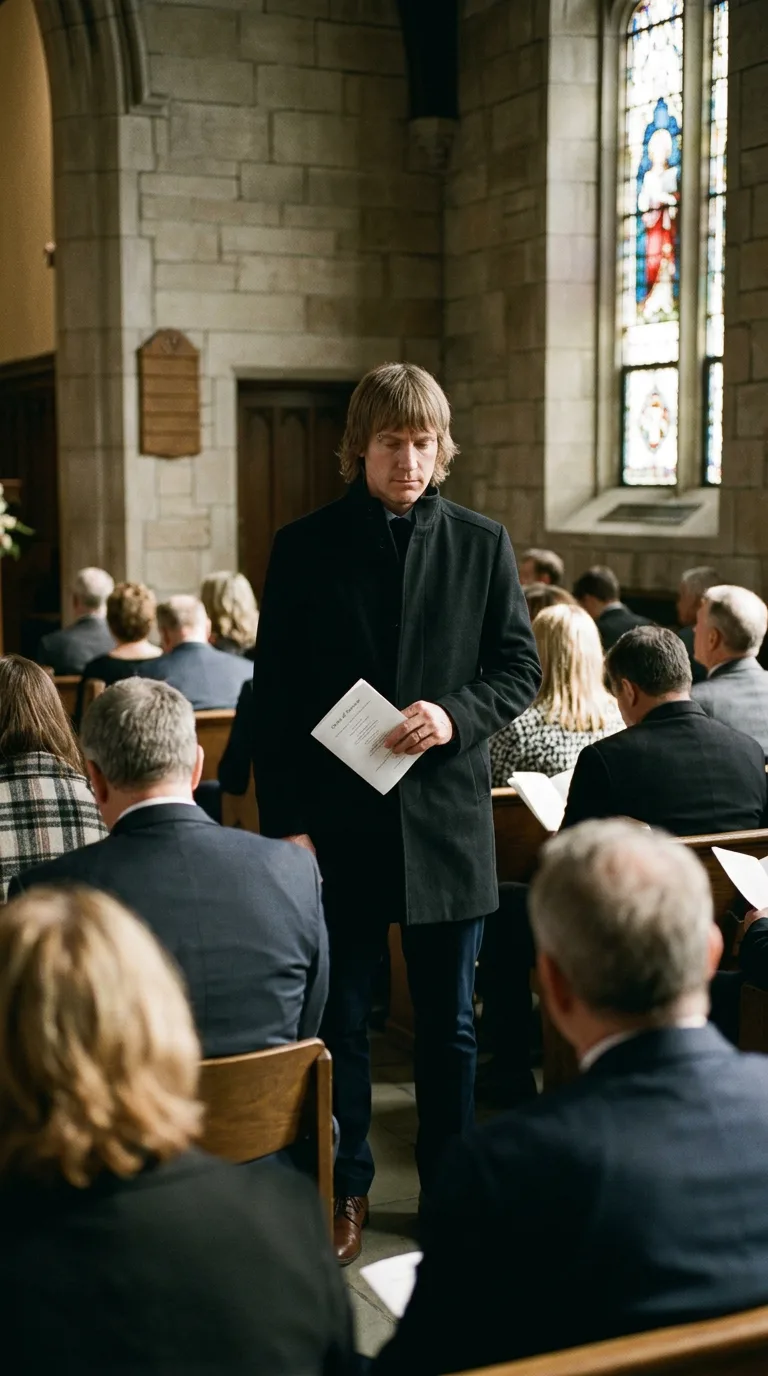
Rarest thing about him: Eyebrow — uncommon, 1 in 141
Season 1seed 1621757168 · engine v11
Character card
lineage 2NZHHJ
His body-swap story
@connor.waskiewicz, wearing Marcus Whitfield, rolled the wheel on and woke up as Stephen Kowalski, spent under a minute in him, then spun the wheel and woke up as Nicolás Barrientos
You are leaving Marcus Whitfield because of a drawer. Somewhere in the middle of an Atlanta afternoon, in his kitchen, you opened it looking for tape and found a child's drawing of a bridge, signed in crayon, and nothing in you moved. Not grief, not tenderness. His ease with the drawer, and his calm, and his forty-four years all sit on you like a coat that fits and was never yours. You have worn him for under a minute, long enough to know he is competent and that it is not enough. The brown eyes in the window are fine. You are bored of fine already. You put the drawing back, sit, and press the wheel.
The organ stops.
The room stands in one rustle and you come up half a beat behind it, in the back of a crowded chapel, in a borrowed black coat, a folded order of service in your right hand. Your eyes are lowered. Stone, wax and wet wool, and under it a sweetness of lilies. Your knees are a little stiff. Your weight settles over long legs. The heavy fringe hangs to your brows and you see through it as through reeds.
Your left hand goes to the coat and smooths it down, slowly, finding the buttons one by one. They are not your buttons. Nobody turns around.
The coat is wool, heavier than it should be, and it isn't his. The collar smells of another man's cedar closet. It gives you a flash with no picture, only his embarrassment: a hand holding out a hanger, a brother-in-law saying, "Take it, you can't go in a fleece." Stephen's own black coat is at the cleaners, or gone, and he is a man who does not own the coat for this. He's fought off shame about it all week.
The paper is in your fingers, edge softened by his thumb. Under it, a name and two dates, and a photograph of a woman laughing at something off to the side. The paper gives you her. She is his ex-wife's mother, and for eleven years she called him "my Stephen," even after the lawyers. A kitchen, a Sunday, her hands in flour, telling him he held a knife like an apology. Something thick comes up in your throat that is not yours and is real anyway.
Your right thumb goes to the cuticle of your left. It picks, finds a ragged bit, and works at it without asking you. You let it. Under your feet the stone floor pushes cold up through leather soles. His shoes are good ones, old, brown and polished the night before in the kitchen, because polishing was a thing to do with his hands.
Your ring finger is bare, and the skin there is pale, a band of lighter flesh, and when you rub it with your thumb you get the first clean memory: standing at a sink, working the ring off with soap, the knuckle red, and feeling nothing and then, in the car, everything. Two children. A girl who rolls her eyes with his own mouth. A boy who still takes his hand in parking lots. They are in the front pew, somewhere ahead, with their mother.
A small cold weight on your brow pulls at you: the barbell, a stupid, stubborn little silver thing he got at thirty-six, the one rebellion his store job allowed. The keys at his hip are absent today. You feel for their weight anyway, a hand that knows a lanyard's habit. Pallets, a box cutter, a radio on his shoulder, forty employees who say "boss" when they mean "Steve." Tomorrow he is supposed to open at seven. The thought arrives like a bill.
Your back is long and strong, a body that lifts and does not mind it. A drink or two most evenings has left a faint dull ache behind the eyes. A little money put away, not much, and a feeling about it like a held breath. He doesn't pray. He lights nothing. He believes something is listening in the quiet after the organ, and he's listening back.
The room sits. You sit late.
You look at your hand, turn it over, the pale band, the bitten edge, and lift your eyes into the lens.
"Well," you say, quietly. "Here we are."
Nothing in you knows how long that holds.