Nicolás Barrientos
Fictional. Generated by AI — not a real person, and no likeness of one is intended.
19, student in New York · rolled by @connor.waskiewicz · card — no film
History
who has worn him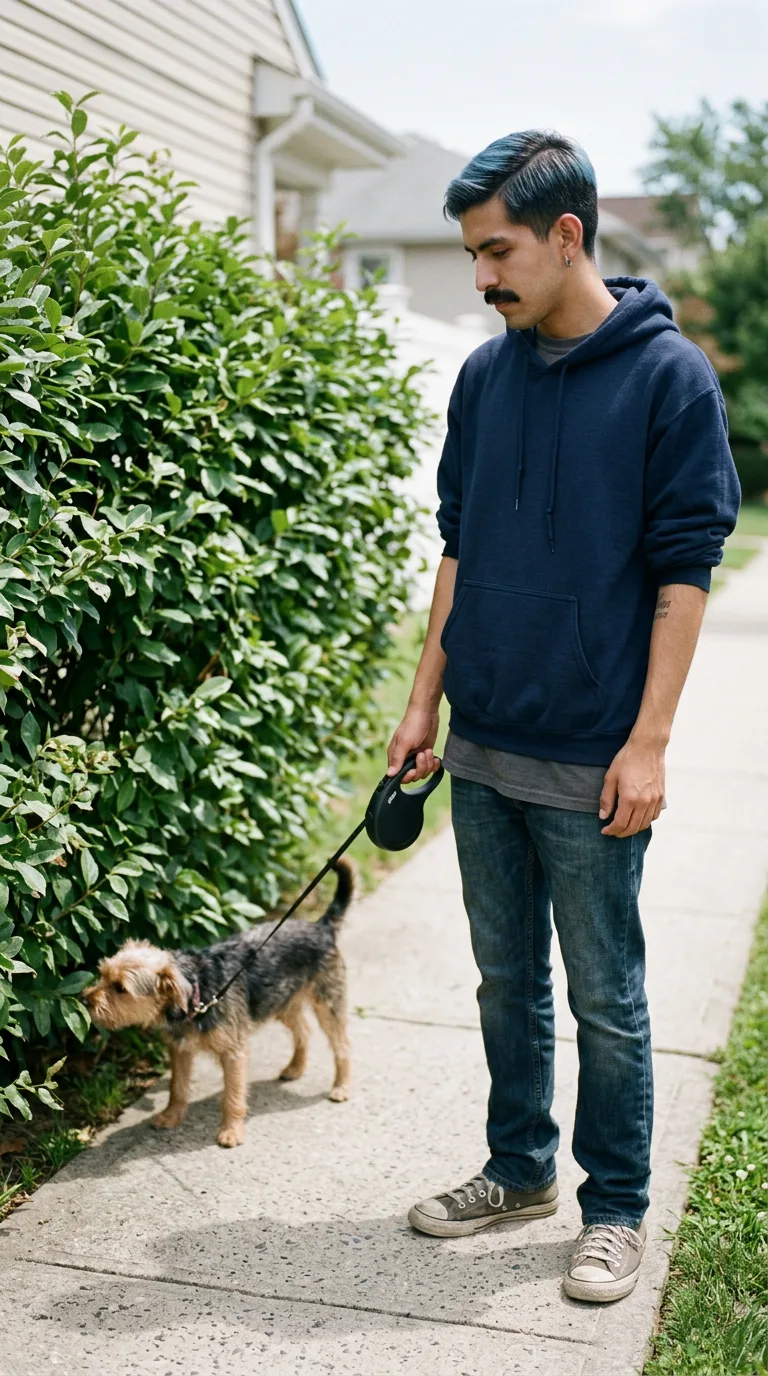
Rarest thing about him: Fashion color — common, 1 in 76
Season 1seed 1153832420 · engine v11
Character card
lineage 2NZHHJ
His body-swap story
@connor.waskiewicz, wearing Stephen Kowalski, rolled the wheel on and woke up as Nicolás Barrientos, spent 1 minute in him, then spun the wheel and woke up as Owen Lindqvist
You are standing in a stockroom doorway in Pittsburgh, in a body that is forty-two and six-foot-one and has never once ached, and you are watching a delivery driver wrestle a pallet jack. Stephen Kowalski's shoulders are loose. His knees are good. His name is stitched over the pocket of a polo you have worn for under a minute, and already you can feel what's wrong with him: he is finished. He knows the codes and the keys and the ordering, and none of it is a thing you want. Somewhere in him there is a competence you can't hold, and it sits in your chest like a swallowed stone. You came back to the wheel with his hand still warm on the mouse, because a body that works is not the same as a body that wants.
You spin.
Heat comes first, then green. A hedge, wet-bright, close enough to smell. The sun is flat on the back of your neck and the sidewalk is gritty under rubber soles. In your right hand is a plastic handle, ridged, warm from someone's grip, and a thin line runs from it down to a small wiry dog with its nose in the leaves. You have been standing here for a while. You have just arrived.
The dog looks up past the hedge. Ears flat. It does not know you, and it knows.
Then the things on him start talking. The hoodie first, heavy cotton on skinny shoulders, cuffs pushed to the elbow. It gives you a morning: a dim room, a radiator ticking, his hand pulling this navy sweatshirt off a chair because it was the clean one, and the faint shame of that, and the thought of a lecture he hadn't read for. The jeans are stiff at the knee and soft at the thigh, and they give you a night: borrowed money, a cousin's couch, counting twenties twice. The cheap canvas shoes press the arches flat. The left earlobe carries the small silver hoop, and the memory is a bathroom, a friend's needle, laughing so he wouldn't flinch.
You lift your free hand to your face. The moustache is coarse under your thumb, and the thumbnail snags, because he has chewed it to the quick. Your teeth want to go there. They actually want it. A tin of dip sits in the hoodie pocket against your hip, round and hard, and the thought of it floods your lip with phantom wintergreen, and with it his father's truck, the radio, a man spitting politely into a cup. The tattoo is under the sleeve on the arm that holds the leash. You pull the cuff back with your thumb: a name in script and a date. The skin there remembers before you do. A woman's kitchen, a hospital smell, a Catholic funeral, the heat of a church in July, his own hand shaking on a rosary he doesn't believe in and carries anyway. It is his grandmother's name. Grief arrives as a weight low in the ribs, and it is not yours, and you carry it anyway.
He is nineteen and weighs nothing. His wrists are thin, his stomach is empty, and he wants a drink tonight, one or two like always. He is almost broke and almost fine. Underneath it a small stubborn hope runs, the kind that only lives in someone who has never been handed anything.
You look at your hands. They are brown, narrow, with bitten nails. You turn the right one over and the leash handle shifts in it, and it feels like your own.
You look up.
"Okay," you say, in his voice, low and a little rough. "Let's go."
You wind the leash twice around the hand and start walking, longer in the stride than he ever was, and the dog has to hurry to learn you. Somewhere under the sun a question is already forming: how long, and when will the wanting come back, and whether there will still be a you in him tomorrow.