Sanjay Anselm
Fictional. Generated by AI — not a real person, and no likeness of one is intended.
47, handyman in Western Kansas · rolled by @colin.hasbrook · card — no film
History
who has worn him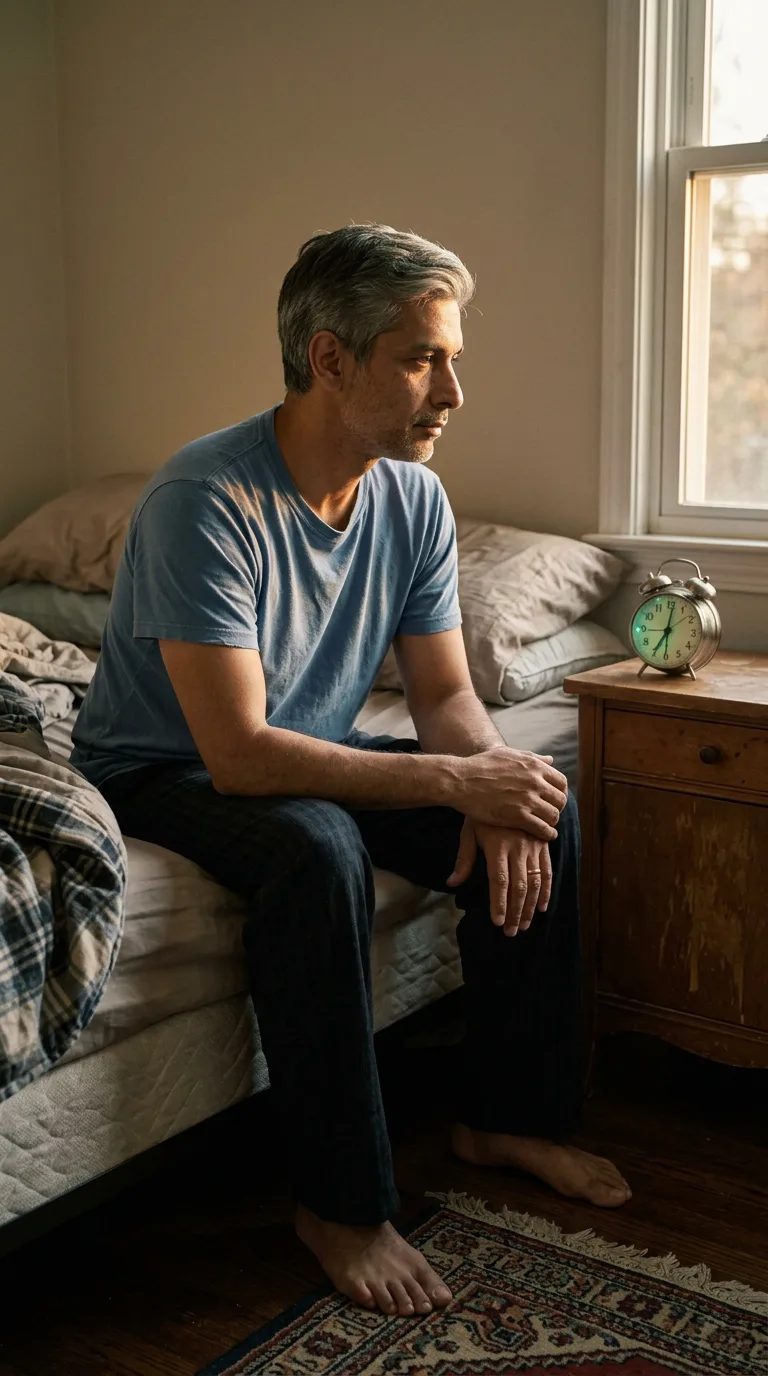
Rarest thing about him: Handyman — common, 1 in 521
Season 1seed 369789854 · engine v11
Character card
lineage 2NZHHJ
His body-swap story
@colin.hasbrook, wearing Peter Anselm, rolled the wheel on and woke up as Sanjay Anselm, spent under a minute in him, then spun the wheel and woke up as Colin Vasquez
You stand in Peter Anselm's kitchen for the fifty-eighth second of his life, and it is already not enough.
His phone is in his hand — his hand, you keep correcting, though it has been your hand for less than a minute — and on the lock screen there is a photo of two brothers at somebody's wedding, one of them tall and pale and grinning like the joke's on him, the other short, dark, solid, not smiling at all, looking sideways at the tall one like he's used to being the punchline and doesn't mind it. You know the tall one. You were just him. You know his apartment, his help desk headset, his blue eyes in the bathroom mirror this morning, the whole clean rented life of him, and none of it told you anything about the man standing next to him in that photo. That's the itch. Peter never talks about his brother except to say he's "out in Kansas, doing good, doesn't call much" — and the not-calling sat in you the whole fifty-eight seconds like a splinter you didn't put there. You didn't want Peter's life. You wanted the door he kept shut.
So: the site again, on his phone, thumb — your thumb, briefly — finding it without having to think, because apparently some things a body knows before you do. The wheel spins the same as it did the last eight hundred and twenty-three times you made someone else pay for it.
—
The bedspread is rough under your forehead and it is the first thing you feel, before you feel anything else, before you even feel that you have knees. Cotton, cheap, sun-faded, smelling of fabric softener and someone else's sleep. There is a t-shirt bunching against your ribs. There are two knees pressed into a rug that has a design in it, wool, the nap flattened in two permanent ovals from years of exactly this. Your hands — his hands — are still loosely laced together underneath you, knuckles dark-haired, a wedding band pressing a thin cold line into the finger beside it. Somewhere behind you a window is doing something gold and low and the room smells like weather about to happen.
You were saying amen. You can still feel the shape of the word leaving, half a laugh riding under it, the getting-up already started in the hips — and then the getting-up simply didn't finish. Something came down through the middle of him like a hand on the back of the neck, gentle, absolute, and put him back on his knees, and now you are the one kneeling instead.
The bedspread keeps talking. Fingers first — his fingers, drumming once against the quilted cotton without you asking them to, an old unconscious tic, and it brings with it a flash of a truck cab, drumming on a steering wheel at a red light in Garden City with the radio off, waiting to turn toward a job. Then more: this exact bedspread, bought at the Penney's in Dodge City the year the twins were born, Priya picking it because it wouldn't show dust. The nightstand clock, green-glowing, cheap, a wedding gift from her sister that neither of them has ever liked enough to replace, and thirty seconds ago his eyes were open on its hands not because he was watching the time but because praying with your eyes shut always felt like performing for someone.
You reach for the t-shirt collar without meaning to and it opens this morning whole: him pulling it over his head in the gray predawn, the fabric worn thin at the shoulder seams, a coffee stain washed to a ghost near the hem that Priya keeps threatening to throw out and he keeps not letting her, because Aisha bought it for him at a school fundraiser eleven years ago and it still fits, more or less, if more or less means the belly's gone soft over a frame that was never going to be big to begin with. Fifty-four inches of him, all of it known to itself: the low ache behind the left knee from thirty years of ladders, the permanent gray shadow of stubble he stopped fighting around forty, the freckles across his nose that Priya still touches sometimes like she's counting them, that his daughter has too, a scatter of them, the one thing of his she'd take on purpose.
The jeans on your legs remember themselves next — not these jeans exactly, but every pair like them, worn at the knee from kneeling on porches and floors, a tape measure clipped somewhere that isn't here right now because a man doesn't pray with a tape measure on him, but the muscle memory of reaching for it is in the hip anyway. Today's actual work: a screen door two doors down, hinges shot, the homeowner's wife bringing him lemonade he didn't ask for and didn't refuse, the thunderhead over the stubble fields going the color of a bruise while he worked, and driving home into it thinking, not for the first time, that he ought to say something to God about the ordinary goodness of a day like that, even though church stopped fitting him around the time his father died and never came back.
Peter arrives with the drumming fingers too, unbidden, a smaller and stickier feeling than the marriage or the daylight: a brother nine years younger, white-passing enough on their mother's side that people never guessed, gone west and then farther west and then just gone, missed calls stacking on both ends until neither of them bothered anymore, and under the missing a thing that isn't quite guilt and isn't quite relief — something more like the specific loneliness of being the one who stayed.
Priya. Not remembered so much as arrived in whole, the smell of her shampoo on the pillow an arm's length away, seventeen years, the two kids now teenagers and mostly gone into their own rooms, an old girlfriend's face surfacing once a year or so uninvited and unwanted, no weight to it anymore, just a name the mind still keeps a drawer for. A pack of cigarettes on the dresser he isn't supposed to have and Priya pretends not to smell. A bank balance neither of them talks about because talking about having enough felt, for a long time, like asking for it to be taken back.
He was, half a second ago, thanking somebody he wasn't sure was listening, for a day, a door fixed, a wife, two kids down the hall, a body that mostly still worked. Half-laughing at himself for even bothering to kneel.
You lift your forehead off the bedspread. The room is going the deep gold particular to a storm that hasn't broken yet. You look at the hand nearest your face — his hand, freckled at the knuckle, ring worn thin along one side from turning it in his sleep for seventeen years — and you turn it over slowly, like you're checking it's real, because in a way you are.
You say, out loud, to no one in the room, "Okay." Then, quieter, almost his own half-laugh still caught in it: "So that's what that feels like."
Outside, the light goes the color it goes right before the hail.