Sami Haddad
Fictional. Generated by AI — not a real person, and no likeness of one is intended.
21, baker in Chicago · rolled by @colin.hasbrook · card — no film
History
who has worn him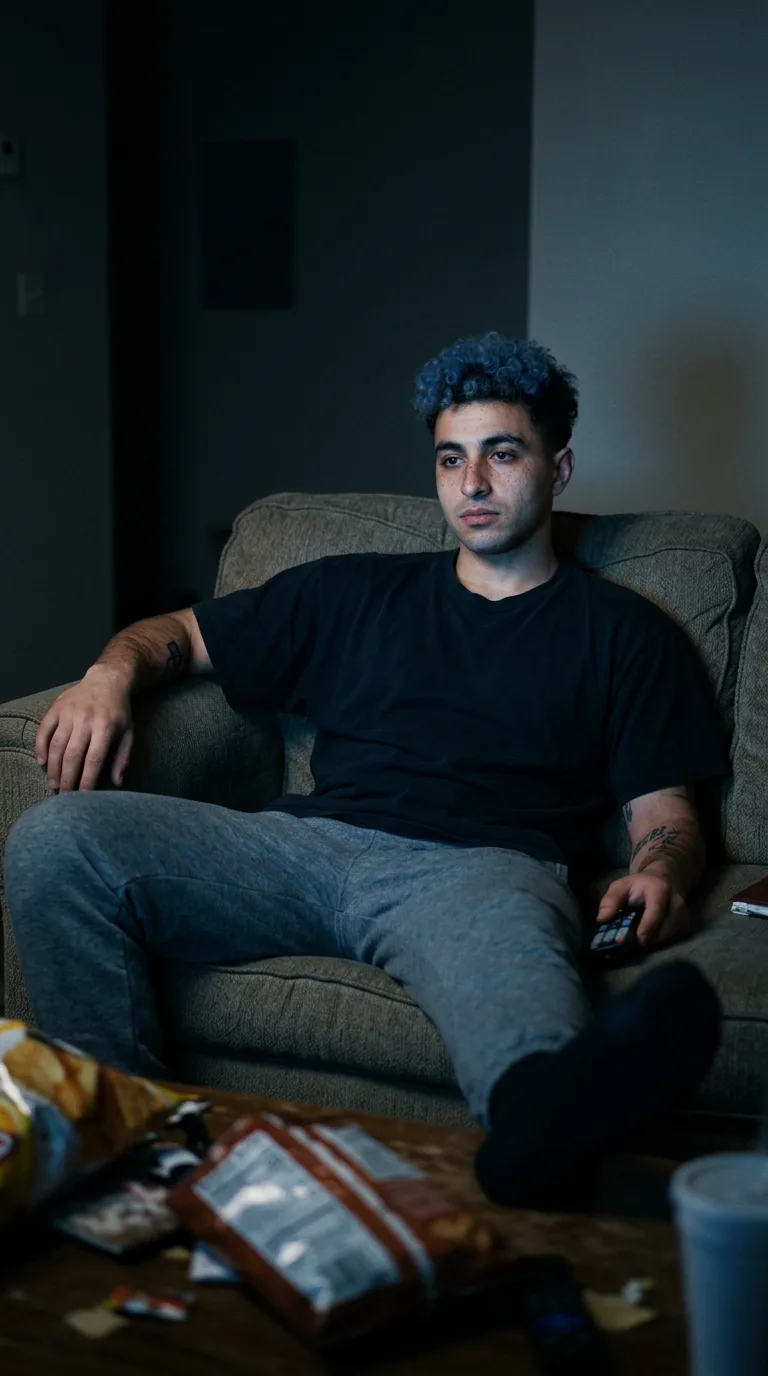
Rarest thing about him: Sleep apnea — epic, 1 in 88
Season 0seed 1950768931 · engine v10
Character card
lineage 2NZHHJ
His body-swap story
@colin.hasbrook, wearing Owen Bracewell, rolled the wheel on and woke up as Sami Haddad, spent 4 minutes in him, then spun the wheel and woke up as Marcus Whitaker
Owen Bracewell's classroom smells like dry-erase marker and radiator dust, and you have been standing at his desk for nine minutes deciding you don't want it. His hands are freckled too, you notice, but softer than they should be, a teacher's hands, chalk-pale even in April. Outside the window Ohio is flat and gray and slow, and somewhere down the hall a bell is about to ring for a class you have no intention of teaching. Nine minutes was enough. You already miss the wheel's noise, the certainty of not-this. You take out your phone — his phone, cracked case, a photo of a golden retriever as the lock screen — and you go to the site instead of your email. vessel.cards. The wheel is already spinning before you've finished deciding, which is its own kind of decision.
It lands on him mid-slouch, mid-sentence of a show he isn't watching, and the room you arrive in is not a room, not at first — it's a body letting go of a couch cushion, weight settling backward into upholstery worn soft in exactly this shape, a hand curled loose around a remote that isn't yours yet. The television throws blue light in pulses across a face that has freckles scattered like the last body's, but younger, denser, real. The show cuts to something brighter and you feel yourself — him — straighten without meaning to, spine going upright, remote setting itself down on the arm of the couch as if some old politeness in the muscle insisted on it. You do not laugh at the part that made him laugh twenty minutes ago. You don't know yet that there was a twenty minutes ago.
Then the shirt against your back gives you the first of it: a soft cotton tee, slept in more than once, and through it comes the smell of proof dough and someone else's shampoo, and you are standing — no, sitting — in an apartment under the tracks, and a train passes somewhere close enough to move the glass in the window frame. Sami. The name arrives sideways, the way his name always arrives to him, through the ring of a bakery timer, through his mother's voice saying it with the H caught in the back of her throat. He is twenty-one. He has been awake since two in the morning and home since nine, and it is not evening here, whatever the television insists — it is late morning, and the blackout curtains are doing their one job badly, letting a knife of white winter light lie flat across the carpet, and this is why he is watching cartoons in the dark instead of sleeping like a person who works nights should. The apnea machine sits unused on the nightstand in the other room; he hates the mask, hates the hiss of it, and some mornings he just doesn't bother, and pays for it in headaches he doesn't mention to Layla.
Layla — that name comes through the couch itself, through the specific give of the cushion where two bodies have worn a groove side by side for a year and a half now. She's at work. She left a note on the counter this morning that he hasn't read yet, in handwriting he'd know blind. You feel, distantly and completely borrowed, the shape of missing someone who is only in the next room, sometimes, and today isn't.
The sweatpants against your legs bring the walk home: five a.m., cold enough to hurt, flour still gray in the creases of his knuckles no matter how long he scrubs at the sink in the back of the shop. The apron isn't on him now but you feel its ghost anyway, canvas gone soft and pale with washing, the strap sitting on the same worn track on his shoulder every single morning for three years, the owner — Marisol, sharp-voiced, fair — trusting him alone with the ovens before the sun's even thought about it. His hands know things without him: the particular give of dough at the exact right proof, the sound a loaf makes tapped on the bottom when it's done, how to score a baguette in one clean unhesitating stroke so it doesn't look overthought. Calloused pads at the base of each finger. A burn scar's ghost that isn't there because you were told there are no scars, only the memory of a near-miss with a tray, a flinch that taught his hand caution instead of leaving a mark.
The remote in his hand — his hand, now — brings back the smaller thing, the good ordinary thing: last night, Layla's feet in his lap, both of them arguing softly about what to watch, her laugh when he did the voice from the show they always do. He loves her in the unspectacular way of a person who has stopped being surprised by it. There is no ex who matters. There has never needed to be anyone else.
He doesn't smoke in the apartment — Layla asked him once, gently, and he moved it to the fire escape without complaint — and even now some nicotine-shaped want stirs at the back of the borrowed throat, small and animal, unrelated to anything except the hour and the body's own long habits.
You look down. His hands: broad, tan going pale at the winter knuckle, flour ground so deep into the nail beds it will never fully wash, freckles scattered up the backs of them same as his face. You turn one over slowly, the way you always do, checking it like a purchase, and something in you that is not him and never will be, notes: good hands. Young. Whole. Worth having, at least for now.
You look up into the dark room, into the last blue wash of a show still playing to no one who's watching it.
"Huh," you say, in his voice, testing the weight of it. "Okay."