Sameer Nayak
Fictional. Generated by AI — not a real person, and no likeness of one is intended.
29, meteorologist in Atlanta · rolled by @marco.villagrana · card — no film
History
who has worn him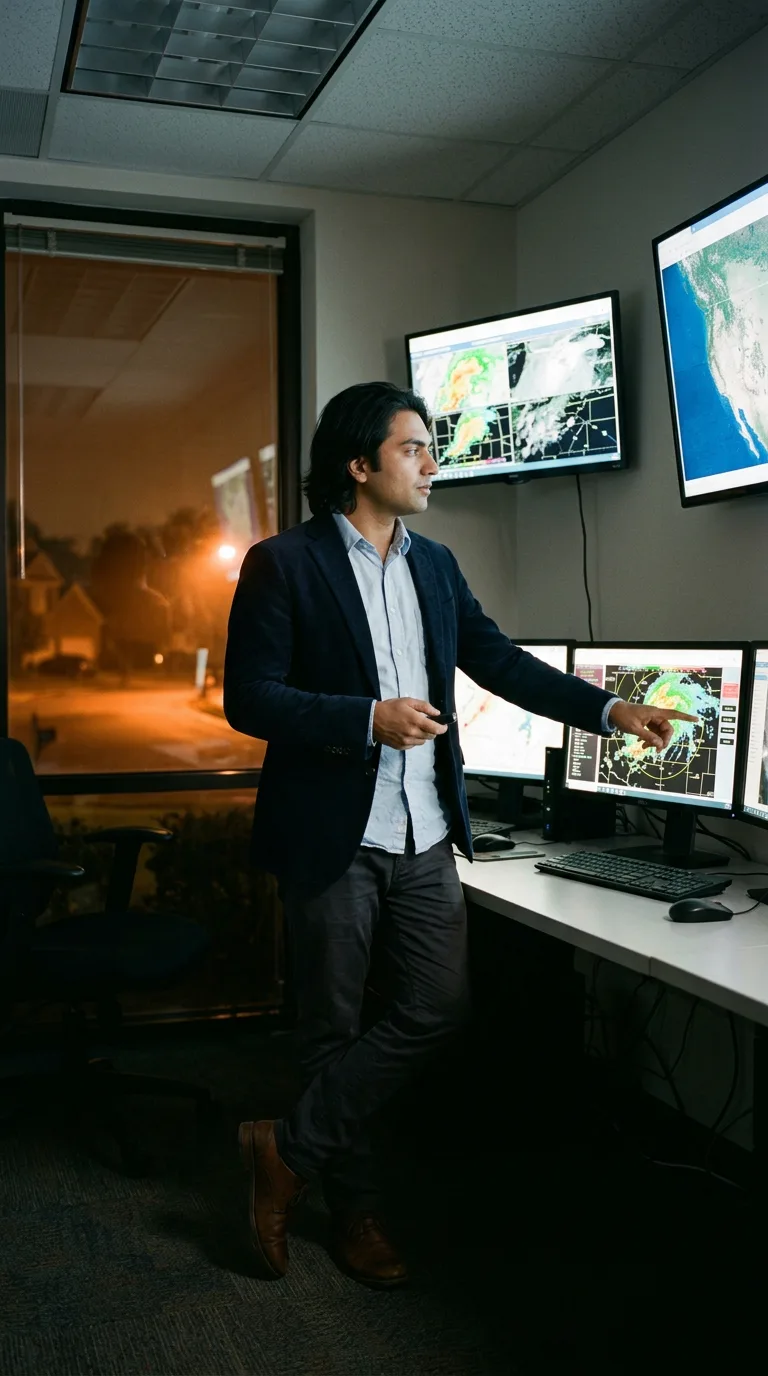
Rarest thing about him: Meteorologist — uncommon, 1 in 2,446
Season 1seed 1398916844 · engine v11
Character card
lineage LJL8SV
His body-swap story
@marco.villagrana, wearing Wonjun Cho, rolled the wheel on and woke up as Sameer Nayak, spent 4 minutes in him, then spun the wheel and woke up as Colton Reyes
---
Wonjun Cho's apartment smells like takeout containers going soft in the sink, and you have been standing at his kitchen counter for four minutes wearing his weight, his unibrow, his short beard scratching at a jaw that isn't yours, and you already know you're done with him. It isn't hatred. It's the opposite of anything — a man who manages a team of people whose names you almost got from his hands touching a stapler, once, on the walk in from the car, and none of it held. Boston is muggy through the window glass. Saturday night, and somewhere in this body is a mid-level ache in the lower back that has nothing to do with you. You paid for a spin and got a person too heavy to feel curious about. Your laptop is already open. The card catalogue behind your eyes — a hundred and thirty-seven faces, thick and thin, old and young — flickers past the way it always does before you commit, and none of it slows you down. You spin because four minutes was enough, because there is a low hum under your ribs that never fully answers to anything you've been, and because somewhere it is always evening on a Saturday and always someone else's turn.
The wheel spins. Wonjun's hand — thick fingers, a wedding-ring tan-line from a marriage that isn't your business — goes slack around nothing, and then it isn't his hand at all.
It is smaller. Darker at the knuckle, lighter at the palm. It is closed around a mouse, mid-click, and the click that was already moving completes itself wrong — scrolls the radar loop two frames too far — and then, carefully, walks itself back one frame at a time, checked, checked, checked, the way you'd double-tie a shoe you'd tied ten thousand times before and suddenly weren't sure of. Monitors bloom red and green in front of you, hook echoes and gust fronts laid out in a grid of four, five, six screens, and outside the window it's full dark over a cul-de-sac, a single porch light standing orange and patient against the glass. The body under you is short — you feel the desk hit you differently than it hit him a half-second ago — light, wound tight through the shoulders in the particular way of someone who has been sitting upright and alert for hours without noticing his own spine.
The shirt is what opens first. Cotton, soft with washing, catching slightly at the collar where mid-length hair brushes it, and through that touch comes an hour — this morning, or what was his morning, an ordinary graveyard-shift morning at four in the afternoon, sun too bright for pajamas, blinds down, the particular guilty pleasure of being awake when the street is asleep and asleep when it's alive. He'd pulled this shirt off a hanger without looking, buttoned it standing in front of a mirror he wasn't really using, more from habit than vanity — Sameer Nayak did not think about his face much, and the mirror had never asked him to. The chinos next, worn soft at the thigh from a chair that holds him seven nights a week; the memory of pulling them on comes with the small contortion of a man who lives alone and has stopped needing more than one lamp on to do it by. The boots — scuffed at the toe from a stairwell at the office that everyone takes too fast — bring back the walk from the parking lot into this building hours ago, heat still sitting on the asphalt like a hand.
The desk gives you more. Years of it. A degree from Georgia Tech, framed somewhere in a box because he never got around to hanging it — atmospheric science, a specific and total love that had nothing performative in it, the kind of interest that started with a boy tracking a hurricane's cone of uncertainty on a paper map because it felt like the only homework that mattered. Nights on this exact swivel chair, learning the radar the way another man might learn an instrument — not flashy, never wanting the on-camera job, happiest here with six screens and a headset and the small, real responsibility of being the one who tells a county to take a storm seriously. A girlfriend two years back who used to say she felt like she was dating the weather, not unkindly, and who is gone now, a name that surfaces without weight, without wound — he was fine, he is fine, he has been fine in that particular unbothered way of a person for whom heartbreak was never the main event of his life. No one who still matters. A mother who calls on Sundays and worries he eats standing up. He does. He's doing it right now, more or less, a granola bar wrapper crushed in the pocket of the blazer draped over the chair back — the blazer he keeps at the office for the mornings reporters sometimes come through, navy, a little nicer than the rest of him, a small vanity he'd deny having.
His hands know this board with a fluency that has nothing to do with thought — cursor, hotkey, cursor, the reflex of a body that has done this so many nights the checking should be unnecessary, and yet for the last ten seconds every motion has come out slow and deliberate, an unfamiliar carefulness laid over an old competence, like a man relearning to trust his own fingers. Under the shirt his shoulders are narrow, unremarkable, twenty-nine years old and carrying it easily; a low unfocused ache lives behind his eyes from staring at radar in dim light, and beneath his jaw is the particular smoothness of a man who shaved before this shift out of habit rather than need, nothing left to shave really, and won't need to again before the sun's up. Somewhere in the fingers is the old unthinking urge, and you feel it rise and take it — a soft crack, knuckle by knuckle, before you even decide to.
You look down at the hand still curled near the mouse. Small, brown, a stranger's hand doing a stranger's checked, careful click, and it is yours now the way nothing has been yours in four minutes, in four minutes of somebody who didn't fit.
You lift your eyes to the dark window, to the porch light and your own reflection ghosted over the radar loop, and you say, quietly, to no one in the empty office: "Okay. Let's see what you've got tonight."