Russell Hoyt
Fictional. Generated by AI — not a real person, and no likeness of one is intended.
56, longshoreman in High-desert Nevada · rolled by @colin.hasbrook · card — no film
History
who has worn him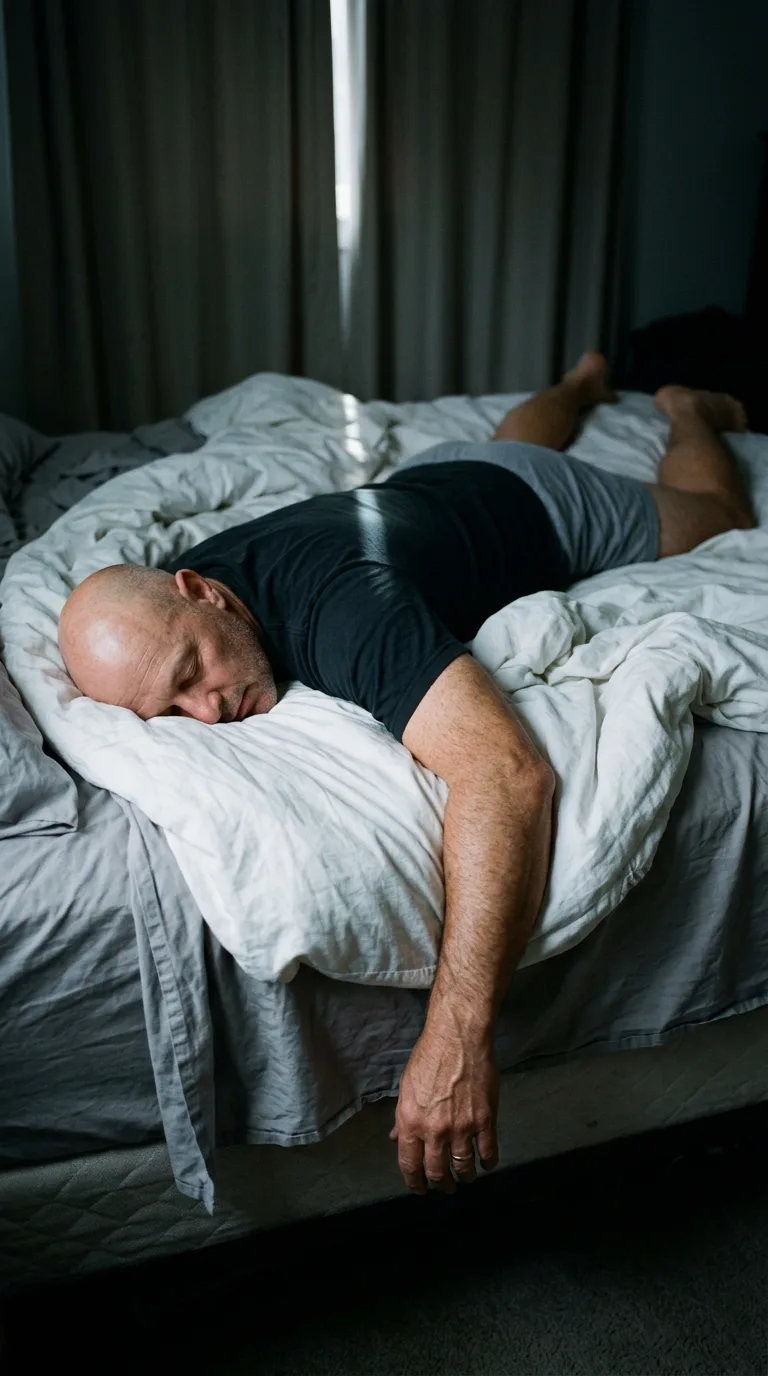
Rarest thing about him: Longshoreman — uncommon, 1 in 124
Season 0seed 1181931229 · engine v10
Character card
lineage 2NZHHJ
His body-swap story
@colin.hasbrook, wearing Marcus Deveraux, rolled the wheel on and woke up as Russell Hoyt, spent under a minute in him, then spun the wheel and woke up as Marcus Odom
Marcus Deveraux's hand is still on the mousepad, the wheel on the laptop screen slowing to a stop behind eyelids that don't want to be open at this hour. Western Kansas at three in the morning is a wife breathing beside a man who is not, right now, entirely her husband. His office door is shut. His office door is always shut for this. Forty-one years old, a lawyer with a dad bod and a mortgage he doesn't worry about, and none of it matters in the second it takes to feel the itch come back — the specific itch, the one that isn't boredom exactly, more like a room you've already looked at every wall of. Less than a minute he's been him, this time, sitting back down after a case he won today that felt like nothing. Winning felt like nothing. That's the whole problem with Marcus, or with staying Marcus. You pay again. You spin again. The wheel doesn't care that you just got here.
The screen stutters color and then there is no screen.
There is a pillow. There is a pillow against a face that is not the face that closed its eyes on it, and a body rolling itself onto its back like it has done this every night for fifty-six years, though it hasn't, though this is new — the hanging arm draws up off the mattress edge and folds at the chest, fingers laced over a sternum that aches faintly in a way Marcus's never did. Breath goes from a ragged catch to something slow and even, like a held note resolving. Streetlight through a gap in cheap curtains lies across a shaved scalp. Outside, sagebrush and hardpan and a blue that isn't quite dark, because in high-desert Nevada the middle of the night comes at a different hour than it does in Kansas, and this body has spent thirty years teaching itself to sleep whenever sleep is offered, day or night, whatever the yard schedule wants from it.
The sheets are what speak first. Cheap cotton, softened by a hundred washes, and the second your palm — his palm — flattens against them you are somewhere else: a woman's laugh from the kitchen, decades back, the smell of coffee and creosote through a window that doesn't shut right. Ellen. Not the wife. The one before, the one who left for Sacramento with a promise he didn't keep to follow her, because the union local wanted him here and he wanted the union local more, or told himself he did. That regret sits in the chest like a low note that never resolves, plucked now by nothing more than bedsheets.
The ring is next — it is always the ring, once you notice a ring is there, and this hand has worn one so long the weight of it is not a weight anymore, it is a fact of the finger. Debra. Twenty-two years. A wedding in a VFW hall with a band that played too much Skynyrd, and a marriage since that has mostly been dinners eaten a little apart and worked, somehow, anyway, on the strength of nothing more dramatic than both of them showing up. A son, grown now, an apprentice electrician down in Vegas who calls on Sundays and calls him "old man" with real fondness. The pride of that comes up through the sheets like heat off asphalt.
His own skin gives him the rest, unprompted: the ache low in the spine that has been there so long it isn't pain anymore, it's just where the body starts. Fifteen years under the gantry crane, guiding container corners with a hand signal and a whistle, the particular exhaustion of a body that is still strong — average build, but the strength is real, load-tested daily — carrying itself past the point strength usually quits. Hands that used to hold a cigarette between calls and now, empty, drum against whatever surface offers itself, an old tic outliving the habit it came from. A drink or two most evenings, not more, just enough to put the ache to bed before he does.
And the money — half a million, maybe more, sitting quiet in accounts he doesn't talk about at the union hall, because a longshoreman with that kind of number learned a long time ago not to advertise it, learned it from a father who had none and wanted him to have some. He built it slow and told no one, and it is one of the only private things he owns outright, the way his back pain is his, the way Ellen is his, folded away where Debra has never had to go looking.
None of it came with a face he chose. None of it came with a wanting he understands from the inside — only from the outside, only as the shape it left in this man, this stranger, whose whole quiet unremarkable life you are standing in the middle of like a man who walked into the wrong house and found the lights already on, warm, someone's dinner still on the stove.
You lift the hand off your chest and look at it in the streetlight — blunt fingers, a plain band, a faint white scar across one knuckle that isn't yours to have gotten. You turn it over once, like checking whether it's really there, then look past it into the dark where a window would be if you could be bothered to find it, and instead there's only the ceiling, the trailer's low pressed panel, the whole flat unglamorous fact of him.
"Fifty-six years for this," you say, to no one, in his voice, and it comes out rougher than you expected, sleep-cracked, half a laugh in it — not unkind. Not yet knowing how long you'll want to keep it.