Roy Dietrich
Fictional. Generated by AI — not a real person, and no likeness of one is intended.
46, grocery stocker in Rural Texas · rolled by @colin.hasbrook · card — no film
History
who has worn him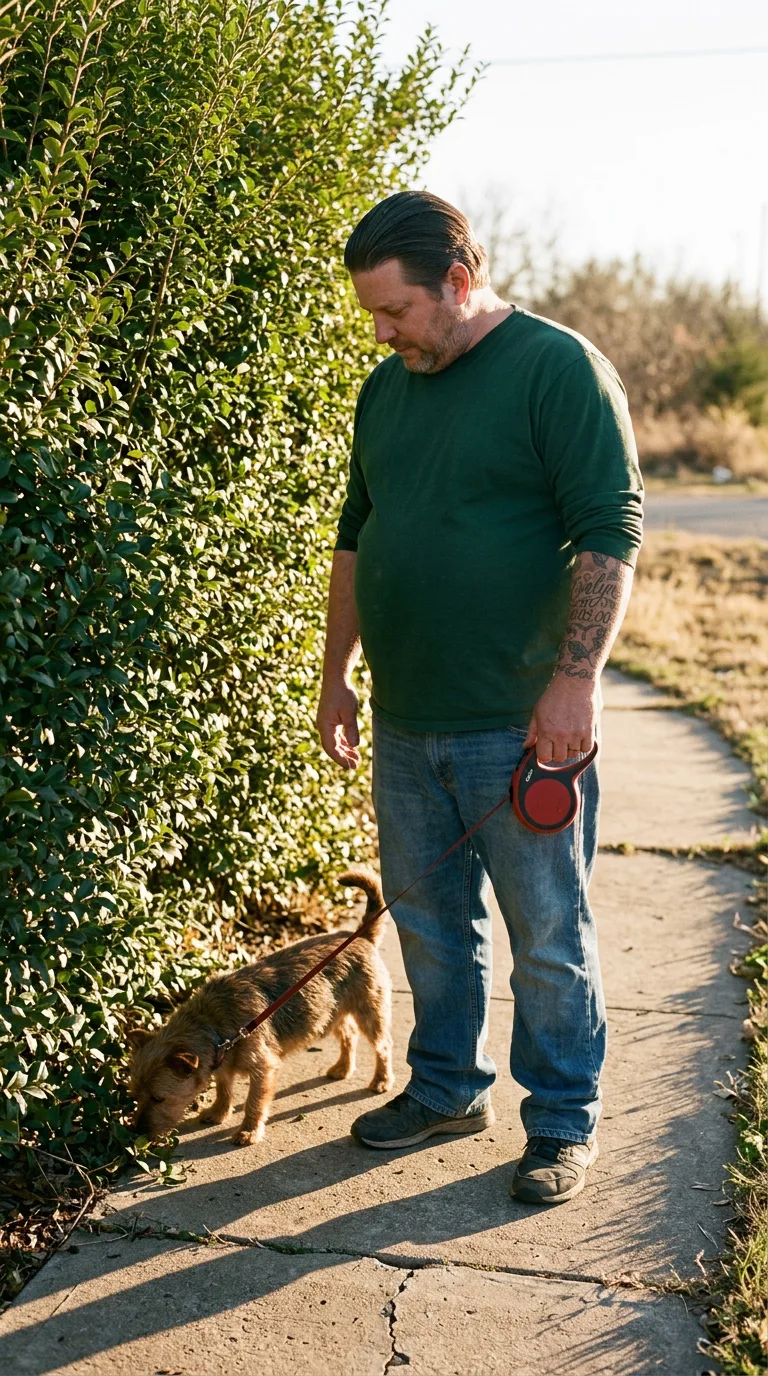
Rarest thing about him: Full sleeve — common, 1 in 53
Season 1seed 865348498 · engine v11
Character card
lineage 2NZHHJ
His body-swap story
@colin.hasbrook, wearing Marcus Delgado, rolled the wheel on and woke up as Roy Dietrich, spent under a minute in him, then spun the wheel and woke up as Grant Pelzer
Marcus Delgado has been standing at his own front door for forty-one seconds, key in the lock, not turning it, because his shoulder aches from a route that isn't going to get any shorter tomorrow, and because in nine hours he'll be back on it. Thirty years old and skinny and already the cartilage in his knee talks to him on stairs. You have been him less than a minute and you already know the whole shape of the rest of his week, and it is the shape of every week, and that is the thing. Not misery. Just: this again. You take out your phone on the stoop, still not opening the door, and you go to vessel.cards instead, and you spin, because there is a version of not-Marcus somewhere in the country having his own ordinary Thursday and you have never once let a body finish getting boring.
The wheel doesn't ask permission. Delgado's hand — key still raised — goes nowhere. Somewhere south and hours behind, a leash goes slack in a fist that has stopped walking.
You are heavier before you are anything else. That is the first fact of him, arriving all at once: the gut, the low center, the way standing itself is a kind of work his knees have made peace with. A dog looks up at you from beside a hedge, ears back, reading something in the man that isn't there anymore. Your hand — his hand — winds the leash twice without being told to, some old muscle answering before you do, and you start walking again, and the dog has to trot to catch the new rhythm of it.
The leash handle is nylon-wrapped and warm from his palm, and it opens first: not a memory exactly, just weight, the specific weight of this dog pulling against this hand every evening for six years, since it was a shelter mutt with parvo scars nobody wanted. Fine. You keep walking because stopping would be its own kind of scream, and the sidewalk under these boots — steel-toed, scuffed pale at the seams — gives you the rest in pieces, the way a bad radio finds a station.
The shirt against your back is thermal, forest green, and it remembers being pulled on this afternoon over a body sore in the shoulders from four pallets of canned goods at three in the morning, the fluorescent hum of a stockroom that never gets brighter or darker, just on. You work nights. You have worked nights at the City Fresh Market outside a town too small to need a stoplight for eleven years, and the vest with the logo on it — hanging on a hook by the door right now, not on you, because you're off the clock, because this is your life and not your shift — is the only thing in the closet you don't have to think about putting on. This shirt, though. You remember choosing it. Green because it was clean. That's the whole decision most days.
The sleeve on your right arm is heavier than the left — not in weight, in years. Ink under the thermal, unseen but known the way a room is known in the dark: script letters, a name, a date. Evelyn. 10.05.05. A niece, your sister's girl, born on a Wednesday you drove four hours through West Texas dark to be there for, and she is twenty now and calls you Uncle Roy on the phone twice a year and you have never told her what the tattoo cost or how long you sat in the chair for it, sweating through your shirt, because it mattered more than the pain did. No wife wears that date. No wife at all — you checked out of that particular hope so long ago it doesn't even sting anymore, just sits there, a room you don't go into.
The gravel crunch of the road, when the sidewalk runs out at the end of the block into the county's idea of pavement, brings up the whole town at once: the water tower with the town's name peeling off it, the barbed wire someone's cattle lean against every morning like it isn't there, the particular quiet of 3 a.m. shelves and a box cutter that lives clipped to your belt on a red coiled cord, cutting tape on cases of soup you could stack in your sleep. Your hands know that motion the way they know their own scratching — the box cutter, the glove tucked in your back pocket for the walk-in, the itch at your jaw you scratch six times an hour without once deciding to. You do it now, on the sidewalk, stubble rasping under fingers that have done this ten thousand times, and it isn't nerves, it's just what the hand does when the rest of you isn't paying attention.
A cigar after Sunday Mass, sometimes two — that's the whole vice, that and a big night out every few weeks with men from the store who complain about the same shift you complain about. No wife, no kids, no one waiting up. Money you don't spend, sitting quiet in accounts nobody at the store would guess at, because a man who stocks shelves for a living learns not to look rich even when the numbers say otherwise. None of it for anyone. All of it just there, the way the house is there, the way the dog is there, small and mostly patient, tugging now toward another hedge.
You look down at the hand holding the leash. Thick fingers, a white scar across two knuckles from a box-cutter slip nobody remembers the story of anymore, not even him. It is not your hand. It has never been your hand. You turn it over once in the last of the sun, feeling the new size of everything, the low center of this body like a held breath, and the dog stops pulling to look up at you again, waiting to see which man is going to finish the walk.
"C'mon then," you say, out loud, to the dog, in a voice thicker and slower than the one you left on a stoop in Pittsburgh forty-one seconds and eight hundred and thirty men ago — and you don't know yet if that's the last thing Roy Dietrich's mouth will ever say, or just the first thing yours will.