Roy Dettman
Fictional. Generated by AI — not a real person, and no likeness of one is intended.
59, furniture mover in Small-town Ohio · rolled by @colin.tarwater · card — no film
History
who has worn him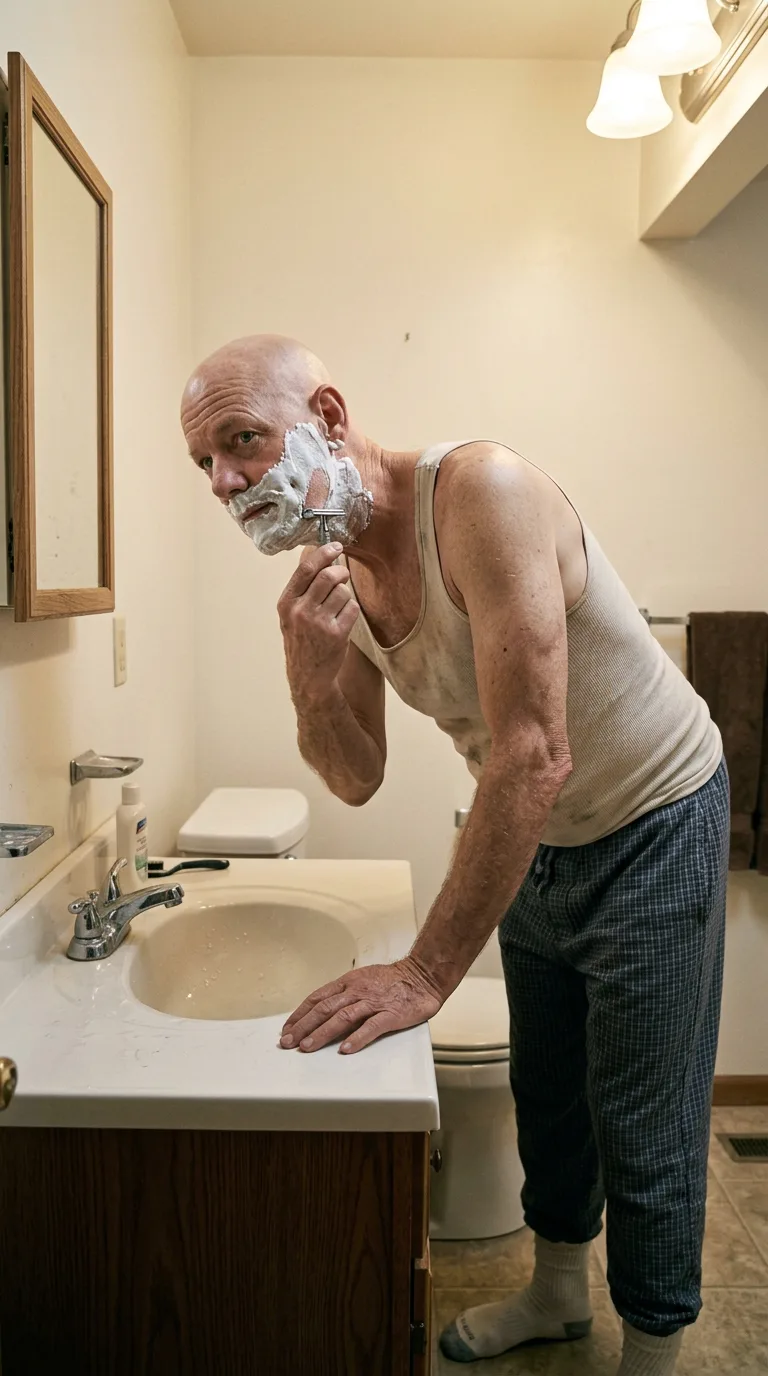
Rarest thing about him: Living with a partner — rare, 1 in 17
Season 0seed 1789850960 · engine v10
Character card
lineage COEU7T
His body-swap story
@colin.tarwater, wearing Gary Halvorsen, rolled the wheel on and woke up as Roy Dettman, spent under a minute in him, then spun the wheel and woke up as Emiliano Cabrales
Gary Halvorsen's knees are good. That's the thing you notice first, standing in his kitchen on a Saturday with the compressor humming out in the truck bed and a service call forty minutes away in Naperville that you are not going to make. Fifty-four years old and the knees still take the stairs two at a time. You've had him eleven days. He is, by any honest measure, the best body you've worn since the beginning — light brown hair that hasn't started thinning, a refrigeration tech's steady hands, blue eyes nobody's ever once mentioned to you the way they'll mention somebody else's dimples. He is fine. He is more than fine. He is the kind of body a person keeps.
Which is exactly the problem. You are standing at his kitchen counter with his laptop open to the site because Gary Halvorsen's life fits you like it was tailored, and eleven days in, that has started to itch worse than any bad fit ever did. There's no ache in him to chase off, no injury, no unfinished business — just a Saturday with nothing in it, and the wheel a click away, and sixty-two men behind you who all, eventually, stopped being enough just by being good. You don't examine it further than that. You pay. You spin.
—
The razor is already moving before you're finished arriving, up along a jawline that isn't Gary's, no hitch where a jaw should hitch, and you feel it before you see it: you are bent low over a sink, weight braced on a hand that is not the hand you had four seconds ago, half your face cold with drying foam and half of it warm with the blade's last pass. The mirror in front of you holds a stranger's bald head, green eyes, and — even now, mid-stroke, no expression on the face at all — two dimples sitting in the cheeks like they were carved there for a smile that isn't happening.
—
The counter under your left palm is laminate, cool, a little tacky where old shaving cream dried once and was never quite wiped clean, and that alone gives you a hundred mornings in this bathroom before you've even finished the thought — but it's the razor that opens him wide. Its grip is a bar of scored metal worn smooth on the two spots where a thumb and two fingers have held it every day for thirty years, and holding it now you get *him*: the same corner of the mouth, every single morning, where he slows down and goes over it twice because he nicked himself there once, badly, at nineteen, at a bathroom mirror in a house that isn't this one, and some nerve in him never unlearned the caution. Except right now the second half of his face is going faster than the first ever does, no hesitation at that corner at all, and some part of him that isn't you at all is already, dimly, elsewhere.
The tank top is thin ribbed cotton gone soft with age, and it gives you his shoulders — not big, never were, going a little soft over muscle that used to move refrigerators and now mostly moves sofas, sixty years and change of skinny turning to something looser without ever once turning to fat you could grab a handful of. Skinny fat, is the phrase, and you can feel exactly what it means standing in him: strength still living low down, in the forearms and the low back, wrapped now in not enough insulation to keep the cold out of a truck bed in November. The low back tells you plainly, the second you settle into it, that it has opinions about mornings like this one, a dull banked heat along both sides of the spine that never fully goes out, that started with a couch wedged wrong on a staircase in Marysville eleven years ago and never once in eleven years apologized for staying.
The flannel pajama bottoms — checked, worn through at one knee — bring back a woman's voice from another room, not sharp, just familiar: *Roy, you're gonna miss the whole morning.* Sherry. Not the wife — there wasn't a wife, not the second time, not after Diane left with the kids old enough to have kids of their own now — but Sherry, seven years in this house with him, who makes the coffee too weak on purpose because his stomach can't take it strong anymore and who is, right now, on a Saturday, somewhere past this door doing something ordinary while he shaves for absolutely no reason he could name to her if she asked, except that some Saturdays a man just wants his face to look like something got finished.
The socks on the tile give you the cold of the floor in February and, threaded through it, unrelated, a flash of Cheryl — the old one, the first one, Danny's mother, gone eighteen years and still turning up in his chest sometimes with no warning at all, the smell of her shampoo in some other bathroom decades back. Three kids between the two of them, one more with somebody in between that Roy doesn't talk about at family things, and all of them grown now, and none of them close enough by that a Saturday morning shave means anything to anybody but him.
And under all of it, waiting the way it always waits, is his leg — not moving now, both feet flat, but you can feel exactly where it wants to be, bouncing, burning off something that was never named and never will be, a motor that's been idling under this man since before Diane, before Cheryl, before any of it, and it does not care that his knees ache or that his back is bad or that he is fifty-nine and just wants, today, to look decent for no occasion at all.
—
You straighten up off the counter and the ache in the low back announces itself fully, and you look down at the hand that just set the razor on the porcelain edge — thick-fingered, weathered, a white line of dried lather along the wrist — and turn it over once like you're checking it's really attached.
Then you lift your eyes to the mirror instead of the lens, because there isn't one, only Roy's own face looking back at you with those dimples sitting there doing nothing, waiting to be used, and you say, to nobody, to Sherry two rooms over, to the sixty-three men now folded into whatever you are:
"Give me a minute — I look almost finished."