Ronald Speck
Fictional. Generated by AI — not a real person, and no likeness of one is intended.
38, priest in Eastern Kentucky · rolled by @marco.villagrana · card — no film
History
who has worn him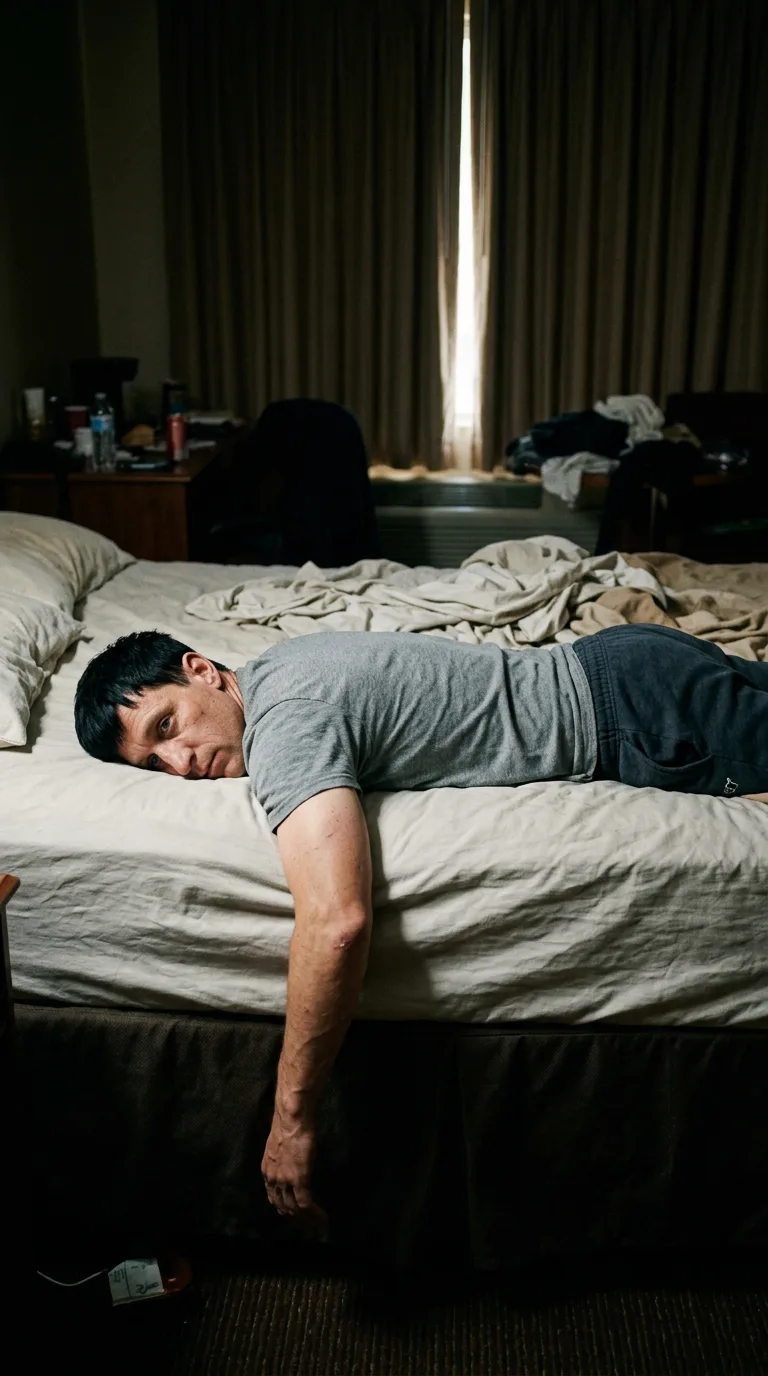
Rarest thing about him: Dyed black — epic, 1 in 80
Season 0seed 1549483116 · engine v10
Character card
lineage LJL8SV
His body-swap story
@marco.villagrana, wearing Anand Chaudhary, rolled the wheel on and woke up as Ronald Speck, spent 3 minutes in him, then spun the wheel and woke up as Marcus Ellison
You have been Anand Chaudhary for three minutes and it is already unbearable — the gray in his stubble coming in wrong on this jaw, the ache in a lower back that has spent thirty years bent over a cutting table, the smell of the shop still on him like a coat he can't take off even sitting in a break room chair with the wheel open on a phone that isn't yours. You paid for him last, you spun and got him, and you have been sitting in his folding chair in the walk-in's antechamber for one hundred and eighty seconds deciding you don't want this — not the hands, ropey and precise, not the knees, not the fluorescent hum, not even the small competent dignity of him, because dignity was never what you came for. You came for the wanting itself, the drop before the number lands. Anand's phone screen dims in his hand and you tap it awake again, thumb pushing at an app icon skinned like a roulette wheel, and you think: once more, then maybe you'll keep whatever comes. You always think that.
The wheel spins the way it always spins, all light and no sound, and it lands, and there is no seam between the landing and this: sheets under a chest that is not moving in Anand's shallow tired rhythm anymore but broader, steadier, a breath going from ragged to even in the space of one exhale that isn't planned by anybody in charge. An arm that had been hanging off a mattress lifts itself, unbidden, folds up onto a chest with the other hand, and you are on your back in a bed that smells like fabric softener and someone else's shampoo, streetlight slicing through a gap in the curtain onto a stucco ceiling you have never seen. It is dim in the room. Late morning, maybe, gone dark and cave-quiet with curtains pulled — a working man's blackout. You lie there inside him a second before anything comes.
Then it comes through what he's wearing — a worn gray T-shirt gone soft at the collar, sweatpants with a drawstring gone slack — and it arrives in his feeling, not yours: Sunday, and the relief of Sunday, the particular hollowed-out peace of a service that went fine, that always goes fine now, eleven years into knowing how to do this without flinching. You get the vestibule before you get anything else — cinderblock painted the color of weak coffee, a coat rack with someone's abandoned umbrella, an old woman named Verna gripping your forearm too hard and saying you preached it good today, Father, though nobody in this church calls you Father, they call you Brother Speck or just Ronnie, and you correct people gently every single time and it never sticks. The clergy shirt is downstairs in a hamper. This body slept in that vestibule feeling before it slept in the bed — the two-hour turnaround between the second service ending and the exhaustion hitting like a truck, because you took the overnight shift at the county line dispatch center Friday into Saturday to cover for a man with a sick kid, because the church can't pay him enough to live on and hasn't been able to since the coal money left this county for good.
The pillow gives you Denise — not through anything you're touching, but through the dent on the other side of the bed, the shape of an absence — three years now, her laugh loud enough to embarrass him at potlucks, her son from her first marriage calling him Ron and not Dad and that being fine, actually fine, more than fine some nights. And under that, quieter, snagged like a hook in cloth: Ashley. The one before Denise. Ashley who left two winters back and still texts him on hard nights, and he still answers, and Denise doesn't know how often, and that not-knowing sits in his chest like a low coal he keeps meaning to let go out. There is a daughter, eight years old, who lives with her mother forty minutes toward Pikeville, and there is a photograph of her on a dresser you can't see yet but already know is there, taped-corner, taken at a creek with a cable footbridge behind her, green shade off the trees, the kind of picture a man keeps because a Sunday with her is a Sunday he got to have.
His body underneath it all: thirty-eight and average and unremarkable in a way that took him years to stop minding, five-nine, a build that used to run and now mostly stands at a pulpit, blue eyes that have cried in front of a congregation exactly twice and both times on purpose, a blood pressure number his doctor keeps a little too close an eye on. The nose — broken at nineteen in a parking lot outside a Bristol, Tennessee gas station, over nothing, over a girl neither of them ended up with — sits crooked under fingers that find it sometimes without meaning to, the way you're finding it now, a reflex older than the ministry, older than Denise, older than the county. His jaw works at nothing, gum he isn't chewing because it's still on the nightstand, muscle memory grinding on air. He gave up drinking the year he got ordained and never missed it the way people expect him to say he does. He is not a man haunted by much. He is a man tired in the specific, forgivable way of someone who works two jobs God only pays him for one of.
You sit up. The curtain gap throws its blade of light across your knuckles, and you turn your hand over like you've never seen the back of it — which, this second, you haven't. Five-nine feels smaller than Anand's frame and steadier than it, and the crooked nose sits on your face like something you didn't earn and now have to carry anyway.
"Denise?" you say, out loud, into a room with nobody in it, and your voice doesn't sound the way you expected it to sound, and you don't know yet if you're going to keep it.