Rohan Mehta
Fictional. Generated by AI — not a real person, and no likeness of one is intended.
24, sheriff's deputy in New Orleans · rolled by @owen.prescott · card — no film
History
who has worn him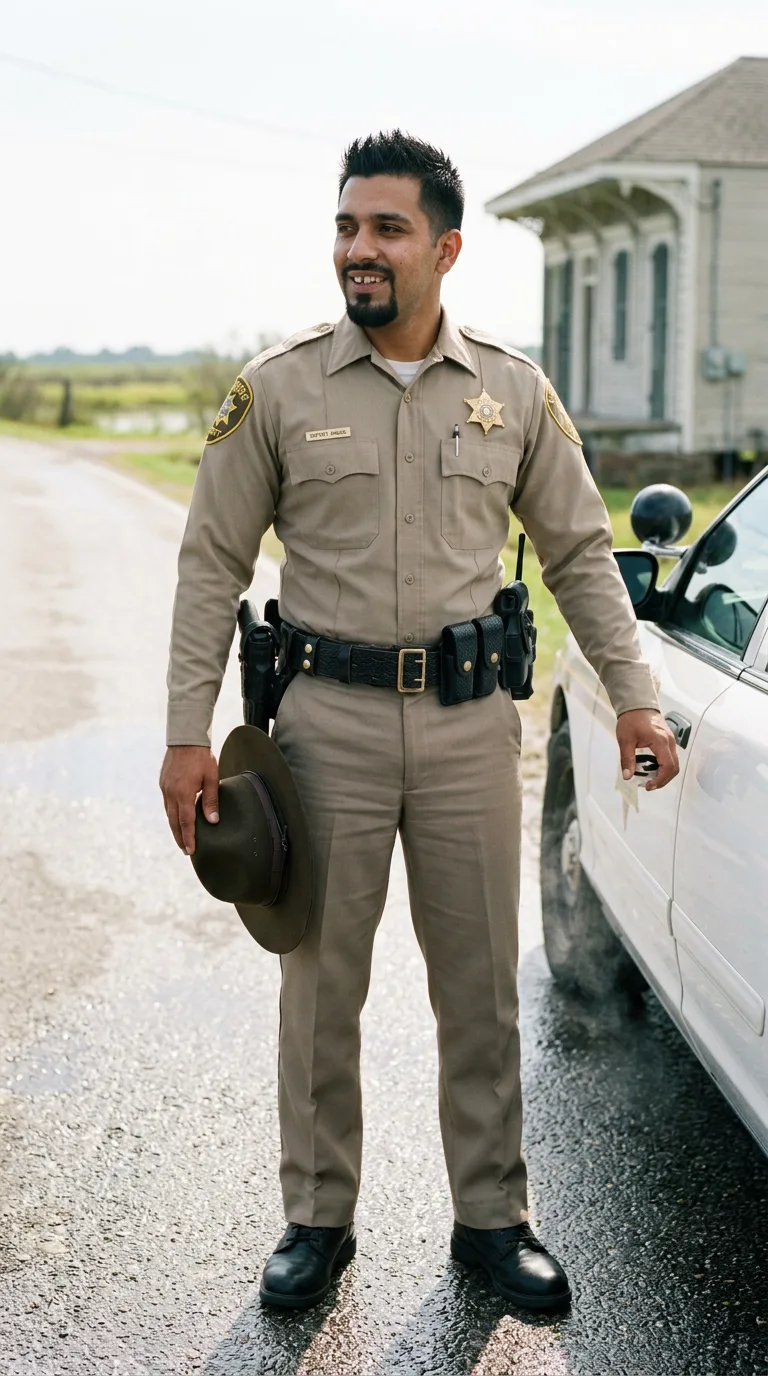
Rarest thing about him: Sheriff's deputy — common, 1 in 585
Season 1seed 1185883698 · engine v11
Character card
lineage 5OR92V
His body-swap story
@owen.prescott, wearing Jason Whitaker, rolled the wheel on and woke up as Rohan Mehta, spent under a minute in him, then spun the wheel and woke up as Neil Standish
You are Jason Whitaker for another ninety seconds, and you are already tired of his knees.
It is the middle of a Tuesday morning in Houston, and the store's carpet is the color of nothing. A woman is holding two nearly identical lamps and asking you which one is *warmer*. You hear yourself say "the left one" in his flat, helpful voice. Thirty-four years of skinny-fat sit on your ribs like a coat that was never yours. The lanyard itches. You have been him for less than a minute, and the lamp woman is already smiling at a man who is not there.
Something sent you back. It was nothing he did. It was a smell in the stockroom, and the way the shirt hung wrong, and a feeling that you had stood in the wrong life again and called it a prize. You would not say that to anyone. You tell the lamp woman, "Take your time," and walk toward the back with the phone already in your hand and the wheel already turning.
Then there is gravel, and you are standing in it.
The air is wet and warm, and the sun comes down flat and white through haze. Your right hand is on something small and papery by a car door. Your left hand holds a hat by its brim. You are halfway through a motion, and the motion is wrong. Your fingers have fumbled it, and you feel the half-second of the stumble in your own tendons. Then the hands do it again, slowly and correctly. Ten more motions follow, and each one is checked, though the job has not needed checking in years.
The hat comes first. The felt is stiff and the brim is damp from his grip. A flash comes up through your left palm that is not yours. It is a Sunday, a folding chair, a pastor's voice saying *in the valley*, and his mother's hand tapping the hymnal against her knee. You feel the shame of being twelve and bored in a church you would still never leave. You feel him love it anyway.
The shirt is tan and starched stiff, and it sits on your shoulders as if it were built for them. As you breathe, the memory of this morning comes sleeve by sleeve, in his hands. The left arm goes in first because he is superstitious about it. He fastens the cuff button with his teeth showing, the gap in them whistling a little on the exhale, and he thinks about the girl who used to laugh at that whistle. The undershirt is already damp at the collar. The badge goes on last, and he touches it twice with two fingers, drumming it like a table, a habit he never notices.
The belt is heavy, and so is the leather around it. The holster's weight drags at your right hip, and the muscle there knows exactly how to stand against it. Your boots are not boots at all but black shoes, polished that morning, and the wet road has already dulled them. The soles press the gravel, and your knees tell you that you are twenty-four. Nothing aches. Your back is a straight, clean line. You are shorter than Jason by three inches, and the world sits closer to your chin.
Your tongue finds the gap between your front teeth and rests in it. A flavor of wintergreen and tobacco is still stuck to the inside of your lip. The dip tin is in the back pocket, a worn circle pressed against the cloth. You touch it, and a night opens. It is a bar on Magazine Street, a whole table of deputies, cheap whiskey, and his laughter loud and unembarrassed. It is the one big night of the month, and he has not quite stopped, though he said he would. Beneath it is the quiet of her apartment afterward. Your chest tightens around a name that is not yours. She left in the spring. He still keeps her last text.
The paper in your right hand is a citation book, half open. You thumb the corner, and the whole ordinary decade of the work comes up in you. It is a thousand roads at dusk, a thousand strangers' windows rolling down, and the small courtesy he always offers: *Evening, ma'am.* There is a savings account with a number in it that makes him feel safe, somewhere between twenty-five and seventy-five thousand, and he is proud of every digit. There is a house too, a shotgun, one room wide, where the rooms line up behind each other like thoughts.
The fingers of your left hand are already drumming on the hat brim. You let them.
You turn your right hand over. The palm is a little rough, with calluses where the pen sits and where the radio clips. There is nothing else on it, no mark, nothing to find. You look up at the long, wet road and the green field beyond it, and a pale house stands in the haze with the sun over it.
"Well," you say, in a voice that is deeper than you expected, with a whistle in it. "Hello."
The tin presses your hip. The radio is quiet. You do not know how long this one lasts, whether the wanting comes back by the weekend or by the end of this road. You only know that your fingers are still drumming.