Roger Passalino
Fictional. Generated by AI — not a real person, and no likeness of one is intended.
51, bus driver in Atlanta · rolled by @brian.okafor.lynch · card — no film
History
who has worn him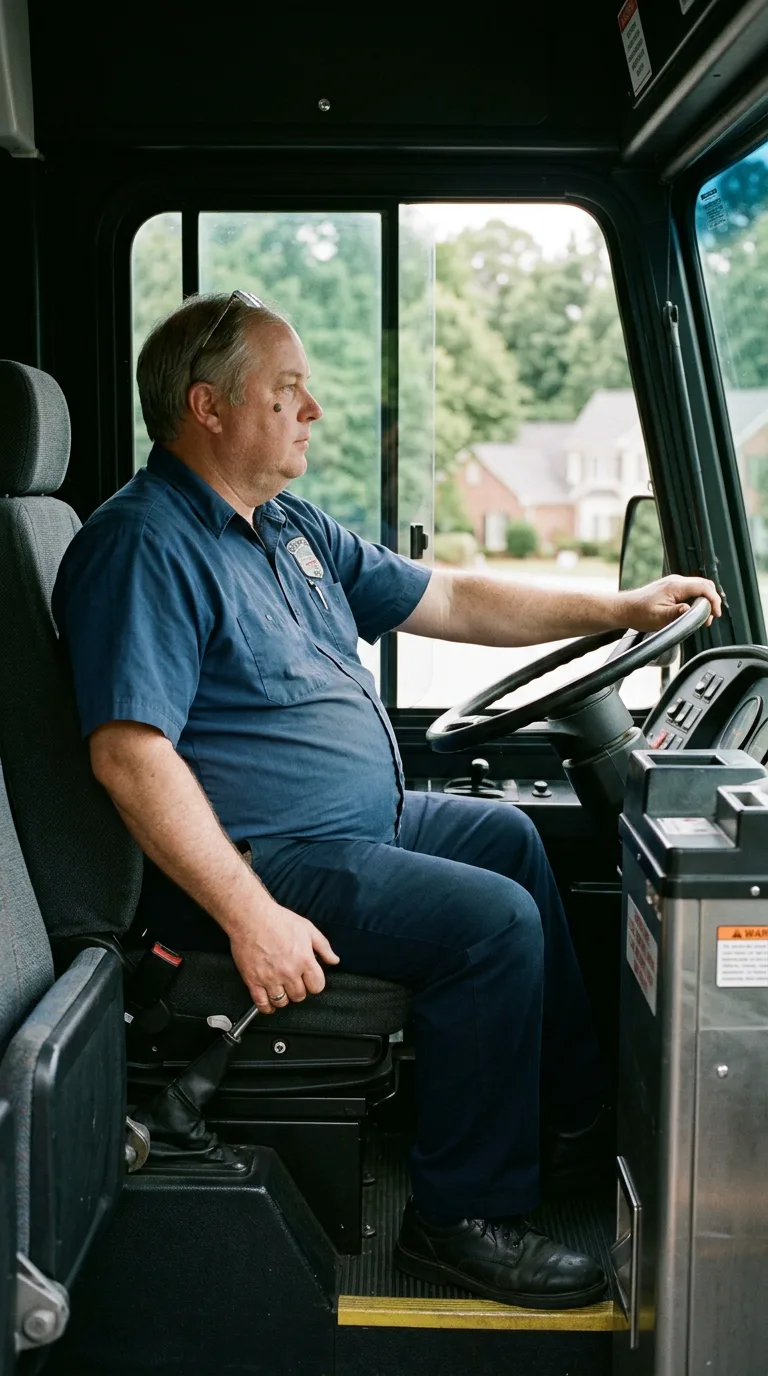
Rarest thing about him: Bus driver — uncommon, 1 in 85
Season 0seed 1313731163 · engine v10
Character card
lineage 79CGDV
His body-swap story
@brian.okafor.lynch, wearing Brian Okafor-Lynch, rolled the wheel on and woke up as Roger Passalino, spent 1 minute in him, then spun the wheel and woke up as Denny Okafune
---
The mower is cold under your palms — Brian's palms, still, technically, for another few seconds — and the grass isn't even due to be cut. It's five in the morning in Small-town Ohio, no sun yet, and you had him walk out here in his boxers to stand over a Toro he has no reason to touch, because you wanted to see if you still could feel anything in this body before you left it. Muscular, twenty-nine, a beauty mark you keep catching in mirrors like it belongs to someone interesting. It doesn't. Three days in him and the biggest feeling you found was the ache in his shoulders after mowing eleven lawns in county heat, and you are tired, already, of a body whose only trick is that it doesn't hurt. You want the version of this that costs something. You go back inside, past his sleeping dog, and you open the site on his cracked phone with his thumbprint, which somehow still works, and you spin not because you've decided anything but because deciding is not really what you do anymore.
The wheel spins through faces you don't watch.
It lands, and the mower and the dark yard and Brian Okafor-Lynch fall away entirely, mid-thought, mid-everything, and you are sitting down, heavy, low, your knees wide because there isn't room for them any other way, both hands on a steering wheel the size of a manhole cover, and it is bright outside — full daylight, trees, brick houses — and you are turning into a cul-decas at what your body insists, in its bones, is two in the afternoon, though somewhere behind you it is not yet six in the morning and a man is still asleep on a mower he never got up to look at.
Your right hand does something wrong first — eases the wheel a half turn too far, clips the mirror against a low branch that isn't there — and then, a half-second later, corrects itself, slow and deliberate, like a student repeating a sentence the teacher didn't like the first time. The next ten curbside stops come out of you checked, each one, brake — pause — mirror — pause — door lever pulled soft instead of yanked, on a route this hand has run so many thousand times it forgot it was capable of being watched.
It is the shirt that gives you the first of him — short-sleeved, navy, damp already at the collar, a company patch stitched crooked at the breast because Diane at the depot sews them all herself and she is seventy-one and her eyes aren't what they were. Roger Passalino. The name arrives with the shirt, the way his name always would, from the label sewn inside the collar he's felt against his neck ten thousand mornings, and behind it comes the whole low tide of him: the alarm at four forty, dark house, Carol still breathing evenly on her side, the two kids grown and out — Danny in Marietta, Ashley somewhere near Nashville he can never remember without checking — and the ritual of it, undershirt first because his skin can't take the poly-blend straight on anymore, not since the psoriasis started at forty-five, then the uniform shirt buttoned from the bottom because his fingers are stiffer in the morning and the bottom buttons are bigger. His back gives a flash all its own — L4, L5, a decade of the driver's seat's lousy lumbar support, a chiropractor in Decatur he sees every third Tuesday and calls a scam to Carol's face and a lifeline in his own head. The wedding band is tight going over the knuckle the way it's been tight for six years, since the weight came on slow and steady like weather, and under the ring is Carol at twenty-four in a yellow dress at her cousin's wedding, and under that, buried further, a version of him standing at a different altar entirely — Denise, 1994, the wedding that didn't happen, her face the one thing thirty years hasn't sanded down, the road not taken running parallel to this one his whole life without ever once crossing it. He does not resent Carol for existing instead. He has never told her that name out loud in either direction.
The steering wheel gives you the depot — six a.m. roll call, the smell of diesel and the coffee that's always burnt, forty-one years old when he passed his CDL after the plant in Griffin closed under him, a man starting over at forty-one with two kids in high school and a wife who didn't blink, just said get the license, we'll manage. He got it. They managed. He has driven this route nine years now, knows which houses have dogs that bark at the airbrakes, knows Mrs. Okafor at the corner — no relation, he's checked, laughed about it once with dispatch — always waves whether or not her granddaughter makes the bus. He is a deacon on the second Sunday of every month at Cornerstone Fellowship, gave up drinking the year Danny was born because his own father drank and he'd made himself a promise in a hospital parking lot, gave up cigarettes the same year Carol did, cold, out of solidarity, and still sometimes wants one on a bad back day like this is going to be, the pain already sitting low and familiar as the bus levels off the last curb cut.
His weight settles into the seat the way it always does, wide and grounded, five-eight and heavy enough that his knees complain going up the two steps into the well, and his hands — thick, sun-spotted at the backs, the mole on his cheek catching in the mirror's edge every time he turns his head to check the door — know this wheel without him. Knew it. You feel the exact moment his knowing stops being a memory and starts being yours to spend.
You lift your right hand off the wheel at the next stop, the doors sighing open onto empty summer air, and you look at it — thick fingers, the band loose enough now to turn with your thumb, a scar along the side of the index finger from a fan belt in 2003 that isn't yours and now entirely is.
"Didn't feel a thing," you say, to no one, to the empty aisle behind you, and your voice comes out lower and rounder than you expected, Georgia soft at the edges, and you don't know yet if that's true or if you're only saying it because it's easier than saying you already miss being twenty-nine.