Rigo Escamilla
Fictional. Generated by AI — not a real person, and no likeness of one is intended.
45, sanitation worker in High-desert Nevada · rolled by @colin.hasbrook · card — no film
History
who has worn him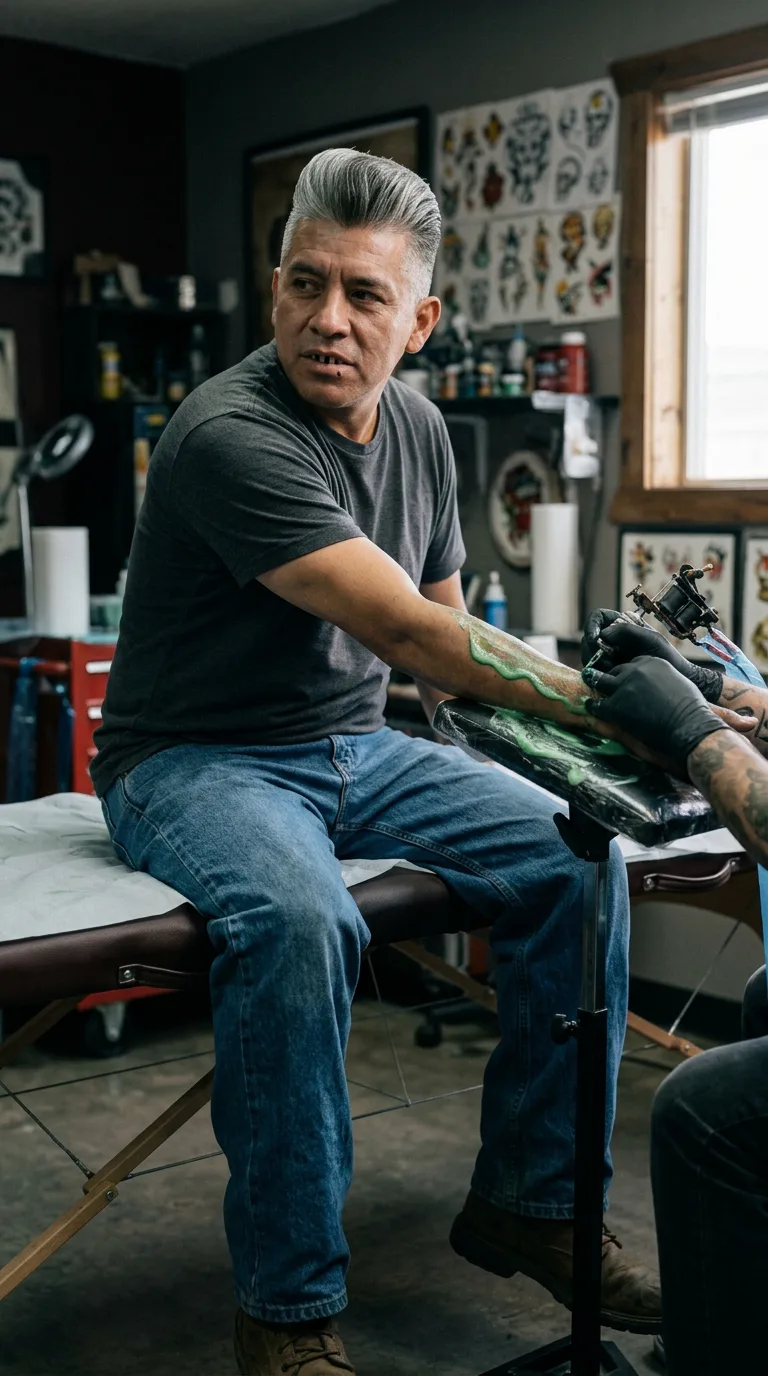
Rarest thing about him: Getting a tattoo — rare, 1 in 278
Season 0seed 209528037 · engine v10
Character card
lineage 2NZHHJ
His body-swap story
@colin.hasbrook, wearing Sami Nazarian, rolled the wheel on and woke up as Rigo Escamilla, spent under a minute in him, then spun the wheel and woke up as Óscar Beltrán
The office chair is too big for Sami Nazarian's twenty-year-old frame, or maybe the body just hasn't decided yet how to sit in it like a man who belongs there. Thirty-eight minutes of hazel eyes blinking at freckled forearms, of a mouth still learning where its own accent lives. It should be enough. It should be a miracle, a whole rich life stolen clean, and for thirty-seven of those minutes it was. Then the billable-hours email lands, some partner's name at the bottom like a verdict, and something old and restless in the seat behind Sami's eyes goes: no. Not this one either. Not tonight. The hand — his hand, technically, for another few seconds — is already opening the site on the monitor before the decision finishes happening. Six in the evening in Philadelphia. The wheel doesn't care what time it is anywhere.
It spins through names and does not pause on any of them, and there is a full second, no time at all, where nobody is driving either body.
The power comes back on in a room eighteen hundred miles west and an afternoon away, and the arm under the needle stops flinching.
You are sitting on a padded table that smells like green soap and old coffee, and there is a stranger's gloved hand pressed to your forearm holding it flat while a machine buzzes through skin that is not, until this second, remembering it belongs to you. Your head is turned toward the window. Hard desert light through wire-screened glass, flash sheets on the wall — eagles, roses, a dagger through a heart nobody in this room will ever get. The jaw that was clenched a breath ago has gone loose. You watch the needle go into the arm like it's happening to a table, to furniture, and somewhere very far down something that is not you anymore is screaming about that and cannot make a sound.
Then his shirt gets there first — not the gray T-shirt, that came on an hour ago, but the memory riding under it, the coveralls hung on a nail by the trailer door, and it comes back sleeve by sleeve: six a.m., cold enough in the high desert that the fabric bites before your body's warmed it, zipper stuck a third of the way up the way it's stuck for four years, the little tug-and-yank you don't even think about anymore. Rigo. Rigoberto Escamilla, though nobody's called him that since his mother, who is eleven years gone and still the one he half-talks to on the bad mornings. Forty-five years old. The back step of a truck at six a.m., cold rail under a glove, the hydraulic groan of the arm going up, the smell that never really leaves the nose no matter how much you shower, and you find you don't mind it, you never minded it, it paid for the trailer and the truck and the twenty-two grand sitting quiet in a credit union in Pahrump that nobody talks about.
The tattoo gun's vibration is a key too — under it, the memory of deciding to finally get this thing, thirty years too late by his own accounting, sitting in his truck outside the shop for ten minutes with the AC running before he made himself go in. His girlfriend Marisol thought it was funny, told him forty-five's a strange age to start collecting ink, and he'd laughed with the gap in his teeth showing the way it always shows in photographs, and said something about how a man's allowed one stupid thing a decade. Underneath the joke, the other one — Teresa, the one from before Marisol, the one who left for Reno and a man with better prospects and who still turns up sometimes behind his eyes on long drives, not with grief exactly anymore, more like a coin worn smooth from being turned over. He does not tell Marisol about that. He does not tell anyone.
The boots under your feet — steel-toed, scuffed pale at the creases — know a route through a neighborhood better than his own name, know which driveways have the loose dog and which cans are always three pounds heavier than they should be. Your shoulders know the particular ache of the lift-arm lever, forty-five years old and every one of them showing in the lower back on a cold morning. Your hands, when you finally look at them past the needle, are exactly as thick and cracked and sure as hands that have held a garbage can lid ten thousand times, and there is a small, stray pride in that, his pride, arriving late and unasked-for: nobody does this work who can't take it.
You look at your hands.
Then you look up, past the artist's bent head, out through the wire-screened window at the sage and the hard blue shadow of the trailer across the lot, and you say, in a voice with a gap-toothed whistle in it that isn't yours yet and already is:
"Don't stop — I want to see how it looks finished."