Rigo Casillas
Fictional. Generated by AI — not a real person, and no likeness of one is intended.
41, boxing trainer in Rural Texas · rolled by @marco.villagrana · card — no film
History
who has worn him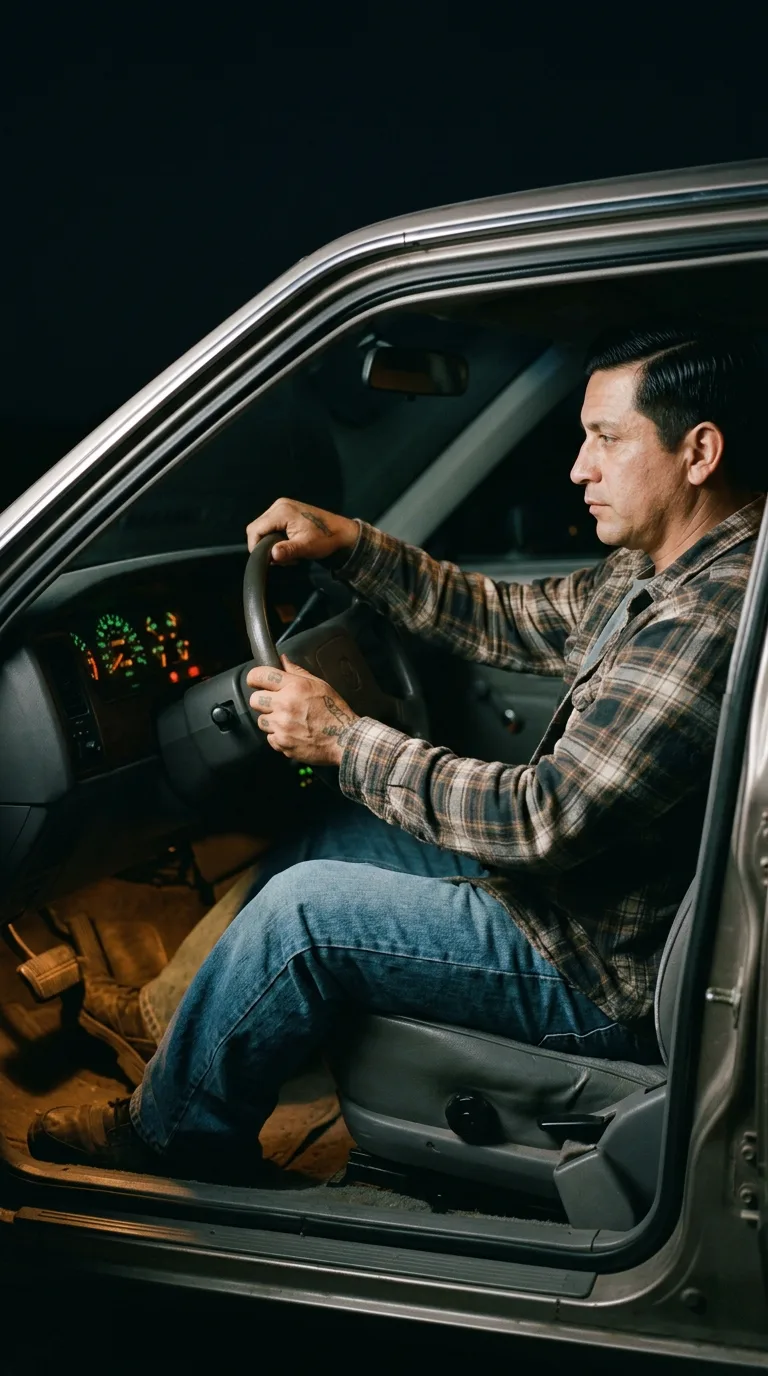
Rarest thing about him: Dyed black — epic, 1 in 60
Season 0seed 965186692 · engine v10
Character card
lineage LJL8SV
His body-swap story
@marco.villagrana, wearing Marcus Delaney, rolled the wheel on and woke up as Rigo Casillas, spent 4 minutes in him, then spun the wheel and woke up as Warren Petracek
Marcus Delaney's kitchen smells like other people's cigarettes even though he never touched one himself, and you stand in it a day and four hours into being him, cracking his knuckles against his will, feeling the ache in a lower back that isn't built for a truck seat. The clock over his stove says almost seven. Sunday, the end of a route, the end of a body you already know too well: heavy through the middle, twenty-nine years wearing thin at the elbows, a life you've read like a menu — divorced parents, a CB radio he talks to like a friend, a dispatcher who likes him more than he lets on. None of it is bad. That's the trouble. There's no ache in it sharp enough to keep you here. You spun the wheel a hundred and three times looking for the ache, and Marcus Delaney doesn't have one, he's just tired in a normal way, and normal is the one thing you cannot stand to sit inside for more than a day. You open the laptop on his counter, the one with a cracked corner, and you go to the page with the wheel on it, and you don't let yourself think about whether that's fair to him, because it never has been and won't start now.
You spin.
The wheel is still finishing its little dying spin in Pittsburgh when you are three miles from a water tower you have never seen, both hands leaving a steering wheel and finding it again lower and wider, like they always sat there, like you didn't just arrive. The turn signal is already ticking for a gravel road that isn't Marcus Delaney's problem anymore. Dash lights green up a set of knuckles shorter and browner than the ones you had half a second ago. The truck — an old one, working one, smells of vinyl gone soft with age — drifts a foot, corrects itself in one pull that his hands know and you don't. You are sitting lower than you were. Your feet don't reach the floor mats the way you expect them to. Something in your chest, small and quiet, already knows how to drive this exact road in the dark without looking.
The shirt is what opens first — a flannel gone thin at the collar, and the second your shoulders settle into it you get him getting dressed in it, this morning, in a house with a swamp cooler running in the window and a woman's voice down the hall telling him breakfast's getting cold. Rigo Casillas. The name comes with the shirt the way a smell comes with a room. He buttoned this from the bottom up standing in front of a mirror with a crack in the corner of it, not looking at himself so much as checking his hairline, patting the part flat with a hand still damp from the sink, black dye combed in careful rows because the grey started coming in five years ago and he decided that wasn't happening to him yet, not for the kids, not for her. His nose in that mirror sat crooked the way it always does — broken in a sparring session twenty years back by a heavyweight twice his size who apologized for an hour afterward — and he didn't mind it, hadn't minded it in years, it was just his face now.
The wheel under your hands gives you more: hundreds of nights on this stretch, headlights swallowed by mesquite scrub, a gas station with a busted ice machine, the gym waiting for him six days a week with its ropes and its smell of old leather and Icy Hot, boys half his size and twice his height coming through the door hoping he'll make something of them. He is short for what he does and it has never once mattered in that ring — what matters is the fourteen-hour days, the pads on his palms gone hard as boot leather, the calluses that don't come from punching but from holding the mitts steady for other men's punches, a thousand rounds of somebody else's ambition passing through his hands. He built that gym out of a pole barn with his own money. He has $60,000 or so tucked away that nobody at the gym would guess, because he still drives this truck, still wears this flannel until it's rag-thin.
The seat under you carries the weight of two kids — a boy's cleats kicked under the passenger side, a permission slip he still needs to sign folded in the visor — and a woman, not a wife but might as well be, waiting in a house with the porch light already on because he's three miles out and she always seems to know. He quit drinking eleven years ago without a program, without a scene, just noticed one day he didn't want it anymore and let it go quiet, the way you let go of a rope you've stopped needing. He has never smoked. He prays sometimes, alone, not in any building, mostly in this truck, mostly about his kids. There is no ex who haunts anything. There is nothing he carries that he'd bring up if you asked him straight out — just an ordinary man's ordinary weight, dad bod soft over what used to be a fighter's frame, green eyes that came from a grandmother nobody else in the family got them from.
Your hands — his hands — find the wheel's stitching worn smooth in two spots from ten and two, ten and two, every night the same. You look down at them. Wide, brown, a callus map of a life spent building other men's jabs. You turn one over slow in the dash light like it might tell you something it hasn't already.
"There you are," you say, to no one, to the water tower, to the three miles left, and you don't know yet if that's a greeting or a countdown.