Rene Balderas
Fictional. Generated by AI — not a real person, and no likeness of one is intended.
33, store manager in Houston · rolled by @colin.hasbrook · card — no film
History
who has worn him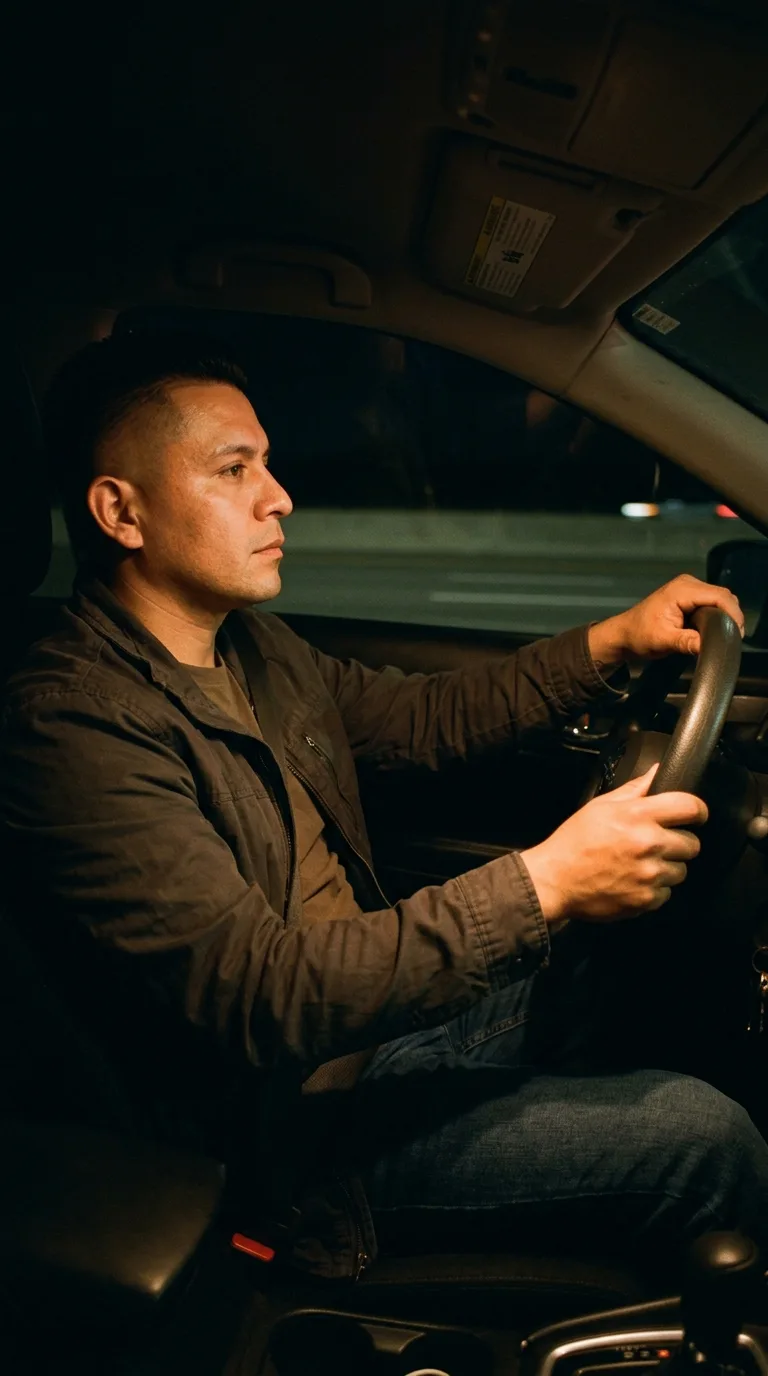
Rarest thing about him: 5'3" or under — common, 1 in 31
Season 1seed 1692473388 · engine v11
Character card
lineage 2NZHHJ
His body-swap story
@colin.hasbrook, wearing Marcus Delery, rolled the wheel on and woke up as Rene Balderas, spent under a minute in him, then spun the wheel and woke up as Jamal Okwuosa
The line that goes taut in Marcus Delery's shoulders comes from a foreman's clipboard, not from anything you did. You have been him less than a minute and already you know the shift: production down two percent on a line that has never once been below quota since the vitiligo patch on his jaw started coming in, some superstition the guys on nights have half-joking, half-not. You are standing in the break room fluorescents, his big hand flat on a cold vending machine, and you feel how tired this body is of being watched for luck. Boston is going dark outside the high windows. End of the day, end of a Wednesday. It is a good body — six-three, strong through the back, a face people remember. But you have had it since last night, and it did nothing wrong, and that is somehow the problem: nothing left to find out about it. You want the part where you don't know yet. You want the unopened box. You take out your phone in his pocket, thumb print scanned, and the wheel is already loading before you've admitted to yourself why.
The turn signal is already clicking — a rhythm that isn't yours, patient, metronomic — when Rene Balderas's hands leave ten and two and come down lower, wider, and the highway keeps sliding under a car that suddenly has you inside it instead of him. Dash light green-gold on the backs of your knuckles. Humid Houston air pushing faint through a cracked window, thick with cut grass and asphalt cooling from a day that was, somewhere behind you, still bright when this began — his evening is an hour deeper into dark than the one you left. The signal ticks for an exit that isn't his, and you don't correct it yet, because you don't know yet that it's wrong.
The steering wheel is the first thing that talks. It's worn smooth in two spots exactly where his palms sit, a decade of the same grip, and it gives you a Tuesday two years back, hauling a busted pallet jack across a stockroom floor at five a.m. because the district manager was coming, sweat cutting through his shirt before the store even opened. His hands know a hand truck's balance point without thinking, know how to break a pallet's shrink wrap with one twist of the wrist, know the particular ache that lives in his lower back after a double. He is thirty-three and it already talks to him in the mornings.
The jacket sleeve against your arm — his jacket, the brown one — remembers itself onto him this same evening: pulling it on in the stockroom office after close, keys jingling off the belt loop, the smell of cardboard dust and the coffee gone cold in a paper cup by the register. Under it a plain shirt, tucked in that particular tired way a man tucks a shirt after ten hours, not the crisp version from the morning photograph but the wrung-out end of it. His jaw is smooth still, shaved at five a.m. before the sun, and by now it should be rough and it isn't — this is one of the small unfairnesses of a Wednesday, that you don't get five o'clock shadow, you just get five o'clock.
The keys against your knee bring back a girlfriend's laugh in a parking lot, the two of you leaning on this same hood eating gas station raspaletas because the AC at her place was out again. Warm, easy, ongoing — not urgent, not a thing he thinks about except in flashes like this. And under that, older, quieter: an ex whose name arrives sideways, attached to nothing but the ghost-feel of a ring he used to keep in this exact cupholder and doesn't anymore. Whatever happened there closed. You don't get to see how.
The dash clock's glow on your knuckles brings the actual grind of him: opening the store, breaking down pallets before the doors unlock, the particular fluorescent quiet of an aisle nobody's walked through yet. He likes the quiet, is the thing you get off him, off the fabric, off the wheel under your palms — likes being the first one in a building that's about to be full of noise. A pack of cigarettes rides low in his jacket pocket and your fingers know exactly how many are left without counting, the way a smoker's hand always does. Your leg is already bouncing against the seat, a motor that runs whether or not there's anything to be nervous about, and it was running in him three miles from a home you have never seen, in a body five-three and built plain and sturdy, no mark on it anywhere, nothing you'd point to in a lineup — which is, you understand now, holding his own hand up in the dash light, sort of the whole appeal.
You look at your hands on the wheel — his hands, calloused at the base of the fingers from box cutters and hand trucks, a burn scar's absence exactly where the facts said there'd be none, just wear, just weather. You ease off the gas without meaning to, the signal still ticking for the wrong exit, and you say, out loud, to no one, in a voice that isn't the one you had an hour and a state away —
"Okay. Okay, where are we going."
Not fear. Not yet. Just a man's leg bouncing under a stranger's want, and no way, from in here, to know how long you plan on staying.