Raúl Esparza
Fictional. Generated by AI — not a real person, and no likeness of one is intended.
57, chief executive in El Paso · rolled by @connor.waskiewicz · card — no film
History
who has worn him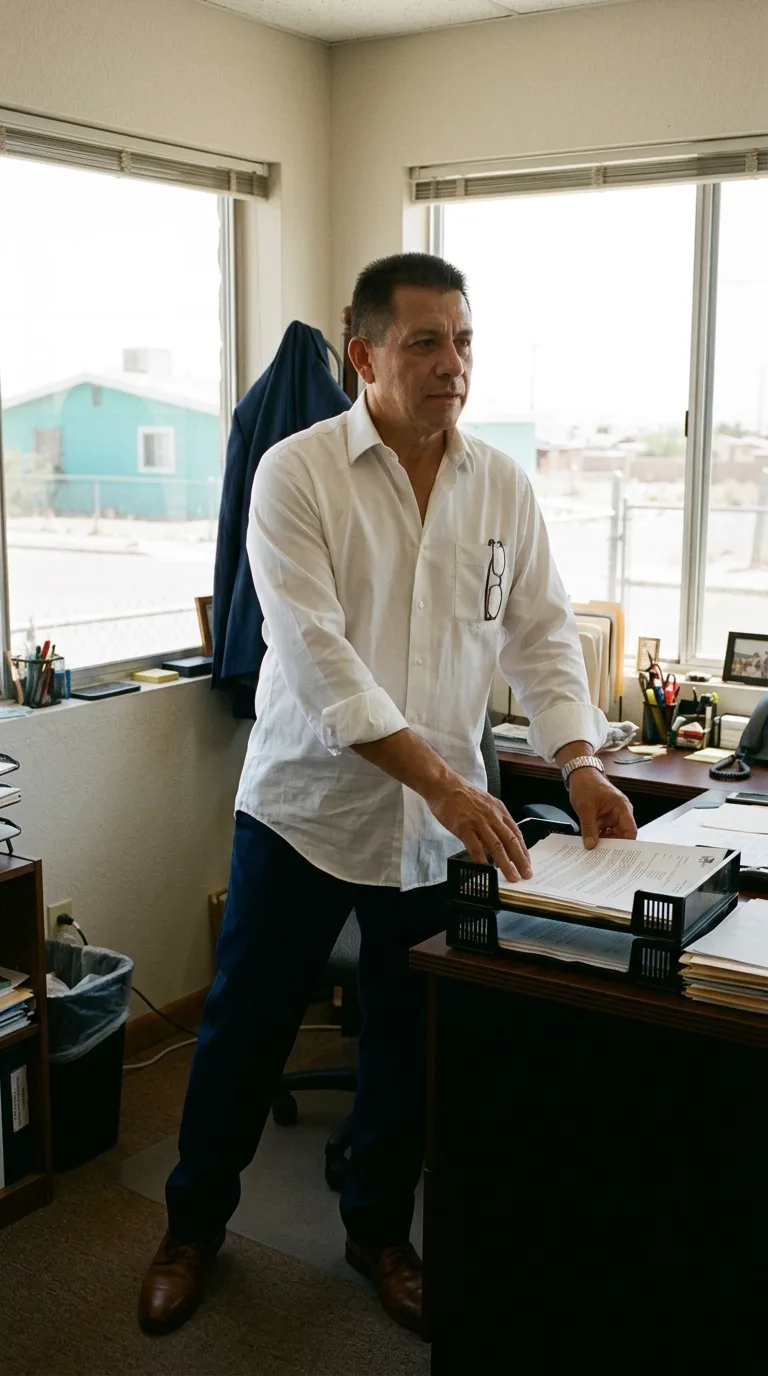
Rarest thing about him: Seriously rich — $3M to $10M — common, 1 in 88
Season 1seed 727228144 · engine v11
Character card
lineage 2NZHHJ
His body-swap story
@connor.waskiewicz, wearing Gary Prechtel, rolled the wheel on and woke up as Raúl Esparza, spent under a minute in him, then spun the wheel and woke up as Raymond Acosta
---
The moustache itches today. It has itched for a week, actually, but you only notice it now, sitting in Gary Prechtel's recliner with Gary Prechtel's fingers pulling at it, because there is nothing else to do. Sixty-five years of somebody else's knees. The beauty mark on his cheek you keep catching in the hallway mirror like it belongs to a roommate. You made him retire eleven months ago — his choice, on paper, his pension, his condo with the bay peeking between two other buildings — and for eleven months it has been enough to be a comfortable old man with nowhere to be. But comfortable wears thin the way carpet wears thin, and this morning you caught yourself refreshing the site on his phone before you'd even had his coffee, and that was the whole decision, really, made before you agreed to it.
You open the laptop. The wheel spins the way it always spins, cheerful and indifferent, and it gives you a name you don't know and a face doing paperwork in a beige office, and you press down through Gary's soft chest into something else entirely.
The motion is: hand reaching for a folder, sliding it into the out-tray, has done this ten thousand times. Except the hand stops a half inch above the tray, hovers, and sets the folder down in the wrong stack. You feel it happen before you understand that you are the one doing it — a man's whole arm, leaner than Gary's, corrected mid-air like a skipped heartbeat. You pick the folder back up. Put it where it goes. Then the next one, and the next, each placed with a strange new carefulness, as if the hand has to ask the desk for permission.
The shirt is what opens first — white linen, sleeves already rolled to the forearm, and touching your own forearm through it gives you the feel of rolling them yourself, this morning, standing at a dresser in a turquoise house while the light outside was already hard and white. Marisol was still asleep. You — he — did this without looking, has done it every day for thirty years, cuff over cuff, three folds, the little hitch at the elbow where the fabric always catches on the old scar he got from a barbed fence at nineteen, before any of this, before the company had his name over the door.
The desk gives you more: the particular heaviness of the stapler, bought for this exact hand, because he likes the weight of a good stapler the way other men like a good watch. The window glass behind you is warm from outside, though the blinds keep the worst of the glare off the monitor, and beyond them you know, without turning, there's a chain-link fence and a flat turquoise roof catching the sun two lots over — his own street, visible from his own office, because he built this business four blocks from where he grew up and never saw a reason to move it.
The wedding band is cool and plain against the next folder you touch, and that alone unspools an anniversary: twenty-six years, a party his daughter organized without asking him, mariachi in the backyard, Marisol in blue, laughing at something he doesn't remember saying. He remembers her hand on his jaw afterward, thumb along his clean-shaven cheek, telling him he still looked like the boy from the framed photo on the mantel. He touches his own face now, the same gesture, unthinking, the jaw smooth from this morning's razor, and for a second grief and love arrive together with no warning, his feeling, not yours, flooding up through your borrowed hand.
There's a photo on the corner of the desk, half-turned toward the window — his daughter's graduation, her hand on his shoulder, him not quite smiling, the way he never quite smiles for cameras, like smiling costs something he'd rather keep. Mass with her on Sundays, out of habit more than conviction anymore, but he still goes, still lets the incense and the Latin cadence sit in him like weather. He hasn't had a drink since before she was born — drifted rather than quit, one decision unmade so many times it became a life. Never smoked. His body is fifty-seven years honest: a stiffness low in the back from decades at desks, the right knee that clicks on stairs, forearms still hard from a childhood of real work before there were any employees to do it for him.
You set the last folder down squarely, correctly, the small checked motion of a man making sure of something that never needed checking. Then you stop moving altogether and look down.
The hand is brown, not blond. No beauty mark, no soft knuckles — a plain gold band, a faint white scar you didn't put there catching the window light. You turn it over once, slow, feeling for whatever's supposed to be wrong with it, and nothing is.
You lift your eyes to the window glass, where his reflection is doing the looking back, and you say, to no one in the empty office, "There you are."