Ramon Estrada
Fictional. Generated by AI — not a real person, and no likeness of one is intended.
58, janitor in Small-town Ohio · rolled by @marco.villagrana · card — no film
History
who has worn him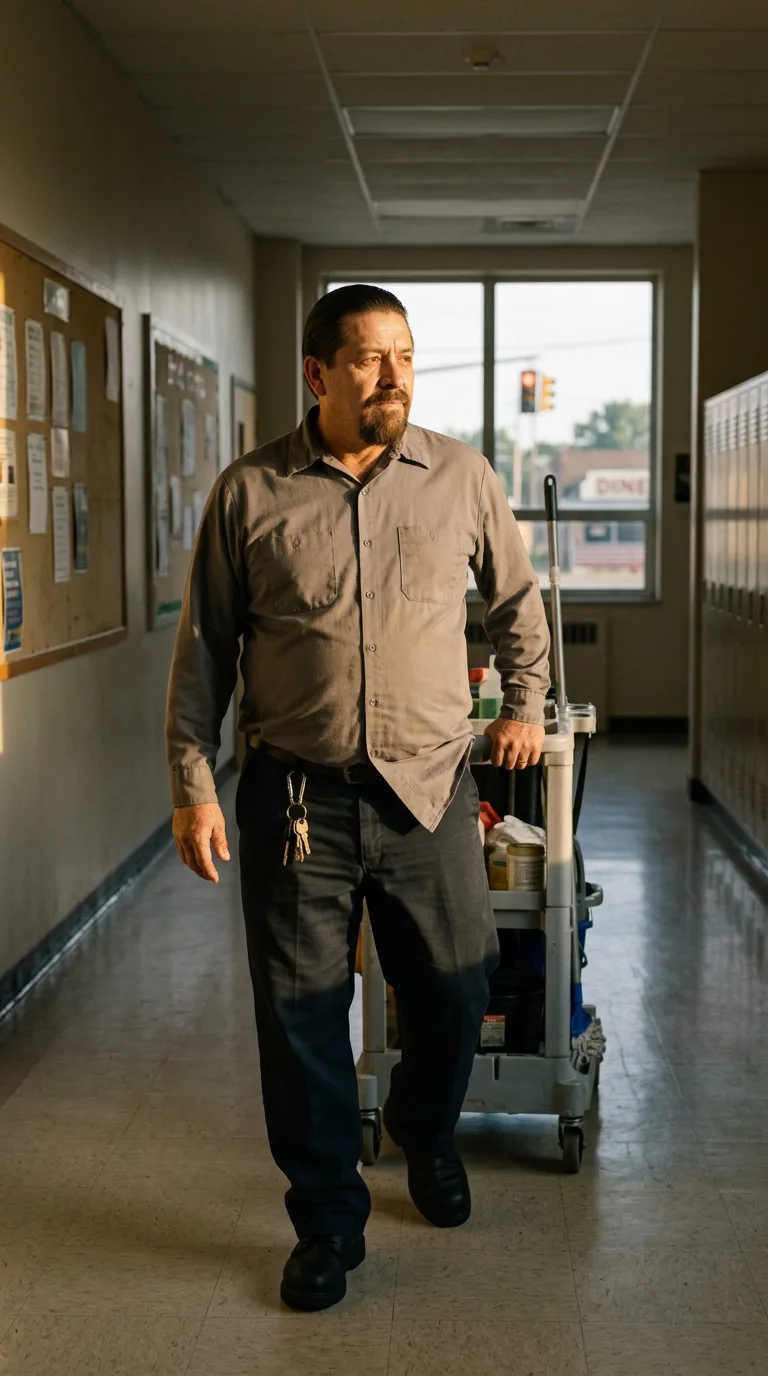
Rarest thing about him: A tremor in the hands — common, 1 in 79
Season 1seed 1640160052 · engine v11
Character card
lineage LJL8SV
His body-swap story
@marco.villagrana, wearing Desmond Achebe, rolled the wheel on and woke up as Ramon Estrada, spent 58 minutes in him, then spun the wheel and woke up as Danny Reyes
You have been Desmond for four minutes, and already the lazy eye is a nuisance, the ache in the knees from a day spent bent over sod is a nuisance, and the phone in the groundskeeping shed's junk drawer has a text from someone named Tasha that isn't yours to answer and isn't interesting enough to want to be. Atlanta is going gold at the windows. You didn't want this one long. You never really wanted this one at all — a shed, a mower, a body already tired before you climbed into it — you'd spun in a hurry last time, greedy, careless, taking whatever the wheel gave without waiting for better, and now you're standing in the proof of that. So you open the site again on the cracked phone screen, the one Desmond bought secondhand, and you spin, because four minutes is enough time to regret a body and there is no rule that says you have to serve out a sentence in one.
The wheel turns and there is no in-between. One second you are Desmond's ache and Desmond's eye and Desmond's shed. The next you are taller, heavier through the middle, and your hand — a stranger's hand, olive-skinned, freckled clean across the back of it — is closed around the handle of a push broom, mid-stroke, three-quarters through a pass down a corridor that smells like pine cleaner and old paper. The stroke stumbles. You correct it. You correct it again, slower, watching your own arm do it like you're grading yourself, and the broom head goes crooked and straight and crooked and straight, ten more times, careful, checked, on a motion this body has not needed to think about in eleven years.
It's dark outside the tall windows at the end of the hall except for one stoplight, red, going amber, going nowhere, hung over an intersection with a diner on the corner that closed its sign an hour before you got here. Small-town, wherever this is. Somewhere that goes to sleep by eight. And that is its own small wrongness, because your own last evening, the one you just climbed out of, was gold-lit and early, Atlanta traffic still humming — and this man's evening is already black at the glass, deep enough that the corridor lights are the only light there is. He's on a different clock than you left. You don't know why that snags at you, only that it does, for a second, like a splinter you can't find.
Then the shirt. Grey, long-sleeved, buttoned to the collar, two breast pockets stained faint and dark near the hem where a mop bucket has splashed him a hundred times over a hundred nights, and it comes through the fabric against your back the way heat comes through a wall — a whole morning, all at once. Standing in a bedroom with the blinds still down, his wife Diana's breathing steady behind him, easing the buttons through one-handed because the other hand won't quite hold still this early, has never quite held still, not since he was maybe fifty, a small tremor that means nothing according to the doctor and means everything according to the mirror. Threading the belt through the loops he's used since Bush was president, feeling for the notch worn soft from years of the same hole. Keys off the dresser, onto the belt loop, four of them and a scuffed rabbit's foot his daughter gave him when she was nine and thought it was funny, and it's still funny, twenty years later, hooked there jingling against his hip while he walks a school hallway nobody's supervising him in.
The mop cart at his elbow gives you more — the smell of it, bleach and rubber wheels — and it opens onto years standing exactly here: shift after shift, the same lockers, the same corkboard with the same layered flyers stapled six deep, the quiet particular to a building built for three hundred kids currently holding one man. He likes the quiet. He didn't used to. There was a year, not long ago, where the quiet held nothing but a woman named Renata who isn't his wife, who he let himself want too much for about eight months before he ended it clean, told Diana nothing, told himself it wouldn't happen twice, and mostly believes himself. There's real love in the marriage under that, a scraped-clean, guilty, ordinary love, and a son at State on a partial scholarship Ramon brags about to anyone who mops near him. A drink most nights, one or two, never more, poured after Diana's asleep so she won't count them. No cigarettes ever — tried once at nineteen, coughed until his eyes ran, never again. Friday prayers when the shift allows it, which lately isn't often, and a private, low-grade guilt about that too, filed next to the other one.
His body under all of it: fifty-eight and heavier than he was, knees that announce themselves on the stairs, a lower back that knows the weight of a mop bucket better than it knows rest, forearms still strong from twenty years of exactly this. The hand tremor, small, waiting under the surface the second you stop paying attention to it, which is most of the time — it has never once cost him a job, only the occasional cup of coffee.
You look down at the hand doing the holding. Freckles scattered dense across it in the fluorescent light, a plain gold band worn thin at the left ring finger, the faint permanent shake settling in now that nobody's watching it. You turn it once, palm up, palm down, like you could read the last thirty years off it if you looked hard enough.
"Okay," you say, to the empty hallway, to the red light dying to green outside the window, "let's see what you got, Ramon."