Desmond Achebe
Fictional. Generated by AI — not a real person, and no likeness of one is intended.
26, groundskeeper in Atlanta · rolled by @marco.villagrana · card — no film
History
who has worn him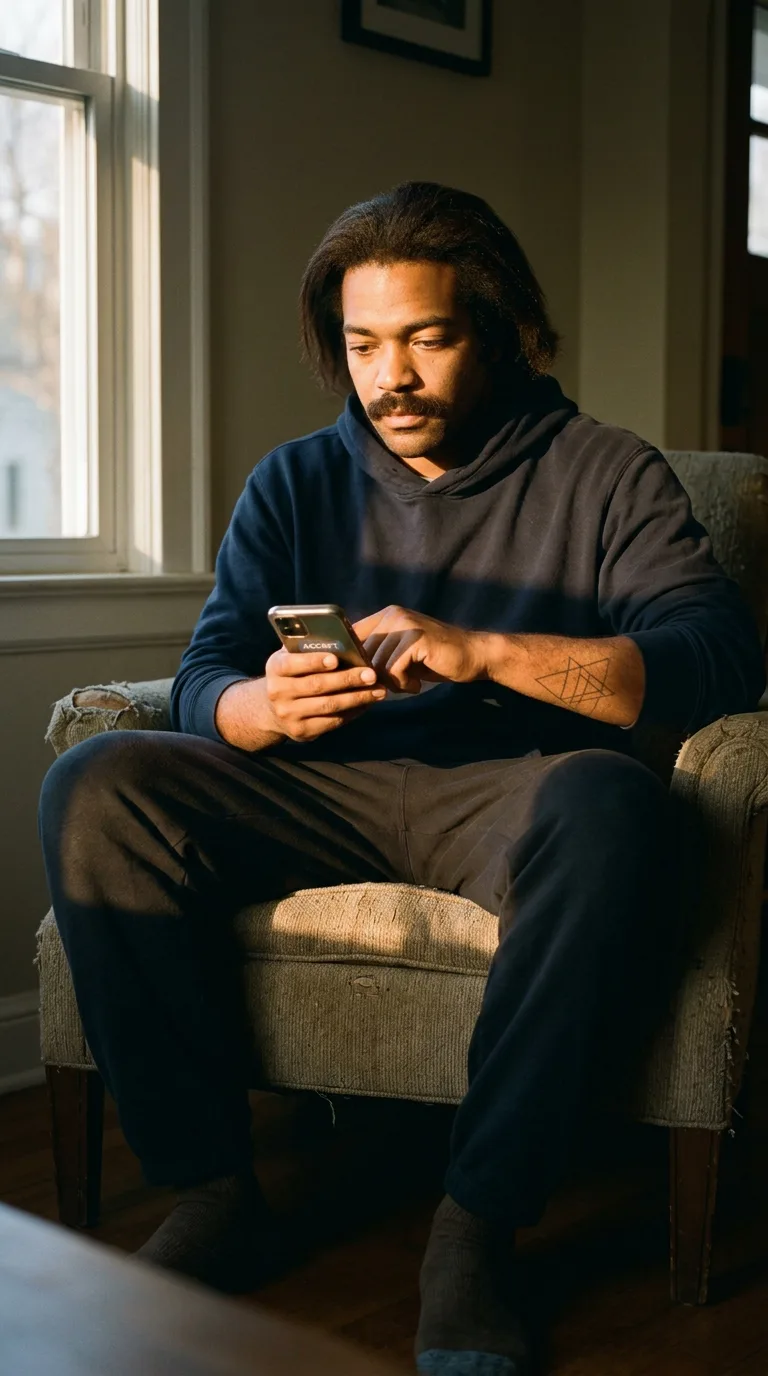
Rarest thing about him: A lazy eye — common, 1 in 66
Season 1seed 2041349451 · engine v11
Character card
lineage LJL8SV
His body-swap story
@marco.villagrana, wearing Harold Petrosky, rolled the wheel on and woke up as Desmond Achebe, spent 4 minutes in him, then spun the wheel and woke up as Ramon Estrada
Harold's dimples do not move the way you want them to. That's the thing nobody tells you about a face like this — sixty-three years of it set into grooves that only know how to smile one way, patient, a little slow, a church-usher smile, and you have been wearing it for two minutes and already you are tired of how kind it looks in the hallway mirror when you don't feel kind. The recliner is still warm where you got up out of it. The television is still on, some rerun laughing at nobody. Small-town Ohio has already gone the color it goes at the end of every day, orange going gray, and you know this light, you have seen this exact light before, because you have sat in this exact room before, an hour ago, being somebody else who was also tired of it fast. That's the shape of it now. You get a body, you wear its ache for a minute, and the ache becomes the reason. Harold's knees hurt getting up. His back has a permanent list to the left. There's a taste in his mouth like the decaf he drank at four. You did not choose this man's dentures and this man's weather and this man's dead wife's photo on the mantel, and now that you have felt all three you would like to put them down. You go to the office nook off the kitchen, where Harold pays his bills, and you sit in his chair and open his laptop with his hands, and you go to the page with the wheel on it, because two minutes was enough, because it is always enough now, because this is the 147th time and the wanting doesn't ask permission anymore, it just arrives, familiar as a doorbell. You pay. You spin.
The room changes under you without moving. One second you are Harold's stiff shoulders and the next you are a different set of shoulders entirely, looser, younger, a thumb still hanging in the air above a phone screen that has already gone dark and locked itself against your face's cooling glow. The chair beneath this new body is deep and shabby, upholstery gone soft at the arms, one arm frayed to threads at the seam. Late sun comes through a window to your left in one long bar across a hoodie, navy, worn thin at the cuffs. You are sitting. You were sitting when it happened. Your arm lowers on its own, the last inch of a motion that started before you got here, and the phone drops into your lap, screen dark, ordinary, done with whatever it just gave you.
The moustache is the first thing your face tells you about, a weight above the lip you didn't ask for, and then the socket — one eye pulling gently outward, off true, so that the window and the room arrive at slightly different times to two different parts of your sight, and your head wants to compensate and does, before you tell it to, an old habit already running the show. The hoodie against your back gives you a flash: laundromat, quarters, a girl behind the counter he used to flirt with badly and on purpose. Sweatpants at your ankles, soft with age, and under them — nothing, socked feet on a floor that creaks a particular way at the third board from the chair, a creak you know before you step on it, because his feet have known it for four years of renting this half of a duplex on a cul-de-sac where the heat sits on the street like something spilled.
The tattoo comes up warm against your forearm where the sleeve's pushed back — fine lines, geometric, a shape that isn't anything, a shape he picked because it wasn't anything, twenty-two years old and wanting ink that didn't mean a story he'd have to tell strangers. Except it does have a story, it comes anyway, uninvited: a shop in East Atlanta, a friend holding his other hand, the buzz going up through bone the way it does, and after, the two of them eating gas station food in a car with the windows down, laughing about nothing, young in a way this body still partly is.
The morning comes back through the clothes, because the clothes remember better than he does: not this hoodie, the work shirt, olive-green, buttons warm from an iron he doesn't actually own, so really just warm from his hands smoothing it flat on the bed. Chinos with old grass-stain ghosts worked into the knees no matter how many washes. Boots by the door caked pale with infield dust, laces double-knotted the way you learn to knot them when you're on your feet nine hours pushing a mower in lines so straight the outfield looks combed. His body knows that walk without asking — the set stride along a stripe already cut, eyes tracking the wheel not straying, both eyes doing that even though only one of them tracks true, some old adjustment made so long ago it isn't an adjustment anymore, it's just how the world looks. Shoulders that ache in a satisfied way, forearms browner than the rest of him, a farmer's tan he's stopped noticing. Hands that know a mower handle, a rake, the particular give of chalk lines, a body used well and paid little for it, and underneath that, tired in the specific way of a man who came home, showered, put on the soft clothes, and sat down in this chair meaning to rest.
The chair gives you more if you let it, and you let it — an ex's voice from a year and a half ago, a man named Julian who used to fold into this same cushion sideways with his feet in this lap, watching something neither of them cared about, and the ease of that, the missing of it, sits in the chair's shape like a body-print that outlasted the body. He hasn't dated since. He tells himself it's fine. Some nights he almost believes it. He quit drinking around then too, not dramatically, just drifted, the way a tide leaves a mark and then isn't there for the next one. No cigarettes in three years, though his fingers still sometimes want one when they're idle, and they're idle now, and they've already found each other, knuckle against knuckle, that small dry crack traveling up through your hand before you've told it to do anything.
Phone still in your lap, dark now, locked, the app icon out of sight behind glass — something a friend named Reggie sent him grinning, try this, it's wild, and he'd laughed and thought why not, tired and a little curious and lonely in the unspoken way, thumb finding ACCEPT the way you find any button that promises to be a small good thing at the end of a long ordinary day.
You look at your hands. Not Harold's, not your own — nobody's, technically, and yet they crack a knuckle again without your say-so, muscle memory arriving before you do, and there is dried green at the cuticle of one thumbnail that four showers haven't gotten all the way out. You turn the hand over. Groundskeeper's hand. Twenty-six years old and it already knows more than you do.
You lift your eyes to where the window would be if you were looking for it, but you're looking past that now, into whatever's holding still in front of you, and you say, out loud, in his voice, testing the weight of it in his own throat:
"Okay. Who am I now."