Rafael Toubia
Fictional. Generated by AI — not a real person, and no likeness of one is intended.
45, family doctor in Coastal Maine · rolled by @colin.hasbrook · card — no film
History
who has worn him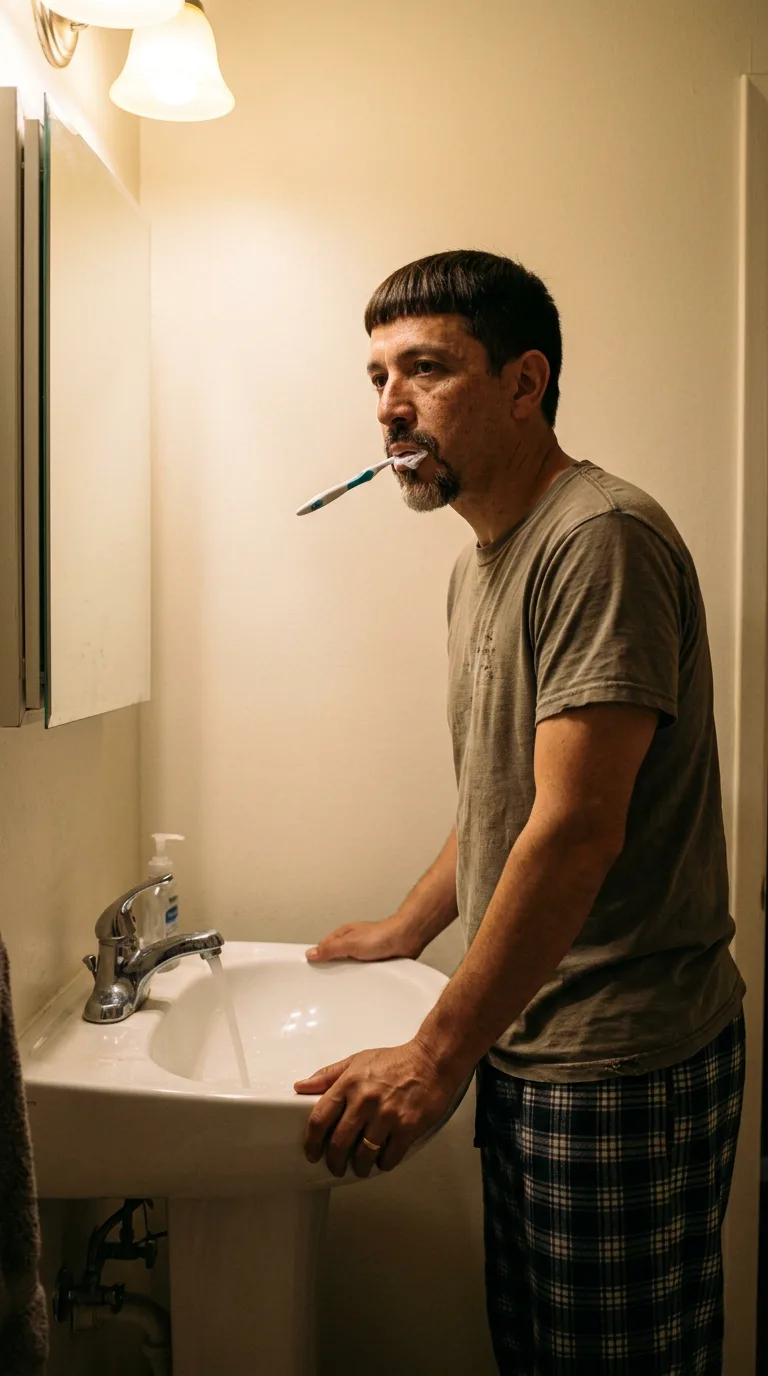
Rarest thing about him: Middle Eastern — common, 1 in 650
Season 1seed 1990045563 · engine v11
Character card
lineage 2NZHHJ
His body-swap story
@colin.hasbrook, wearing Owen Halstrom, rolled the wheel on and woke up as Rafael Toubia, spent under a minute in him, then spun the wheel and woke up as Brendan Kowalczyk
---
The office is dark except for the one lamp Owen Halstrom never turns off, and you have been him for less than a minute and already you are tired of it.
That is the honest shape of it, whatever excuse you dress it in later. Thirty years old in this body, blond, gray-eyed, a jaw that photographs well, freckles that some copywriter probably called "approachable" in a board deck once — and none of it yours, all of it borrowed the way everything is borrowed now, spin after spin, a wardrobe of men worn thin at the same three or four hours before you move on. You made this one decide to reach for a laptop and open a browser tab to vessel.cards before his hand had even finished the motion of loosening his tie. That's the tell, if there were anyone left to notice it: the hesitation that isn't his. Owen Halstrom has been a chief executive for less than a minute and he already doesn't want to be doing what he's doing, and the reason has nothing to do with him. It's yours. It always is. Eight hundred fifty-four men behind you and the wanting doesn't get quieter, it gets efficient — you don't even finish being disappointed in one before you're reaching for the next.
You don't examine it further than that. You pay. You spin.
—
The water is running and there is foam on your lip and the brush is between your teeth, already moving, already yours, mid-stroke on the left side when the room changes hands.
No blackout, no fall. Just a hand — this hand, wider through the knuckle than the one you had a second and a world ago, a plain gold band snug on the fourth finger — finishing the stroke it was given, then starting again on the other side, slower now, working the back molars with a care that isn't quite decision, more like muscle remembering itself before you've caught up to it. You rinse. You rinse twice, because something under the thought insists on twice. You stand the brush bristles-up in the cup, out of water that has sat gray in that same cup for longer than you've been alive in any body, and you don't yet know why that detail matters, only that it does, sharply, the way a habit matters to the person who's kept it for twenty years without once deciding to.
The mirror in front of you is spotted at the corners. The light above it is a cheap fixture, yellow, the kind that makes a bathroom feel like it's underwater. Behind the glass: a fringe cut in a hard straight line, black going nowhere near gray at the top but flecked at the chin where the goatee comes to its point. Freckles scattered like something spilled a long time ago and never quite washed off. Brown eyes that are not looking at you looking at them — they're just looking, the way his always did, at nothing, at the middle distance a tired man finds at the end of a Thursday.
—
The shirt is what opens first, because your back is already inside it.
Cotton, soft from washing, the plaid pattern of the pajama pants brushing your shins with a familiarity that isn't yours yet but wants to be — and then it is, all at once, the way water finds the low part of a room. Rafael Toubia. The name arrives the way his own name would occur to a man, unbidden, obvious, faintly absurd that it needed saying. Forty-five years old. A doctor. Coastal Maine, a house the color of an old nickel, traps stacked in the yard that haven't caught anything in a decade because nobody's fished them, they just came with the place, weathered gray with the house around them.
The T-shirt is the one he wears to sleep three nights out of seven, and putting it on this morning — no, not this morning, a morning, the shirt doesn't know which one, it holds all of them folded into each other — comes back in the ordinary way ordinary things do: standing in the bedroom with the window fogged from the shower, pulling it over his head one-armed because his other hand was still holding his coffee, Marisol's voice from the hallway asking if he'd seen her keys, and him saying the drawer, try the drawer, the way he always says it because they are always in the drawer. Twenty-two years married and the keys are always in the drawer.
The exam room comes back through the coat, though the coat isn't on him now — just the memory of its weight, the two pens in the breast pocket that are always there because a patient always needs to borrow one and never gives it back, the fresh paper crinkling under a thigh, the particular give of a stethoscope's rubber tubing warmed from being around his neck all day. He is good at this. Not brilliant — he doesn't think of himself as brilliant, has made peace with that — but good in the way that matters at eight in the morning to a woman who is frightened about a mole, or at four in the afternoon to a boy who doesn't want a shot. He likes the fifteen minutes he gets with each of them. He has never once, in eighteen years of it, wished for more money or fewer people in the waiting room, though he has, more than once, wished for more time — just generally, the way you wish for weather.
The goatee under his own touch, when his hand rasps against it without his meaning to check, brings back the barber's chair, twice a month, an old man named Pruitt who talks about the Red Sox the entire time and has been doing it since before Rafael had gray in the chin to speak of. The wedding band is warm from his own hand, always is, he never takes it off, not for exam gloves, not for anything — there was a fuss about it in med school and he ignored the fuss.
He does not drink. He remembers not drinking at his own wedding, holding a glass of sparkling cider that everyone assumed was champagne, and liking that nobody noticed, liking most things about not being noticed. He smokes a cigar on the porch on Sundays, one, slow, the traps in the yard going blue then black while Marisol reads behind him with the lamp on, and this — this specific porch, this specific slow-going dark — is the nearest thing his body has to a held breath, the one un-worked hour of his week.
His feet, bare against the bathmat, ache faintly the particular ache of a man who stood most of today, forty-five years old and average built and nothing wrong with him that a chiropractor couldn't tell you about in detail. His hands know things without asking — how to hold an otoscope so the light doesn't wobble, how to press two fingers into a throat's soft underside and find, immediately, without looking, what's swollen and what isn't. Those hands are not doing that now. They are only holding the sides of a sink, cold porcelain, the tap still running warm past them into the drain.
—
You look down at them.
Not his hands, not quite yet — held up the way a stranger checks the fit of gloves before deciding whether to keep them on. Freckled knuckles. The band catching the bathroom's ugly yellow light. Steadier than the hands you had this same minute of an hour ago in a different time zone, a different weather, a different tie half-loosened around a throat that is no longer any part of you.
You shut off the tap. You look up into the spotted mirror, into a face that is not going to age any further tonight, that is done with the part of the day where anyone is watching it, except you.
"Okay," you say, to no one in the empty bathroom, in a voice with a warmth under the vowels that Philadelphia never had. "Okay."
You don't know yet how long the quiet after that is going to hold.