Philip Castagno
Fictional. Generated by AI — not a real person, and no likeness of one is intended.
62, factory foreman in San Francisco · rolled by @elian.carrizal · card — no film
History
who has worn him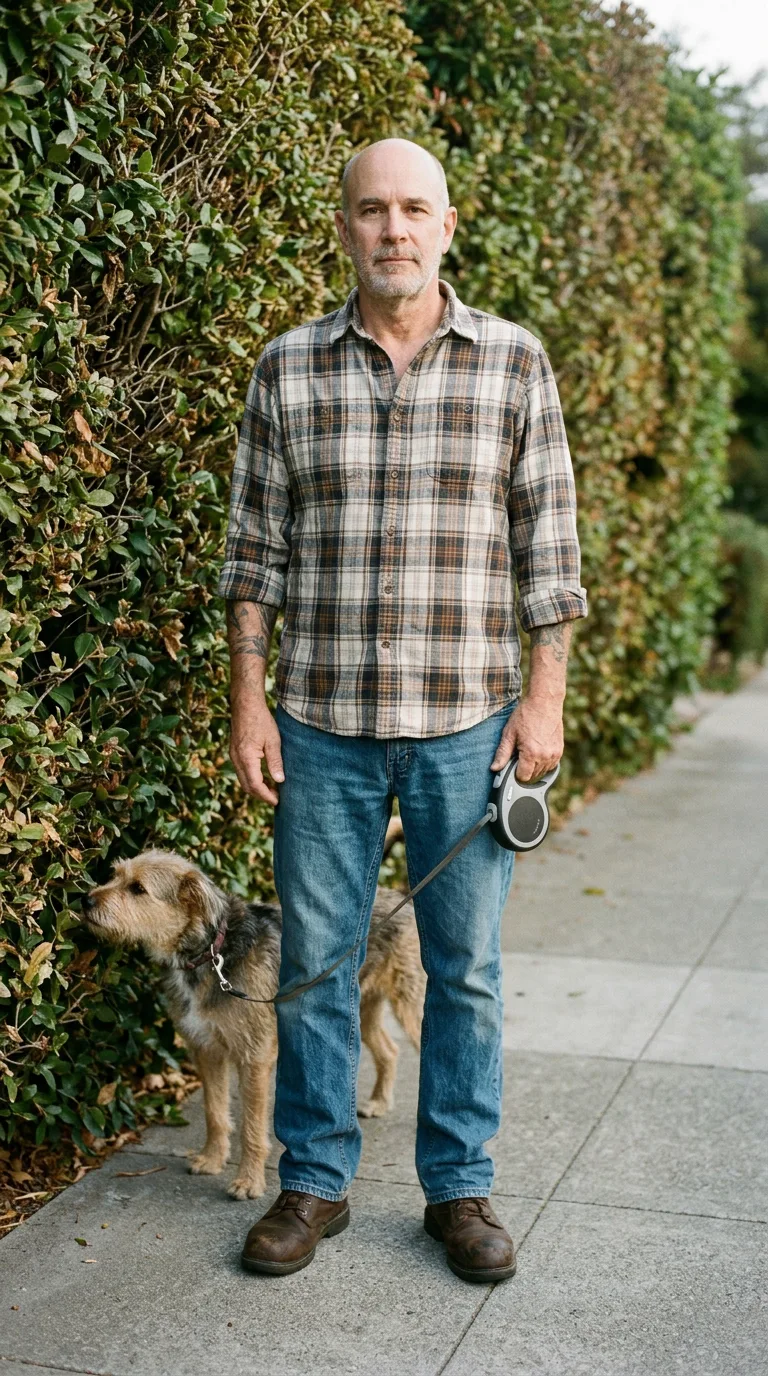
Rarest thing about him: A horseshoe, kept short — common, 1 in 81
Season 1seed 1109593641 · engine v11
Character card
lineage 9IC4OB
His body-swap story
@elian.carrizal, wearing Dennis Wachowski, rolled the wheel on and woke up as Philip Castagno, spent 3 minutes in him, then spun the wheel and woke up as Corey Blankenship
---
Dennis Wachowski's kitchen is quiet the way a construction site never is, and that quiet is the problem. It is a Sunday, before the day has started, and you are sitting at his table in his boxers with his phone lit up in his dimpled hand, and you have been him for three minutes, and already you know. The foreman job is fine. The dimples are fine. But Dennis's knees ache going down stairs, and there's a softness to him, a skinny-fat give under the shirt, that you noticed the second you landed and have not stopped noticing since. Three minutes is long enough to learn you don't want this one. You open vessel.cards again. The wheel is already loaded, spinning before you've finished deciding, the way it always is now — sixty-three times doing this to other men and it has stopped feeling like a decision and started feeling like a tic, like checking a phone you just checked.
The wheel lands.
You are standing on a sidewalk in cold bright air, mid-stride, and a hand that is not Dennis's winds a retractable leash twice around itself and starts walking before you've told it to. The dog looks back, ears flat, trying to figure out why the pace changed. Hedge-smell, wet concrete, the particular gray light of a San Francisco morning. The leash handle is warm where a hand has been holding it a long time. You are taller now. Heavier through the middle in a different way — not soft, just wide, built for standing. Your knees don't hurt. Something else does, low in the back, old and familiar in a way that isn't yours yet.
The leash gives it to you first. Not words — weight. Years of this exact weight pulling against this exact palm, a dog that used to be a puppy and isn't anymore, a loop of nylon worn smooth at the handle from a thumb that rubs it without thinking. Terry. The dog's name arrives with the smell of him, cheap kibble and wet fur, and behind that, unbidden, the woman who picked him out at the shelter nine years ago, who is not here anymore, who left the apartment and left the dog and somehow left the dog with you and not with her, which still strikes you — strikes him — as the one soft thing that came out of something hard.
The shirt gives you the rest. Flannel, soft at the elbows from a hundred washes, and putting it on this morning comes back sleeve by sleeve: sitting on the edge of the bed in the under-house dark, the garage smell of old oil and cardboard that never quite leaves a room cut into a hillside, buttoning it one-handed because the other hand was holding coffee that's gone cold on the counter upstairs, forgotten, the way it gets forgotten most Sundays since there's no shift to run and no reason to hurry. You feel the two days of stubble on your jaw as a decision not made rather than one made — shaving is a workday thing, and the hand that would reach for the razor is the same hand that's been chewing its own nails since before you remember starting, a habit that shows up now as a phantom ache at the cuticles, worn skin that's never quite right.
The body is sixty-two and knows it in the knees and the lower back and the stiffness that takes the first quarter mile of any walk to work itself loose. But the shoulders are good, still thick with twenty years of walking a factory floor, reading a line at a glance, knowing by sound alone which machine is about to jam. That memory comes up through the boots — steel-toe, worn at the heel the exact same way no matter how many pairs he's gone through — the clang and hiss of the floor at shift change, men nodding to him on their way out as he comes in, the particular tiredness of a man who has spent half his life making sure other people's work gets done right. He likes being good at that. He is proud of it in a way he would never say out loud, being the kind of Catholic who keeps the pride private and brings it out only at confession, if then.
There's an ex in here too, surfacing off the leash, off the dog, off the particular ache of Sunday mornings with nowhere to be — not a wound exactly, more a room in the house he still walks past. He quit drinking around the same time she left, though he'd tell you, if you asked him, that the two things aren't related, and some mornings he almost believes it. He quit smoking longer ago than that, for his lungs, for the floor, for no one in particular. Four hundred thousand dollars sits somewhere in accounts he checks twice a year and otherwise doesn't think about, money that came from decades of showing up, and it buys him nothing he wants most mornings, which is simply someone to want the dog walk to go on longer than it does.
The dog finishes with the hedge. The leash is slack, then it isn't.
You stop walking.
You hold the hand up in front of your face — his hand, broad, gray-haired at the knuckle, the nails bitten down past where they should be — and you turn it over once like you're checking it's attached.
"Okay," you say, out loud, to no one, to the dog, to the cold morning. "Okay, Terry. Let's go."
You wind the leash a third time around your fist and start walking, and the dog, after a beat, learns the new stride and follows.