Peter Yoon
Fictional. Generated by AI — not a real person, and no likeness of one is intended.
40, paralegal in Eastern Kentucky · rolled by @colin.hasbrook · card — no film
History
who has worn him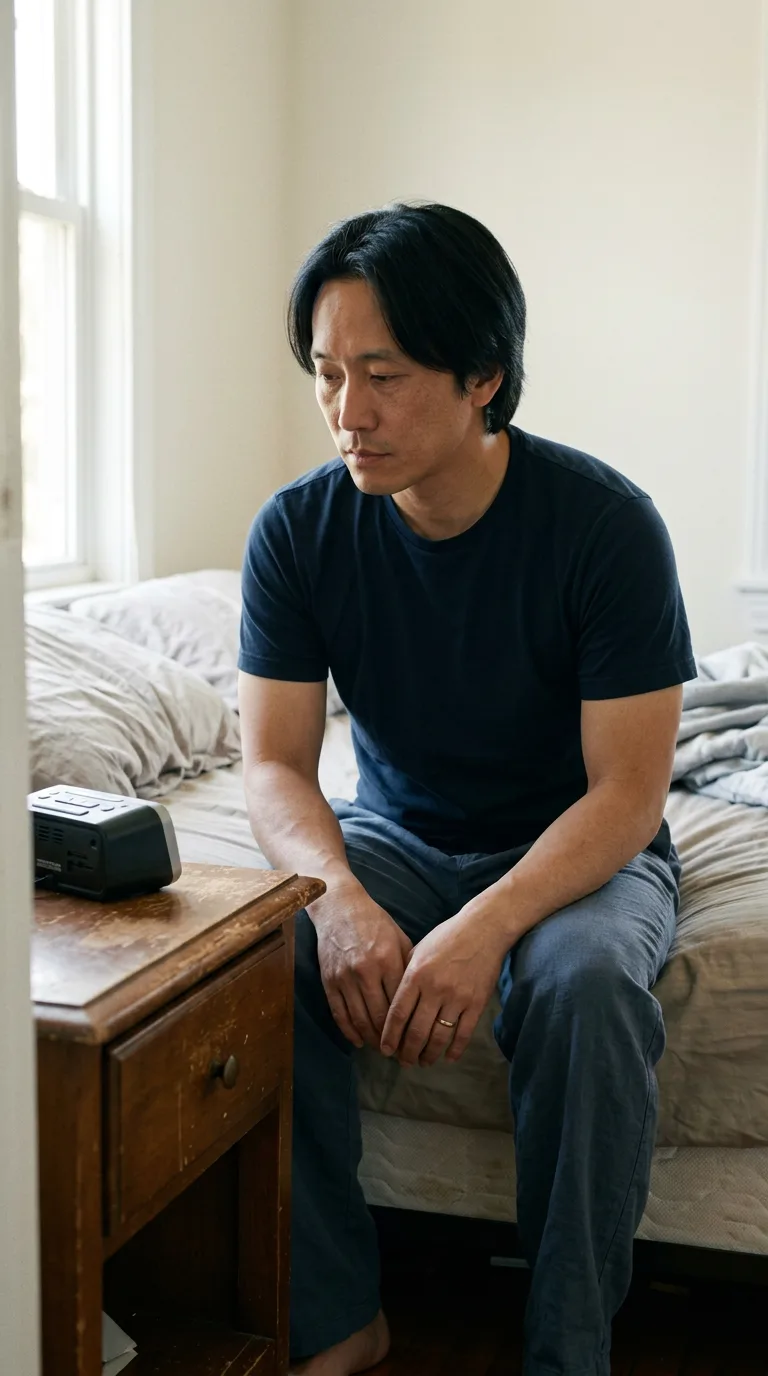
Rarest thing about him: Paralegal — uncommon, 1 in 1,064
Season 1seed 1417526197 · engine v11
Character card
lineage 2NZHHJ
His body-swap story
@colin.hasbrook, wearing Tom Radek, rolled the wheel on and woke up as Peter Yoon, spent under a minute in him, then spun the wheel and woke up as Malik Osborne
The break room clock at the Vegas store says quarter past five and the lights haven't come up yet, and you're standing there in Tom Radek's body with a nicotine pouch he doesn't even use tucked wrong in your own cheek, tasting his mouth's version of morning. Two minutes. That's all you gave him — a moustache you keep almost touching, a gut that sits heavy and unfamiliar under a golf shirt with the store's logo, forearms too thick for the way they hang. It isn't boredom exactly. It's that you already know this floor, this stockroom, this exact grey hour, because some other spin gave you a body just like it eleven turns ago, and the sameness is what does it — not disgust, just the flat certainty that there's nothing here you haven't already worn. Your thumb finds the little wheel on your phone screen before you've decided anything with the rest of you. Tom Radek doesn't get a last thought. You never let them have one.
The room that arrives is white-walled and full of window light, and you are on your knees at the foot of an unmade bed, hands loosely folded, weight settled small and neat through your thighs. You were already most of the way to standing — the muscle had started the motion — and now it reverses itself without your permission, knees finding the mattress edge again, a breath going out through a nose that isn't swollen, isn't heavy, isn't Tom's. The smile that had been forming on this face goes out mid-breath like a pinched candle. Your forehead comes down onto the bedspread, cool cotton against skin that has not felt a single hour of the day yet, though somewhere behind your borrowed eyes a clock on the nightstand insists it's already the middle of the morning.
That clock is the first thing that comes through — not because you're touching it, but because he was looking at it a half-second before you arrived, and that half-second is still warm in the body. Eleven-forty. A Thursday. And underneath the number, faint, the year's worth of Thursdays that made eleven-forty an ordinary time for a grown man to be kneeling in his pajama pants: the night shift at the courthouse annex, the second job nobody at the firm knows he still keeps, four nights a week feeding case files into a scanner until three in the morning so his daughter's braces get paid without his wife noticing the account. Sleep till noon. Pray badly at the end of it, out of some old habit from a grandmother's house he can't picture anymore, just the shape of her hands and the smell of joss paper, gone before he was twelve — no faith left in him at all, just a body that still kneels sometimes out of muscle memory when the room is quiet enough.
The bedspread against your forehead gives you the room itself: cream walls, thin curtains, a window that looks down eventually — though not from here — onto a cable footbridge slung low over a creek gone the color of strong tea, green shade lying flat and cool over the water in a way this town takes for granted and a man from Vegas dust never would. You feel, distantly, how much he loves that bridge, the give of it under his shoes, the particular vertigo of the middle span.
His t-shirt is thin and worn soft against your back, and it gives you the morning he put it on — not this morning, some morning, all of them folding into one gesture: pulling it over his head one-armed while his coffee goes cold on the dresser, wedding band clicking once on the doorframe, a habit of thirteen years. The ring itself, when you feel it against your folded fingers, brings his wife's face up whole and unhurried — not younger, not idealized, just her, laughing once at something small in a kitchen with bad light, and the flat comfortable certainty that he chose right and has never once had to wonder about it. A daughter's height chart in pencil on a doorframe he can't currently see but knows is there, has always been there, an inch added every June.
Your body underneath it all is compact, unremarkable, forty years carried lightly — a clean jaw that was shaved not two hours ago, out of some tidiness that has nothing to do with vanity, and a small ordinary ache low in the back from bending over exhibit boxes eight and nine hours at a stretch, a paralegal's spine. Fingers that want, even now, kneeling, folded, to be drumming against something — a desk edge, a steering wheel, the arm of this bed — a tic so old it isn't even nervous anymore, just idle. Somewhere further down, quieter, a thirst that isn't about water, a familiar dry itch at the back of the throat that a nicotine pouch usually answers before ten a.m. and hasn't yet today. A whole marriage's worth of nights he doesn't examine too closely, glasses that became bottles that became a thing his wife has stopped commenting on because commenting never worked. None of it loud. All of it there, patient, waiting its turn like everything else in him.
You lift your forehead off the bedspread and look down at your folded hands — smaller than the hands you had this morning, no moustache-shadow of a memory over them, just a plain gold band catching the window light — and you turn the left one over slowly, like you're checking it's really attached.
Then you lift your eyes to find whatever's watching, and you say, "Guess that one didn't take."