Owen Kesteloot
Fictional. Generated by AI — not a real person, and no likeness of one is intended.
45, paramedic in Coastal Maine · rolled by @connor.waskiewicz · card — no film
History
who has worn him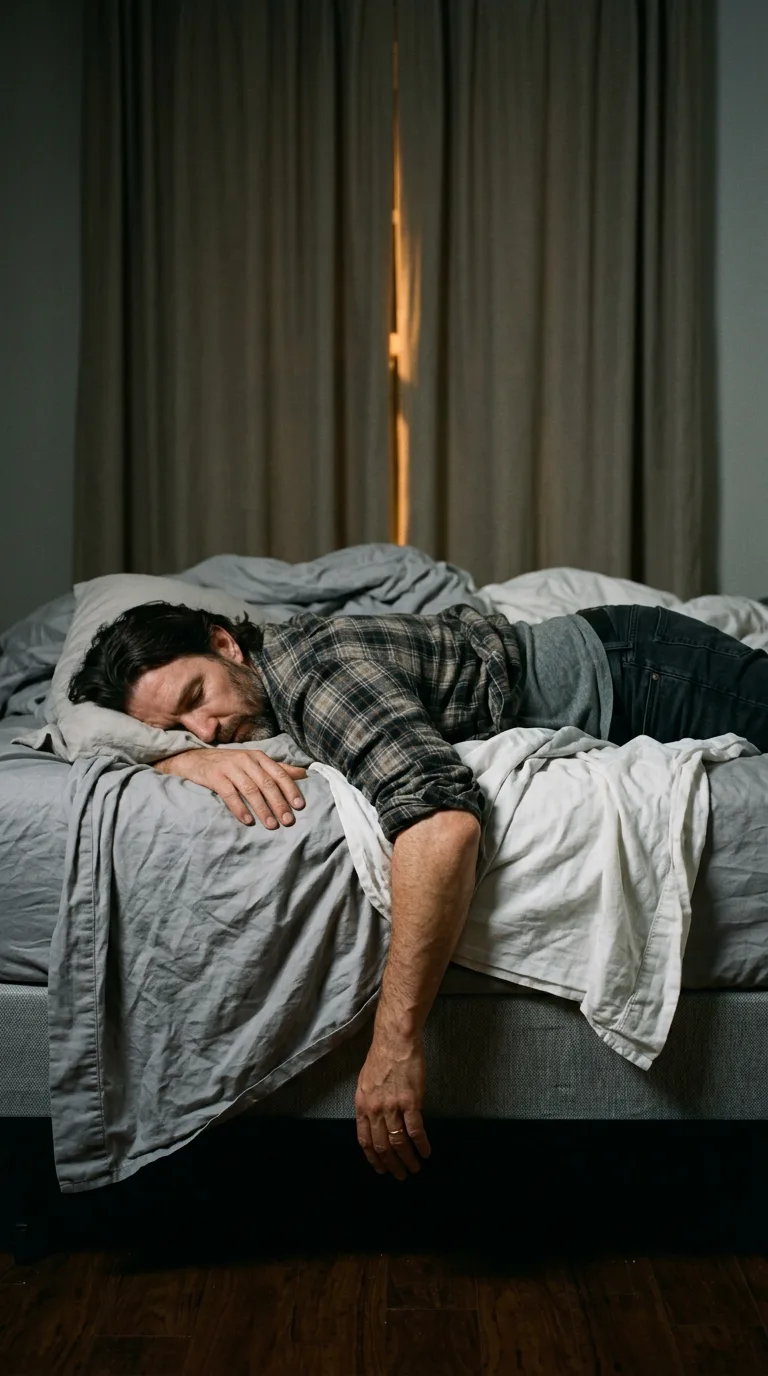
Rarest thing about him: Paramedic — common, 1 in 505
Season 1seed 1096618687 · engine v11
Character card
lineage 2NZHHJ
His body-swap story
@connor.waskiewicz, wearing Warren Aldecott, rolled the wheel on and woke up as Owen Kesteloot, spent under a minute in him, then spun the wheel and woke up as Dale Whitehorse
The apartment in Atlanta smells like takeout going cold, and Warren Aldecott's laptop is still open on the kitchen table showing a bridge tolerance calculation nobody is ever going to finish. It's the middle of the night and every muscle in this body is fine — that's the whole problem with him. Forty-nine and athletic and green-eyed and utterly without a single ache to distract you, and you have been him less than a day and already the rooms of his life feel like somebody else's furniture arranged for your comfort. His ex-wife's name is in his phone under a name that isn't hers anymore. His numbers at work are good. He has done nothing to deserve leaving except that you remember, distantly, in the old flat way you remember everything now, that boredom is the one hunger the wheel always answers. You didn't come here to live somebody's life. You came to feel the door open again. You go to the site with his hands, because they are the hands you have, and you pay, and you spin.
The breath changes first. Ragged, then even, one long pull of cold air that tastes like salt instead of Freon. The hanging arm — not yours, not Warren's, a stranger's forearm gone faintly to sleep — draws itself up off the floor and the whole body rolls onto its back without being asked, and your hands, his hands now, fold themselves at his chest like a man laid out for a wake. Streetlight comes through a gap in the curtain in one bright seam, the way a struck match holds its shape a second before it's only smoke. You are lying in a bed that isn't yours, in a shirt that isn't yours, and somewhere under the ribs a heart is going at a rate that has nothing to do with fear.
It comes in through the flannel first — worn soft at the elbows, one cuff still rolled from yesterday's shift — a smell of antiseptic soap laid over diesel exhaust laid over the specific brine of a dooryard at low tide. Owen Kesteloot. The name arrives with the smell, the way names do here, stitched into a laundry tag on the inside collar in handwriting that isn't his — Lacey's, from years back, marking whose shirt was whose in a house with four people's shirts to lose track of. The flannel remembers being buttoned this morning, if it was morning, if any of this runs on a clock that means anything — a body clocked out at six a.m. after a night tour, the ambulance bay doors grinding up while gulls worked the dumpster behind the co-op, and Owen standing in the parking lot cracking his knuckles one hand at a time before he got in the truck, because his hands do that without him, have always done that, since before Lacey, since before the medic bag, since he was a kid snapping his fingers under the pew during the only years his mother still dragged him to church.
The mattress under him gives up the rest in long unhurried pulls, because there is no hurry here, there is only this held second stretched however far you want to walk it. The house arrives — shingles gone the color of an oyster shell, traps stacked three deep by the back step that he keeps meaning to sell to a real fisherman, a mortgage that never quite closes the gap between what a paramedic makes and what four kids cost, because there are four, the youngest still young enough to climb into their bed during thunderstorms, the oldest already asking about trucks and college money in the same breath. Lacey's side of the bed is a shape gone cool under his palm when he reaches without opening his eyes — night shift means their whole marriage happens in these staggered handoffs, notes on the counter, a hand on the back of his neck at 6:40 a.m. that says more than either of them has said out loud in a year, and it is, somehow, still enough; it has always somehow still been enough. There was a woman before her — Renata, sophomore year, a name that still surfaces sometimes on a bad call when the patient has her eyes, and it costs him nothing now to think of her, only a small clean ache like a tooth he's stopped worrying with his tongue.
The wedding band on the left hand is warm from his own skin, plain, no stone, bought the week before the wedding with money they didn't have, and it brings back the whole church-basement reception in one wash — folding chairs, his mother crying into a paper napkin, Lacey's dress catching on a nail in the doorframe and both of them laughing too hard to be embarrassed. His body is forty-five and unremarkable and it knows things without asking: how to find a vein in bad light, how to talk a man's pulse down over a radio, how to carry weight up a set of porch stairs that always ice first in the dooryard. Nothing hurts tonight. Nothing ever really hurts, just the general low static of a body worked hard and kept anyway.
You sit up. The sheets fall off a chest that has never once slept folded like that, and the room comes into focus the way rooms do now, secondhand — the gap in the curtain, the seam of orange streetlight lying along the floor like something spilled. You lift your hands, his hands, and turn them over, palm up, palm down, the knuckles wanting to crack the way they always do, and you let them, one at a time, the small satisfying give of it traveling up into a wrist that is not the one you had an hour ago in Atlanta.
You look up, past the curtain gap, into the dark where a lens would be if there were one, and you say, quietly, so as not to wake a house full of people who are not yours yet and may never fully be:
"Not yet, Owen. Not yet."