Ovidio Reséndez
Fictional. Generated by AI — not a real person, and no likeness of one is intended.
38, streamer in New York · rolled by @colin.hasbrook · card — no film
History
who has worn him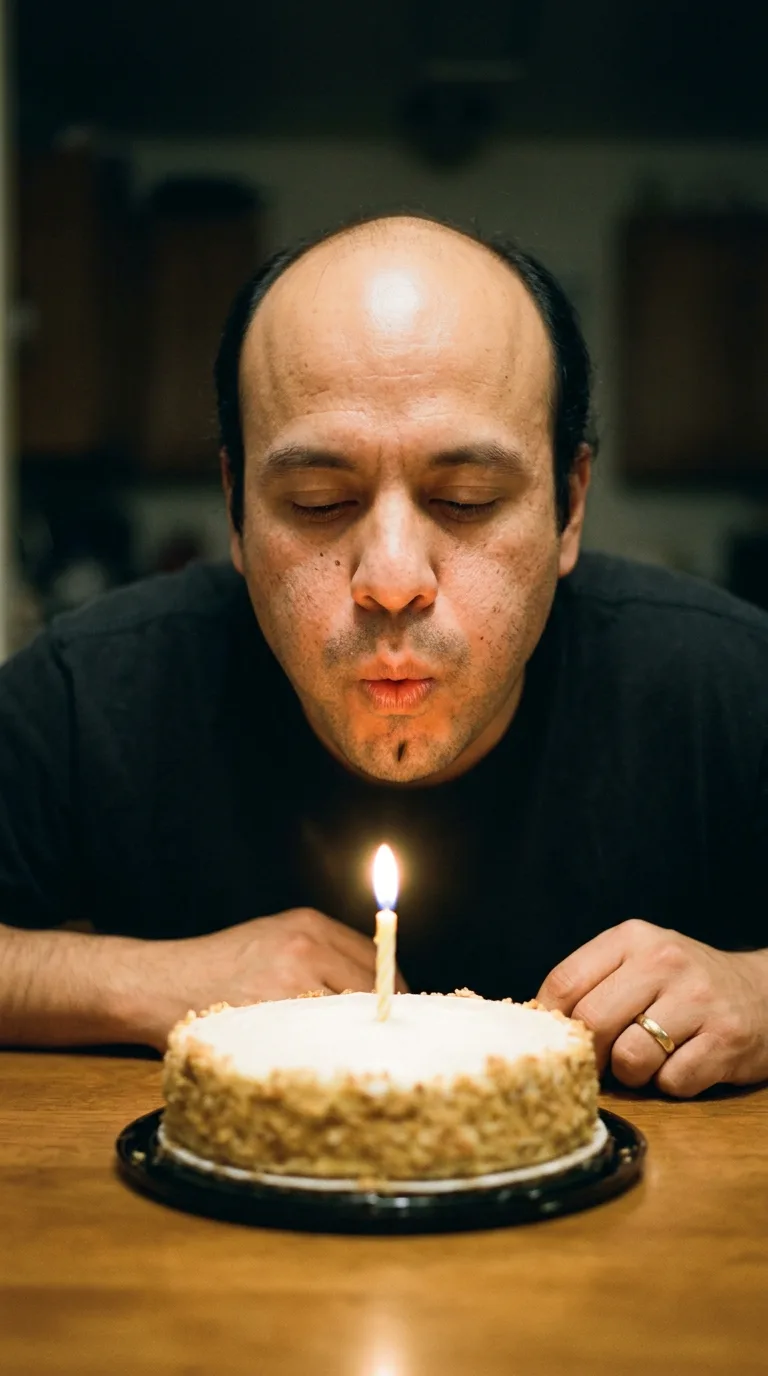
Rarest thing about him: Receding, grown out long — rare, 1 in 76
Season 0seed 156247556 · engine v10
Character card
lineage 2NZHHJ
His body-swap story
@colin.hasbrook, wearing Brendan Ostrowski, rolled the wheel on and woke up as Ovidio Reséndez, spent under a minute in him, then spun the wheel and woke up as Cole Bertrand
---
Eleven at night in Pittsburgh and you are still Brendan Ostrowski, standing in his kitchen in the dark because the fridge light is the only light on, and you are looking at his hands on the counter — thick, nicked up, a scar across the left thumb from a boning knife slipping thirty-one spins ago, or was it thirty-four, you have stopped being sure which memories are original and which are just things you've carried so long they feel like yours. He is thirty, dad-bodied, decent, and less than a minute old in your mouth. You already know the shape of tomorrow in him: four-thirty alarm, the walk-in cooler, the same three guys ribbing him about the Steelers. It is not bad. It is just already worn through in advance, the way a brand-new shirt can still feel like laundry. You are not tired of him. You are tired of knowing what he is before he's finished being it. So you go to the laptop on the counter, the one that isn't his but is now, and you open vessel.cards, and Brendan's hand — your hand, for one more minute — clicks the wheel without hesitation, the way a man reaches for a second drink he's already decided he wants.
The wheel spins somewhere that isn't a place. Then it isn't spinning.
You are bent over a cake. The light above you is off — someone turned it off on purpose, for the candle — and there is a smell of white frosting and grocery-store bakery sugar so sweet it's almost chemical, and your cheeks are full of air you didn't put there. You finish the breath he started. You blow. The flame goes out and the kitchen goes fully dark for half a second, dark the way a room gets when the one light source in it dies, and in that half second there is no you and there is no him, there is only the smoke starting to rise. Then a second breath goes into lungs that are not the ones you left, small lungs, a small chest, and your hand — his hand, a wedding band cold and thin around the ring finger — reaches out on its own first motion and closes around the candle and pulls it up out of the icing. Smoke goes straight up in the still air. Somewhere close, in the dark, a phone camera light is still on, a soft blue-white glow off to the side of the table, patient, recording a birthday nobody's said happy to yet.
The ring is the first thing that talks to you. It is plain, no stone, warmed by a body that has worn it thirteen years, and it comes with a hand already reaching for it in a church in Bensonhurst, a woman named Marisol in her mother's dress let out at the waist, and the particular terror-joy of standing in front of forty people and not screwing up the vows in front of your own mother. Comfortable, that's the word for after — the wedding paid for by her father, the venue photos, both families a little too loud in two different ways. Thirteen years gone through the ring like a wire.
The shirt is next. Black cotton, soft from wear, GAME OVER across the chest in a font he picked because it was funny in 2011 and stayed funny for reasons that have nothing to do with jokes anymore — it's the shirt from the thumbnail of his best month ever, four hundred people in chat, and it is also, underneath that, just a shirt he likes because it is soft and does not itch at the collar the way the good ones from the store do. Putting it on this morning — no, yesterday morning, whichever this is — came with its own small flash: pulling it over his head one-handed in the bathroom mirror, glancing at the hairline he doesn't fight anymore, the long hair at the sides and back that he grows because up top there's nothing left to grow, and thinking, not unkindly, *there he is,* the way you greet somebody you've made peace with.
The chair under you — no, there's no chair, you're leaning on a table, your palms flat on wood that's sticky at one corner with a ring of some old spill nobody's wiped — gives you the apartment. A brownstone floor-through in Brooklyn, walk-up, the rent that made sense five years ago and is a stretch now with three kids eating through it, RGB lights still humming faintly blue-red-blue from the other room where the rig sits, camera pointed at an empty chair because tonight he shut it all down early, for once, on purpose, because it's his birthday and Marisol wanted to do the cake before the two littlest ones went down and the oldest, twelve now, filmed it on her phone rolling her eyes the whole time in a way that is already, this year, more love than embarrassment.
Migraines come up too, faint, a memory of pain rather than pain itself — the aura like heat shimmer at the left edge of everything, three days ago, dark room, ice pack, Marisol's hand flat and cool on the back of his neck not saying anything because there was nothing to say. And under all of it, quieter, an old apartment in Sunset Park that isn't this one, a girl named Deysi who he almost married at twenty-six and didn't, whose name still surfaces sometimes at four in the morning for no reason he'd admit to Marisol, not because he wants her back but because twenty-six was a door and he still remembers which hallway it led off of.
His body: short, five-three, easy to underestimate at a glance and he knows it, has always known it, the average build of a man who used to play rec-league soccer and now mostly sits at a desk twelve hours a day wearing headphones that leave a groove behind his ears. Hands that know a control pad the way the butcher's hands knew a blade — not violent, just practiced, muscle memory built from ten thousand hours of small precise motions. A cleft chin so deep his daughter used to poke it as a baby and laugh.
You straighten up out of the lean. The candle is still in your hand, smoke gone now, just a thin curl of wax smell. You turn the hand over — his hand, small-fingered, the ring catching a little RGB spill from the next room — like you're checking it's real, which it is, more real than anything you brought with you.
You look up into the phone, into his own daughter's camera, and you say, "Make a wish — I already did," and you laugh once, short, not knowing yet whether that was true.