Nathan Sugimori
Fictional. Generated by AI — not a real person, and no likeness of one is intended.
46, surgeon in Anchorage · rolled by @colin.hasbrook · card — no film
History
who has worn him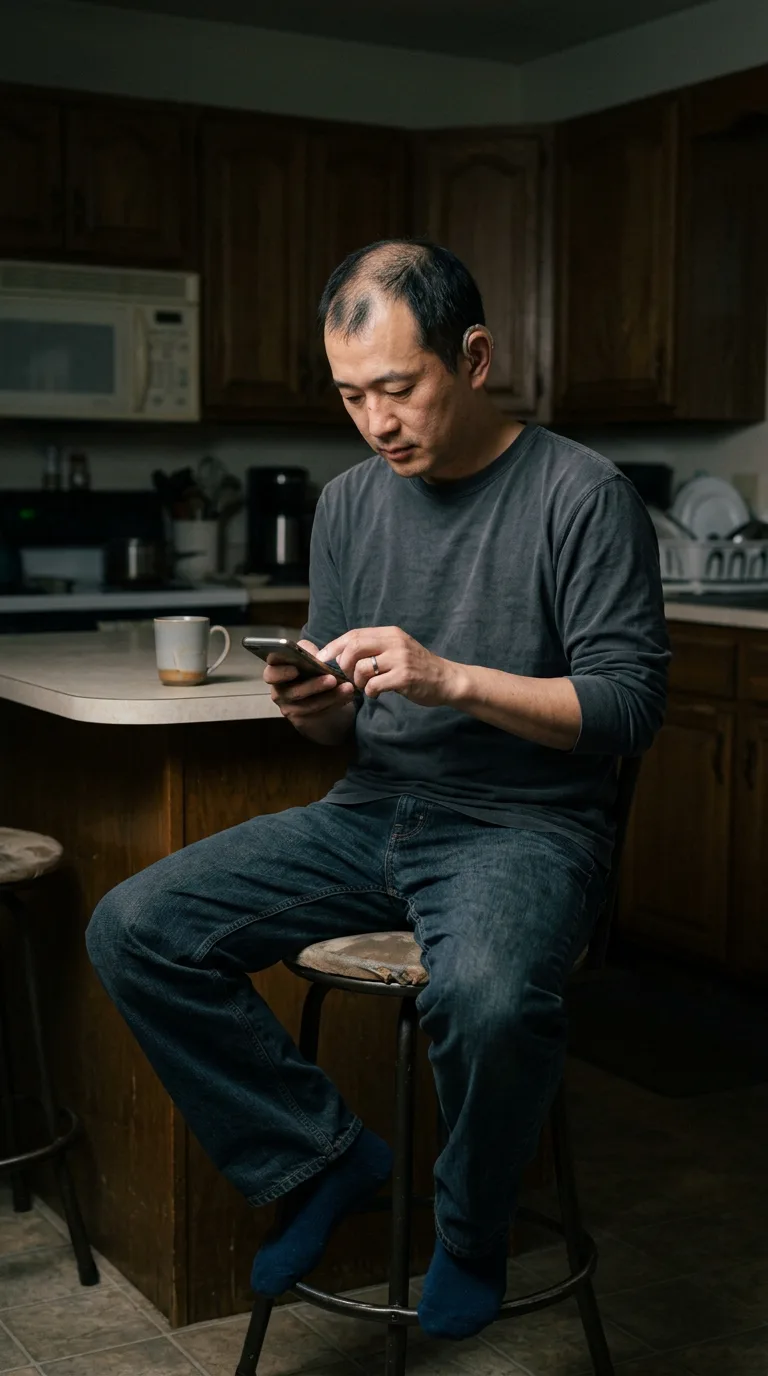
Rarest thing about him: Hearing loss, wears aids — epic, 1 in 165
Season 0seed 286709115 · engine v10
Character card
lineage 2NZHHJ
His body-swap story
@colin.hasbrook, wearing Warren Kaplinsky, rolled the wheel on and woke up as Nathan Sugimori, spent under a minute in him, then spun the wheel and woke up as Dean Rutledge
Warren Kaplinsky's hand is on the mouse for less than a minute before it stops being Warren Kaplinsky's hand. You feel the cleft chin first, always the last thing to leave you, a little dent your thumb finds without meaning to. Forty-four years old, an accountant's soft palms, a bald head shaved smooth under office light in Toronto on a Monday afternoon, and none of it interesting anymore. Warren had good credit and a corner office and a wife who called twice during lunch, and you had already lived his whole shape in the time it takes a coffee to go cold. That's the thing nobody warns you about the wheel: a body stops being a body and starts being a room you've already walked through. You open the site again — vessel.cards, the wheel sitting there patient as a slot machine — not because Warren failed you but because he succeeded completely and there is nothing left to find in a man who holds no surprises. You pay. You spin. The wheel doesn't care that it's the 147th time. It never does.
The kitchen arrives around you mid-breath, and it is not your breath — it is smaller in the chest, older in a way that has nothing to do with years, tired underneath the ribs like a held note. Your thumb is lifted off warm glass, frozen an inch above a price that does not belong to any income you can feel in these hands. The phone turns face-down on tile counter of its own accord, or of the body's accord, muscle finishing a decision made a half-second before you got here. Outside the window it is daylight, flat and heavy, though something in the marrow says it should be dark — the body's clock arguing with the sun and losing. Fluorescent tube in the microwave hood hums. A mug sits with a skin of cold coffee. Wedge of hearing aid warm behind the left ear, tucked in like it's always been there.
The sweater is what opens first — worn thin gray cotton, soft with age, and through it comes a hand not his own, a husband's hand, working this same sleeve down this same wrist on a morning eight years back, laughing about something neither of you remember now, only the laughing. You are standing in Nathan Sugimori's sock feet on cold linoleum and the socks alone bring back a hallway, small and dim, a boy's nightlight glowing under a door, the particular hush of checking on a sleeping child at 2 a.m. after sixteen hours in a theater where you'd held someone's opened chest in your two hands and closed it again, successfully, and driven home not knowing your own name for a second in the driveway. Two kids. A boy and a girl, and their photographs are magneted to the fridge behind you, just out of the frame of what you're touching, but you don't need to touch them — the wanting to protect them is already sitting in the sternum, permanent, like a second heartbeat.
The ring is the loudest thing. Plain gold band, left hand, and it has been turned — you can feel the groove worn into the pad of the thumb from years of turning it without thinking, a tell he doesn't know he has, a nervous tic that survived medical school, survived the crooked nose (broken playing basketball at nineteen, badly set by an ER resident more tired than he was, and he'd never bothered to fix it, wore it like a small joke on his own vanity) — the ring has been turned in traffic, in waiting rooms, in the dead fifteen minutes outside an OR while someone else finished closing. His husband gave him this ring in a courthouse in a state that didn't used to allow it, and the whole memory arrives folded into the metal itself: fluorescent light, a clerk who cried more than either of them, a party after with too much cake and not enough chairs, and Nathan — sober the whole night by decision, watching everyone else get warm and loud on champagne — thinking he had never in his life been so unbothered by being the only sober person in a room.
The counter under his palms is the same laminate that watched him build a life he can't quite afford in a city that costs what it costs because there's nowhere else to be a surgeon in this state. Doing well, on paper — the letters after his name worth more than most people make in a decade — and still scrolling a watch he will never buy, in a kitchen with a microwave from another decade, doing math against a mortgage that eats what surgeons are supposed to have left over. Nothing tragic in it. Just a man closing a phone he doesn't need to check again.
You look down. The hand turns the ring once, out of habit that isn't yours yet but is already comfortable, already correct, like the body taught you the gesture before you asked for it. You lift your eyes to the dark reflection in the microwave door, the closest thing to a mirror in the room, and you say, to no one, in a voice with a rasp under it you didn't know you'd be given —
"Okay. Not yet."
Not a promise. Not a length of time. Just the shape of one, sitting where a decision hasn't been made.