Michael Sartori
Fictional. Generated by AI — not a real person, and no likeness of one is intended.
40, butcher in Chicago · rolled by @colin.hasbrook · card — no film
History
who has worn him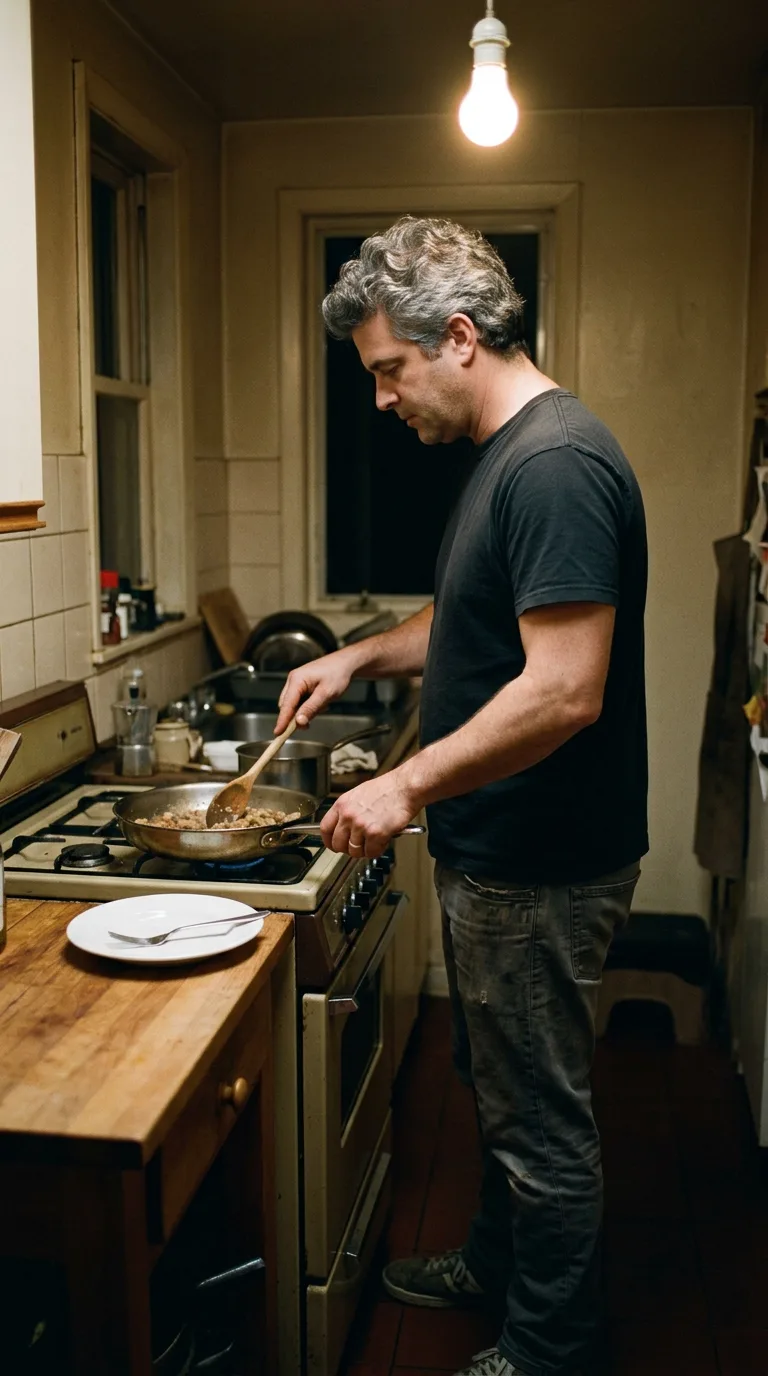
Rarest thing about him: A recent ex — rare, 1 in 20
Season 0seed 85226277 · engine v10
Character card
lineage 2NZHHJ
His body-swap story
@colin.hasbrook, wearing Colby Rasnick, rolled the wheel on and woke up as Michael Sartori, spent under a minute in him, then spun the wheel and woke up as Warren Nakashima
The hives are quiet at this hour, which is the only reason you can think at all. You have been Colby Rasnick for three minutes — his knees still faintly bent from the crouch he was in, his forearms still humming with the smoker's smoke, his chest still rising on someone else's rhythm — and already you know this was not the one. Twenty-six is supposed to feel like something. It feels like waiting for a truck to arrive. You stand in his dark kitchen in his boxers with his phone's light in your face, the wheel already loaded on the screen, and you think: not boredom exactly. Just that a beekeeper in New York at three a.m. has nothing left to do tonight but sleep, and sleep is the one thing you can't stand to do in a body that isn't going anywhere. You spin because it's there. You spin because four hundred and thirty-eight men were not enough to make you stop wanting to know what four hundred and thirty-nine feels like.
The wheel clicks down through names you'll never learn and lands, and the kitchen you were standing in is gone before you finish the thought.
Your hand is already moving — a wooden spoon, small circles, going one way — and it stutters, catches, reverses, and keeps going the other way, as if the hand itself needed a second to remember whose it was. Weight settles into you low and even, shorter than you were, thicker through the middle, feet planted in worn boots on a floor gone slightly tacky with age. Steam off the pan smells like onions gone translucent, something browning underneath. A bare bulb burns overhead on a cord, throwing your shadow long across a butcher-block counter with one white plate already set on it, a fork beside it, waiting.
You salt the pan without tasting it — his hand does it, not yours, some instinct older than you arriving in the wrist — and then that same hand reaches up into the cabinet above the stove and comes down with a second plate, and sets it next to the first, and you don't know yet why you did that.
The spoon is the first thing that talks to you. Worn smooth on one edge from years of scraping the same corner of the same pan, and it gives you, all at once, a kitchen in daylight, this kitchen, but younger — a woman's laugh somewhere behind you, a kid's sneaker skidding on the tile, someone saying *Dad, you're burning it, you're always burning it* — and then it's gone, folded back under the steam. The shirt against your back is next, soft with washing, and it gives you a closet, gray light through a window, an arm going into a sleeve slow because the shoulder underneath it aches in the mornings now in a way it didn't used to. Forty does that. You feel it in this body plainly — a low ache along the spine from standing all day, feet that know concrete the way other men's feet know grass, a strength gone quiet in the forearms from years of a blade instead of a gym.
The apron hook by the door — empty now, coat on over a T-shirt instead — gives you the shop: a counter of trays, a saw gone still at six, the cold rolling off the case into your shins all day until you stop noticing it. Cracked hands from the cold, cracked knuckles from a habit you didn't choose, some tension living permanently in the fingers that only lets go when they're doing something. Small talk with customers you've called by name for a decade. A ring line on the left hand, pale, no ring — that one arrives with weight: a woman's voice on a phone, calm, done, *I already told the kids, Michael* — and under it, more recent and rawer, someone else's voice, someone who mattered less on paper and more in the ribs, saying she needed something you didn't have left to give her. You feel both losses at once, dulled now, familiar, the kind of ache you've learned to cook dinner around.
Two kids somewhere in this city tonight, doing homework in a house that isn't this one, and you feel — not yours, his — the specific loneliness of a Monday when it isn't your week. A drink he already had, one, sitting warm in the stomach. A church basement on Sundays, a folding chair, a prayer he says out of habit more than belief some weeks and pure need on others. A prescription bottle in the medicine cabinet he doesn't hide from anyone anymore.
And under all of it, plain and recent: he set two plates because some nights the muscle memory of a family still moves his hands before his mind catches up, and he lets it, because it doesn't cost him anything to feed a memory that isn't coming to dinner.
You look down. The spoon is still in your hand, mid-air, sauce cooling on the wood.
You turn your hand over slowly, like it might tell you something the spoon didn't, and your eyes come up off it into the dark window over the sink where his reflection is standing instead of him.
"There you are," you say, to no one in the room, and you don't know yet if you mean it as an ending or a start.