Michael Ryan
Fictional. Generated by AI — not a real person, and no likeness of one is intended.
62, paramedic in High-desert Nevada · rolled by @colin.hasbrook · card — no film
History
who has worn him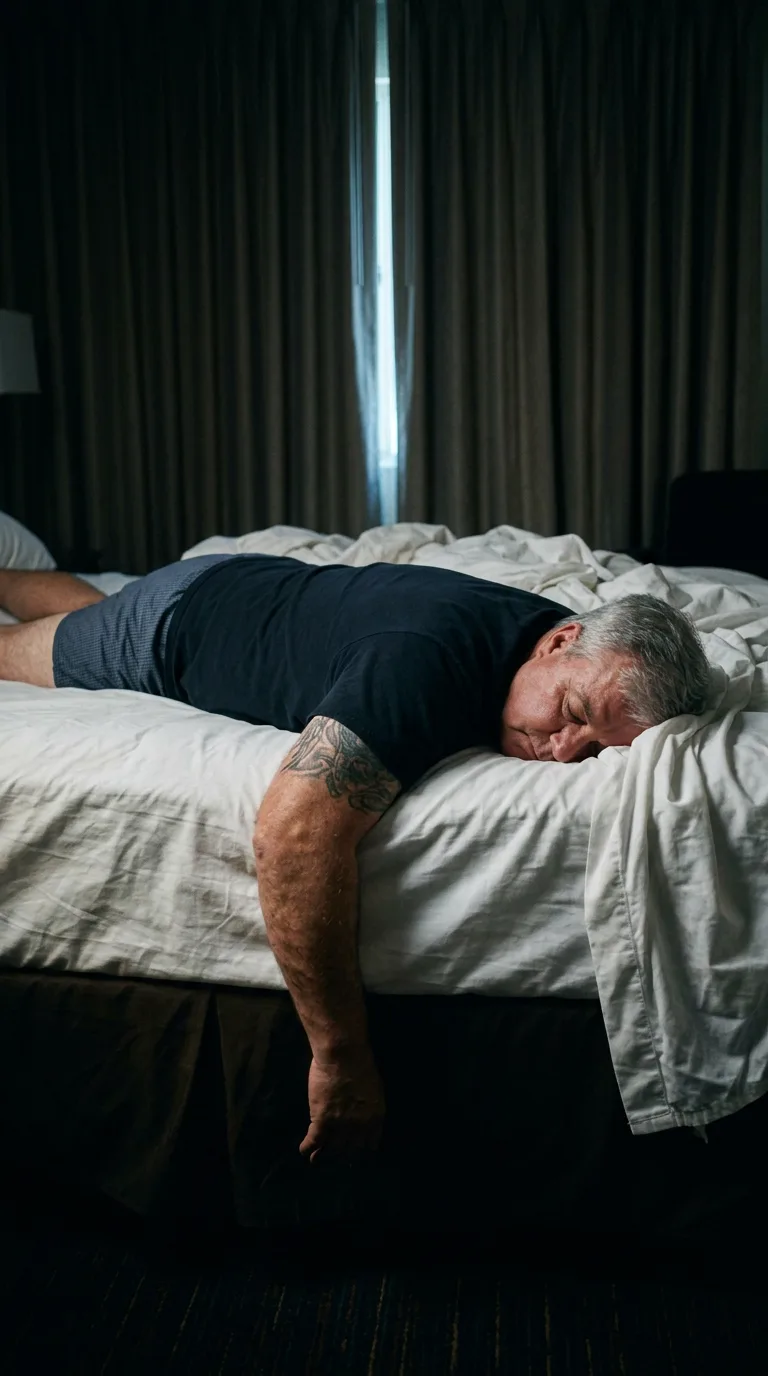
Rarest thing about him: Paramedic — rare, 1 in 106
Season 0seed 409510273 · engine v10
Character card
lineage 2NZHHJ
His body-swap story
@colin.hasbrook, wearing Trevor Guillory, rolled the wheel on and woke up as Michael Ryan, spent under a minute in him, then spun the wheel and woke up as Arjun Deshmukh
Trevor Guillory's apartment smells like bleach and old coffee, and you have been standing in his kitchen for forty seconds doing nothing but hating the smell. It is not his fault. He kept it clean, the beauty mark on his cheek, the dad bod he never worked at fixing, the whole soft tired shape of him — none of it is his fault, because there is no *him* left to fault. That's the thing that gets you, on night two hundred and ninety-three of being a man who isn't there. You did the dishes in his sink an hour ago because your hands — his hands — knew where the rack went without asking. That's when it turned. Not boredom, not exactly. It was the *competence*. Wearing a life that already runs itself, that already knows its own cabinets, feels like living in someone else's grief. You want, for one more night, to be inside a body that is tired in a way you understand — not soft-tired, but *used*-tired. You open the laptop already knowing what you're going to do. The wheel loads slow on his ancient charger. You spin it standing at his counter, in his kitchen, in his life, already gone before it lands.
The breath changes first — ragged, then even, one long pull that isn't yours becoming yours. The hanging arm lifts off the mattress like it was called. Your back rolls into the sheets, hands finding your chest and folding there, a shape this body has never once made in sleep. Streetlight comes through a gap in the curtain in one thin blade across the ceiling. Somewhere outside, sagebrush and hard-packed dirt and a highway with nothing on it. You are heavy in a new way — not soft, dense, a big man's weight settling into a mattress that already knows his shape from twenty years of nights just like it, except none of them like this one, because he has never slept on his back with his hands folded like a man in a casket.
It comes in through the sheets first, cheap cotton gone thin at the corners, and it's laundry day, a Tuesday, the machines at the trailer park clubhouse older than he is, quarters lined up on top like a shrine. It comes in through the pillow, through the smell of it — Irish Spring and diesel exhaust that never fully washes out no matter how many times the shirts go through — and there it is, the shirt, hanging on the closet door where he left it after this morning's shift, sleeve by sleeve: left arm first, always left, a habit thirty years old, shoulder patches cool against the bicep, then the right, then the buttons up from the belly because a big man buttons from the bottom so the shirt doesn't fight him at the gut. The pen goes in the pocket before the badge, never after — he learned that lesson once, badge first, jabbed himself, laughed about it to a partner twenty years dead of a heart he saw coming on a hundred other men and never once looked for in himself.
The knees ache with the memory and it isn't a memory, it's *here*, right now, this exact spine, this exact hip that clicks getting out of the rig. Sixty-two years in a shift that starts too early and a body that answers anyway, because that's the job, because that's always been the job. There's a call this afternoon — a woman on Route 6, chest pains that turned out to be nothing, thank God, and the relief of that sits warm somewhere behind the sternum, mixed in with ten thousand calls that weren't nothing, that never leave, that are just there now, filed and quiet and his. There's a daughter in Reno he talks to on Sundays and a son who doesn't call much and neither of those facts hurts as bad as it should, not tonight, because tonight there is nothing but the folded quiet of a man asleep too early because graveyard eats a person from the inside and he has done graveyard for six years now with a body that keeps voting no.
There's a woman, once — not a wife, never a wife, an old girlfriend whose name comes up through the pillowcase like a bruise you press on purpose, gentle and full of something that isn't quite regret. Fifteen years since, and still the reflex, still the ghost of a Sunday drive to a diner she liked. And under it, quieter, the knuckles — his hands cracking themselves without him, mid-sentence, mid-thought, an old habit nobody has ever once mentioned to his face, and you feel the joints pop now, phantom, though these hands are folded still on the chest and not moving at all.
The cholesterol pill is on the counter in the next room, waiting for a morning that hasn't happened yet in his clock, though somewhere behind your eyes it is already dusk turning to true dark, high desert cooling fast, and the shadows outside are long and blue and hard-edged the way they get out here and nowhere else.
You open your eyes. The ceiling is wrong for New Orleans and exactly right for a single-wide on blocks. You bring your hands up off your chest — his hands, thick-fingered, a plain silver watch loose on the wrist — and you turn them over slowly in the thin light, and they don't answer to anything you know yet, not the way Trevor's hands did after two hundred nights of practice.
"There you are," you say, to no one, to the ceiling, to whatever's left listening — and you don't know if you mean him or yourself, and you don't have to decide tonight.