Melvin Katz
Fictional. Generated by AI — not a real person, and no likeness of one is intended.
62, call center agent in Small-town Ohio · rolled by @colin.hasbrook · card — no film
History
who has worn him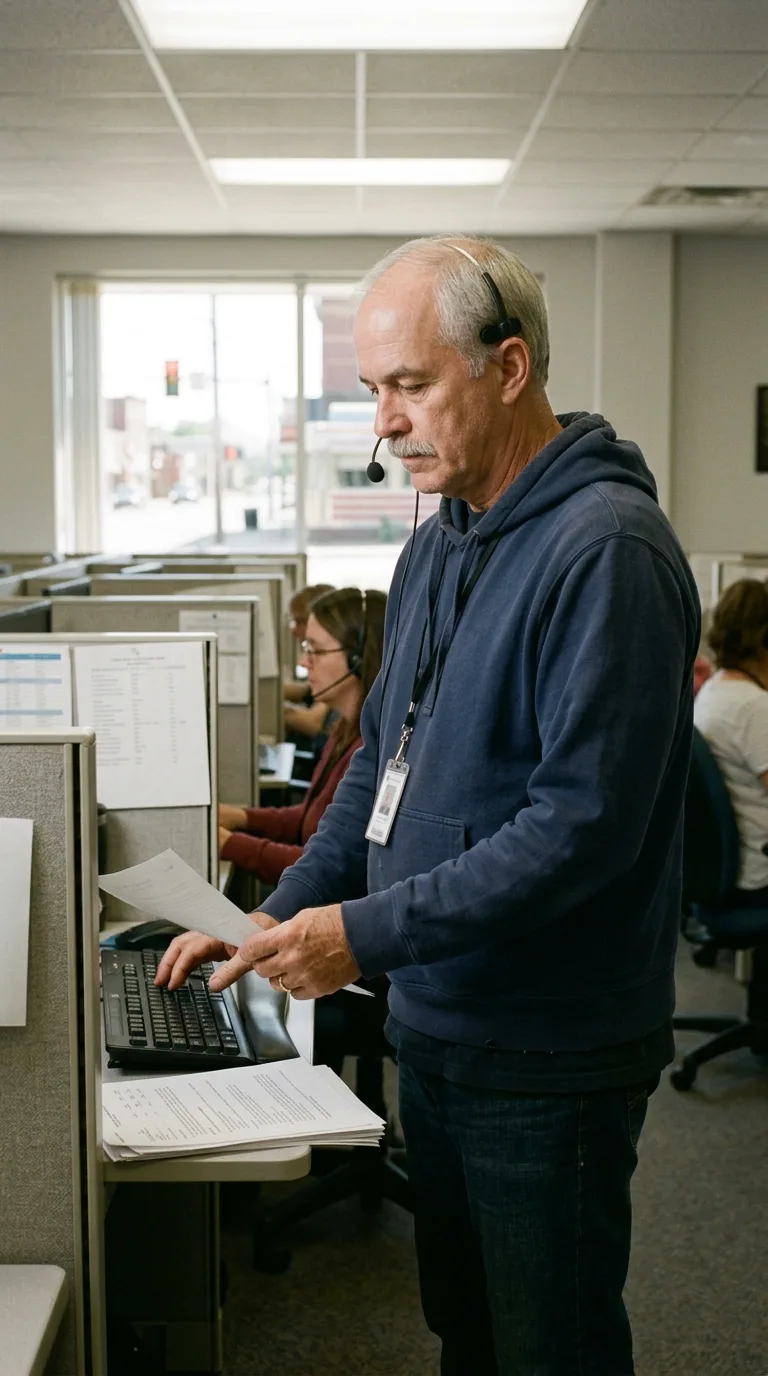
Rarest thing about him: Platinum / silver — uncommon, 1 in 101
Season 1seed 1173858959 · engine v11
Character card
lineage 2NZHHJ
His body-swap story
@colin.hasbrook, wearing Gregory Sandoval, rolled the wheel on and woke up as Melvin Katz, spent under a minute in him, then spun the wheel and woke up as Isaiah Muñoz
The truck idles at the loading dock, and Gregory Sandoval's shoulders — your shoulders, for another forty seconds — ache in that clean, honest way that comes from a body that gets used. It is eleven in the morning in Los Angeles. You have been him less than a day. He is bald by his own razor, bearded, blue-eyed, built like the job wants him built, and there is nothing wrong with him. That is the trouble. Nothing is wrong with him, and you have learned already, eight hundred times over, that nothing wrong is not the same as something you want. You spin because a good body is a room with no window. You want the window. You do not say this to yourself in words. You just find your hand already in your pocket, already holding the phone, already at the page with the wheel on it, before the truck's even in park.
The wheel spins. It does not care what you had.
—
The correction fluid pen is between two fingers, capped, forgotten mid-thought, and there is a stapled packet under your other hand, and a chair that was rolled back from under you because this body does not sit while it thinks. One motion happens wrong — the pen taps the desk on the wrong side, a stapled page turns backward — and then, carefully, it turns forward again. Ten more motions come out of you slow and checked, one at a time, like a man reading his own handwriting for the first time. A headset sits warm against your ear, someone's voice already in it, mid-sentence, waiting on you to answer a question you did not hear asked. Down the row, fluorescent light. Outside a window you have not looked at yet, a stoplight, red.
—
The lanyard is the first thing that gives you anything — the cheap nylon of it against your collarbone, a small weight, and it opens like a door left on the latch. Katz. Melvin Katz. Nine years on this floor, four before that at the plant in Zanesville before the plant closed, and before that a hundred rooms this handling doesn't reach yet. The headset mic brushes your mouth and there's a whole shift folder behind it — the particular tiredness of saying "I understand your frustration" in the same tone for the two-thousandth time, the trick of nodding at no one because nodding helps the voice come out kinder.
The wedding band is what does the real work. It's loose enough now to turn with a thumb, and turning it gives you Carol whole — not a summary, an actual morning, her at the counter in a robe the color of weak tea, laughing at something on the radio with her head tipped back, and then, without warning because grief in this body never asks first, a room with machines in it and her hand gone slack in yours and how long after that the band stayed in a dish by the sink before you put it back on because taking it off felt like the second funeral. Nobody at this job knows that story. A man two cubicles over calls him "Mel" forty times a day and does not know it.
The hoodie remembers itself onto you: pulled over a t-shirt in a bedroom with beige carpet, in a house too big now for one, the drawstring already frayed from being tied and untied for years, a smell of the same detergent his wife used to buy because he never found a reason to switch brands. Under it, your shoulders — narrower than the ones you left, softer — and a low ache low in the back that has been there since some year you can't pin exactly, and knees that announce themselves on the stairs and are silent everywhere else. Fine hair, thin on top, a scalp that gets cold in a way it didn't at forty. The moustache is the one vanity left standing; his hand goes to it sometimes without meaning to, checking it's there, the way another man checks his own reflex is still quick.
There's a son somewhere in this — a photograph he keeps face-down in a drawer at home for reasons that are more complicated than anger, a phone number he has and does not use, a Friday candle he still lights alone though the shul is fifteen minutes gone and he only makes it twice a year now. None of it comes through violently. It comes through like weather, the way all of it does: present, familiar, his.
The paper in your hand is a script for a call about a billing dispute, and your fingers already know where the hold button is without your eyes checking, thirty years of hands that learned this kind of work in one plant or another and never really stopped.
—
You look down at the hand holding the correction pen — spotted a little at the knuckle, the ring loose, a stranger's hand doing exactly what it's always done, without you — and then you look up, past the cubicle wall, out through the window at the one stoplight on the one street, red, going green, nobody stopping for either.
"Carol," you say, quiet, not really meaning to, "I got it, I got it," to the empty desk, to the headset, to no one at all — his voice out of your mouth for the first time, already halfway back to the call on hold, already forgetting, the way he always forgets, that he said it.