Mauricio Salcido
Fictional. Generated by AI — not a real person, and no likeness of one is intended.
28, cattle rancher in Phoenix · rolled by @connor.waskiewicz · card — no film
History
who has worn him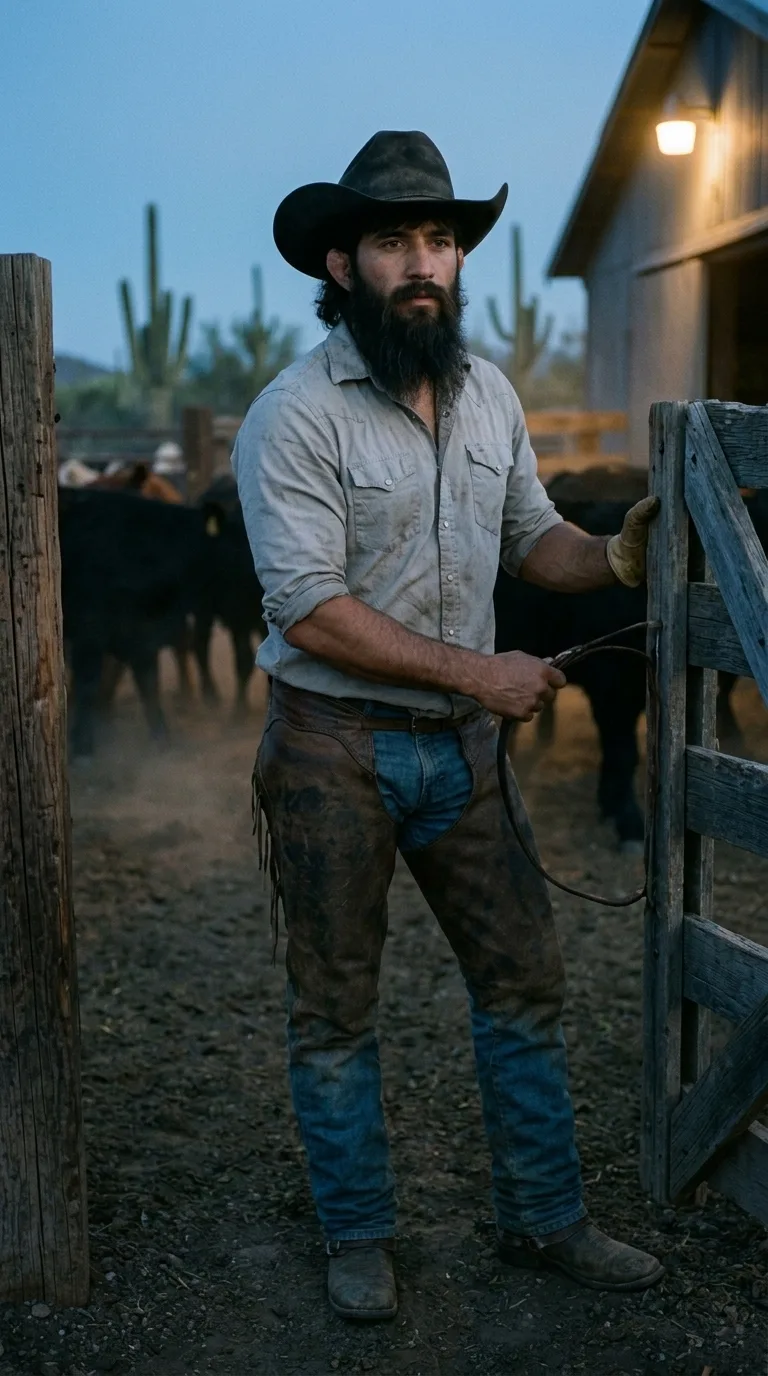
Rarest thing about him: Cauliflower ear — uncommon, 1 in 161
Season 1seed 874988373 · engine v11
Character card
lineage 2NZHHJ
His body-swap story
@connor.waskiewicz, wearing Colton Brewer, rolled the wheel on and woke up as Mauricio Salcido, spent 5 minutes in him, then spun the wheel and woke up as Leonard Tackett
You were Colton Brewer for less than a minute, and the whole of what he gave you was a dorm-room dark and a thumb that already knew the phone. Eighteen, soft where he should have been hard, and the first thing his body did with you was ask for food. That was not why. You sat on the edge of a stranger's bed in Las Vegas before the sun, and the wanting came back the way it always does, flat and total, like a tap you forgot was running. He had nothing wrong with him. He just was not enough to stay in, and you knew it by the time the page loaded and the wheel began to turn.
Then there is no room. There is dusk, blue and cold at the edges, a bulb burning over a barn door, and a gate under your gloved left hand. Your right holds a coil of rope, wet-stiff with age. Cattle shift in the dust behind you, a low continuous grumble, and the smell comes up at once: manure, dry creosote, hot leather that has not finished cooling from yesterday. The rhythm breaks in your hands. You drop the latch wrong, the bar skidding, and you do it again slowly, correctly, and then ten more times, each one checked, because you do not trust this body yet and it has never once needed checking.
The glove is a stiff, sweat-darkened thing, and when your fingers close inside it something opens. His father's glove, no: a glove his father would have laughed at, bought at a feed store on a payday, and the feeling is pride so small and private it embarrasses him. Then the rope. Rope burn in a different year, a heifer pulling, his own shout, a boy's voice cracking, and a neighbor's hand on his shoulder saying *lean back, lean back, let her tire.* He leaned back. He remembers the exact weight of leaning.
The shirt against your back is soft with a hundred washes and gritty at the collar. Sleeve by sleeve it gives him up. Her hand on the button at his cuff in a dark kitchen, the girlfriend, her voice low, "roll them, you always forget." He rolled them. He stood in the kitchen with the coffee going and the window still black, and she was warm in a T-shirt, her hair against his beard, and he thought *I am late and I do not care.* Then the chaps, buckled in the barn: leather cold as a stone, the snap of the belt, the strap over the thigh. Then the jeans, stiff at the knee from yesterday. Then the spurs he does not really need, because the horse is lame and he wears them anyway, for the sound.
Your feet are planted, and the boots hold you up. There is a ringing ache across the shoulders, a deep tired muscle that is strong anyway. Short legs, a low center, a body built to pull and hold. The beard is heavy on your chest and the fringe is damp on your brows. You touch the side of your head and find the ear: thick, ridged, lumpy as gristle. A mat room, a boy's elbow, a laugh, and a ribbon he did not keep. It does not hurt. It is simply his, and now it is yours.
The number under all of it, his and unspoken: the loan on the truck, the feed bill, the balance that sits there and does not move. He carries it like the rope, without looking.
You lift your right hand out of the glove's shadow and turn it over. Callus along the base of every finger, a crescent of dirt under each nail, the knuckles scraped pale. You close it. It closes.
You look up at the cattle, at the bulb, at the cactus standing black against the blue, and you say, quietly, "Okay. Let's see how long you let me."