Leonard Tackett
Fictional. Generated by AI — not a real person, and no likeness of one is intended.
53, assembly line worker in Eastern Kentucky · rolled by @connor.waskiewicz · card — no film
History
who has worn him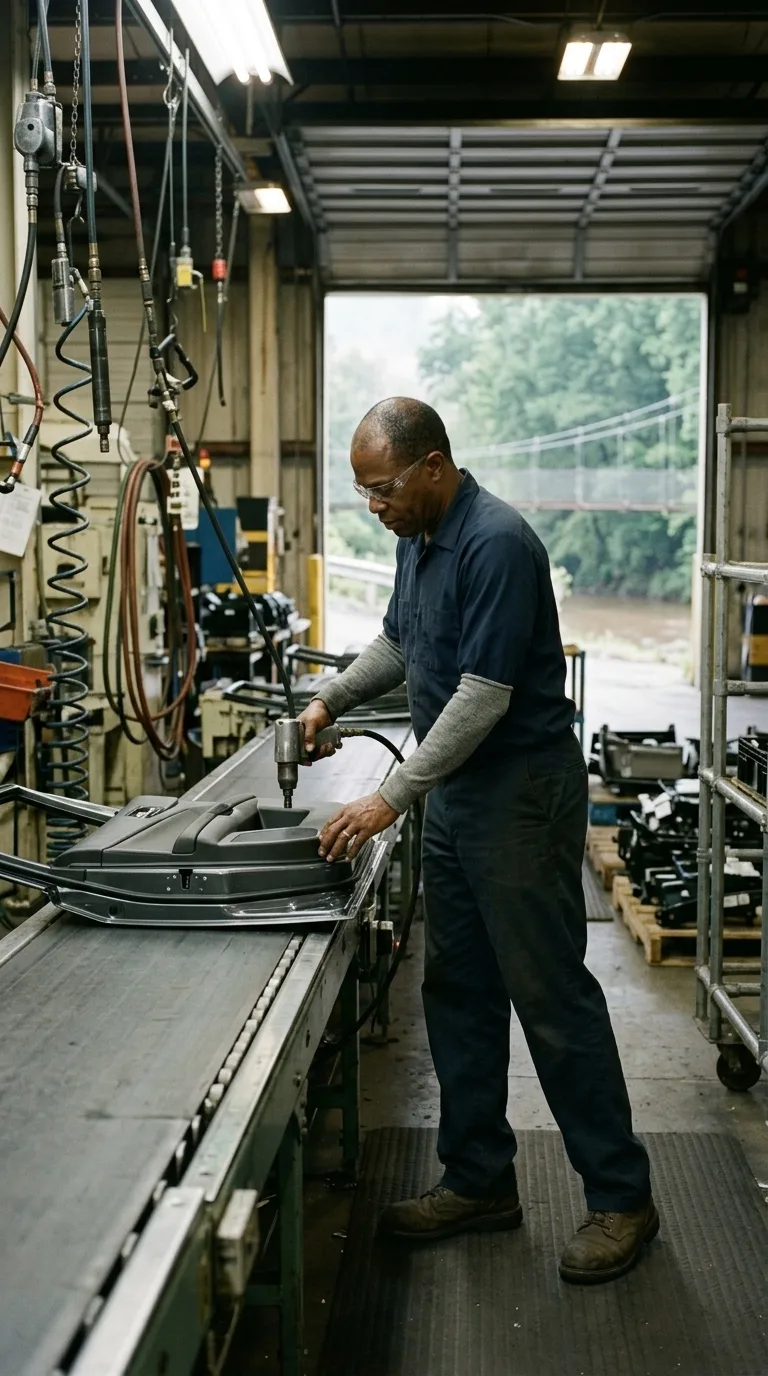
Rarest thing about him: Dimples — common, 1 in 13
Season 1seed 2126189779 · engine v11
Character card
lineage 2NZHHJ
His body-swap story
@connor.waskiewicz, wearing Mauricio Salcido, rolled the wheel on and woke up as Leonard Tackett, spent under a minute in him, then spun the wheel and woke up as Terrence Oyelaran
You have been Mauricio Salcido for five minutes, and already the beard is a nuisance. It is early, still dark over Phoenix. The corral gate is cold under his palm, the cattle are shifting in their own warmth, and the ear he got in some fight you never saw rings faintly when the wind turns. He is strong. His shoulders carry the morning without complaint. You do not feel like leaving him for any reason you could say out loud.
But you were standing at the gate with a bucket of feed, and the animals pressed in, and you had the thought you always have. It is not boredom, and it is not that he is too little or too much. Something is off about being known by a thing that large and warm that trusts you. A heifer leaned her whole weight on your thigh, and you did not want to be the one she trusted. So you set the bucket down and took out the phone with his cracked screen. The wheel is already turning under your thumb. It clicks over a name you will never hear, and the gate is gone.
A hum. A cold slab against your fingertips, a tool heavy in your right hand, air hissing in the hose. A panel is sliding toward you, and your hand has already done something to it, wrong, a quarter-turn early. The body knows it before you do. You stop. You do it again, slowly. Then ten more, and each one you check, because you are checking it, and he never once had to.
Your leg is bouncing. It has been bouncing the whole time, a small steady drum from the heel inside the boot, and you let it, because it is his.
The grey sleeve on your forearm is knitted and tight at the wrist, and touching it opens something. A morning, a kitchen. His fingers working it over the hand because the cold line floor bites at the joints. Before that, the pressed navy shirt, buttoned from the bottom, because the top button is the one that takes patience. He stood a long time at the sink afterward, shaving, slow, careful, a habit left from the years when somebody else would look at his jaw and say something. The smooth skin tingles now. The dimples, he knows, are there even when he is not smiling, and he used to hate it on the days he was grieving, a face that would not agree.
The tool's grip is worn to the shape of him. It gives you a Saturday, a truck bed, a girl in a church dress, and then a second, and a third, three children lined up on a tailgate eating peaches while he said grace over them a little too long. Their mother laughs. It is the same laugh, years on, on the phone, saying his name flat and tired about money. Under the ring finger the skin is pale where the band was, and it itches like something missing. He took it off in a parking lot and sat there until the engine ticked cold.
Cigarettes: a craving in the back of the throat, eleven years old and still not dead. Whiskey he never touched, because his father did. A pew, a hymn, his knee going the whole sermon. Feet sore on the mat. Lower back dull and honest. Fifty-three years, and every one of them is in the hips.
Through the open bay door there is a brown creek and a cable bridge in green shade. He crossed it this morning. You know that now.
You lift your hand off the panel and turn it over. The palm is broad, the knuckles thick, a stranger's, and yours.
"All right," you say, in a low easy voice that is not yours either. "Let's see how long you hold."
The panel comes down. Your leg keeps drumming. You cannot tell yet whether you will still be here when the shift ends.