Mauricio Delgado
Fictional. Generated by AI — not a real person, and no likeness of one is intended.
21, plumber in Western Kansas · rolled by @connor.waskiewicz · card — no film
History
who has worn him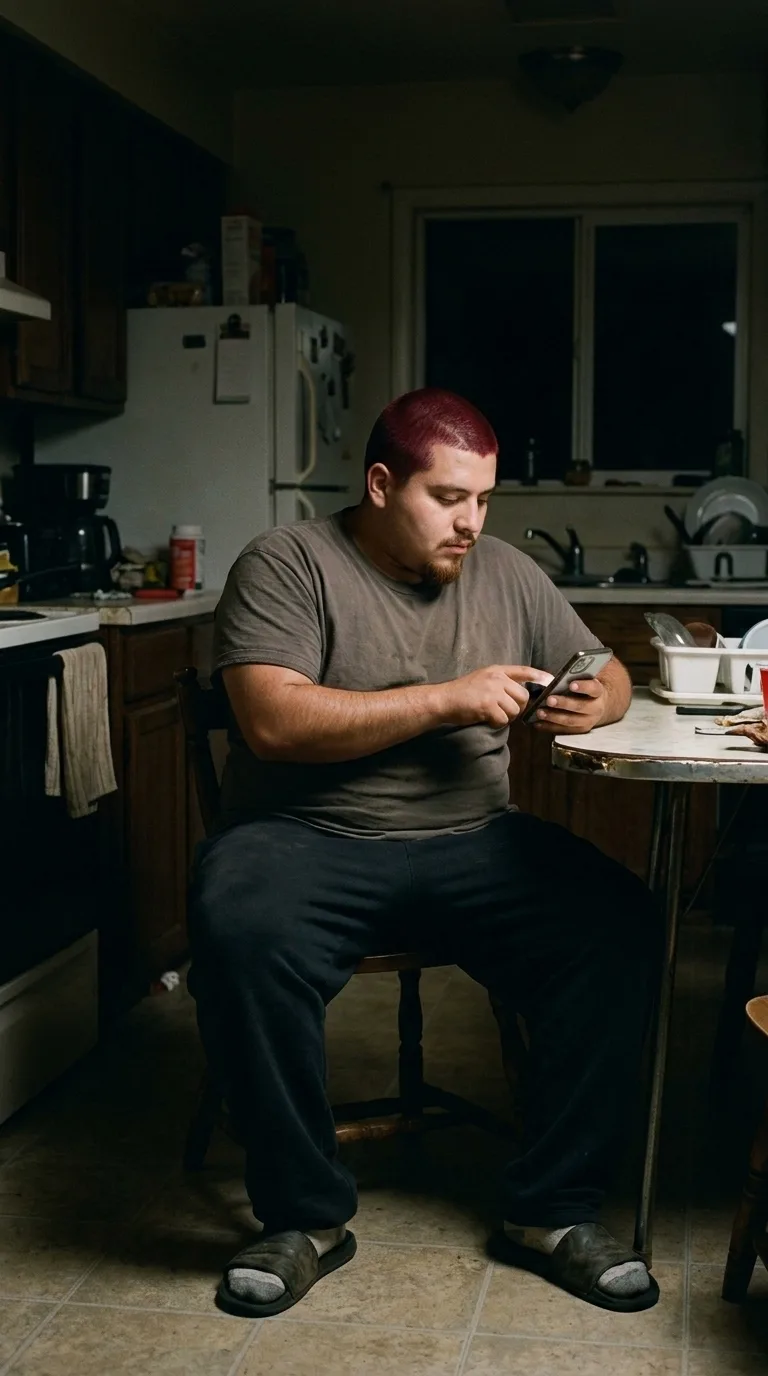
Rarest thing about him: Dyed red — uncommon, 1 in 154
Season 1seed 1742230924 · engine v11
Character card
lineage 2NZHHJ
His body-swap story
@connor.waskiewicz, wearing Walter Chiang, rolled the wheel on and woke up as Mauricio Delgado, spent under a minute in him, then spun the wheel and woke up as Lyle Danforth
Walter Chiang's knees are bad, and you have been feeling them for most of the night. You are standing in his hallway in New York, in the dark, with his hand on the wall where the paint has worn smooth from a lifetime of other hands. You have been him for under a minute and already you know the trouble. He is a man who answers email in his sleep. His wife's coat is on the hook, and the white patches on his forearms catch the nightlight like spilled milk. Nobody is wrong in this house. It is that all of it fits you exactly as a coat fits, and a coat is not a wanting. Something in you had said, quietly, that you only wanted to see how it felt to be someone who couldn't be taken apart by a price. You open the page. The wheel is already turning under your thumb, and you let it.
The chair under you is hard wood, and your thigh is warm against the seat. The phone is in your right hand, and the scroll has stopped on a number that is more than a month of rent. Your thumb lifts off the glass. It stays lifted. Then the phone goes face-down on the counter, a small flat knock, and your hand stays where it set it down.
The kitchen is dark except for the little light over the stove. A refrigerator hums. You are heavy in the chair, and heavy is not the same as weak: the weight sits low and steady, and your forearms are thick and dense. Your breath comes slow, with a faint ache under the ribs from sitting bent.
The shirt is the first thing, thin cotton gone soft against your back, and it opens like a drawer. This morning, his hands. The left sleeve first, because he always does the left first, then the overalls from the hook by the door, stiff with old dirt, the brass buttons cold. He stands on one foot to push the other into a boot, and the bad ground-in smell of it is the smell of a day he is not dreading. A bathroom, a stranger's house, a woman who offers him water and he says no, ma'am, I'm good. He lies under her sink with the flashlight in his teeth and the trap comes free in his hands, and he is happy. Nobody tells you that about a trade: the pleasure of a thing that was stopped and now runs.
Your right thumb moves on the counter and finds a pen there. Click. Click. It is an old habit of his hands, and it goes through you like a hymn. The sweatpants are worn at the knee. Under your feet the tile is cold through the sandals' thin socks. Church comes, folding chairs, his mother's hand around his wrist during the long prayer, and a feeling like being held down kindly. Then the watch. He saw it in a window once in Wichita and stood there until his reflection embarrassed him. It is not greed, it is wanting to be a man whose wrist says he arrived somewhere.
His scalp is warm and prickly under your palm, the red buzzed close. The goatee is rough against your knuckle. Outside, a long way off, wheat stubble and a sky he hasn't looked at yet tonight.
You lift your hands into the stove light and turn them over. Thick fingers, calluses along the pads, a pen pinched in them. Then you look up, at nothing, at the black window, at the face you can feel on your own face.
"Okay," you say, in his low voice. "Okay. You'll do."
And under it, already, the question: how long.