Mateo Ybarra
Fictional. Generated by AI — not a real person, and no likeness of one is intended.
24, warehouse picker in Small-town Ohio · rolled by @connor.waskiewicz · card — no film
History
who has worn him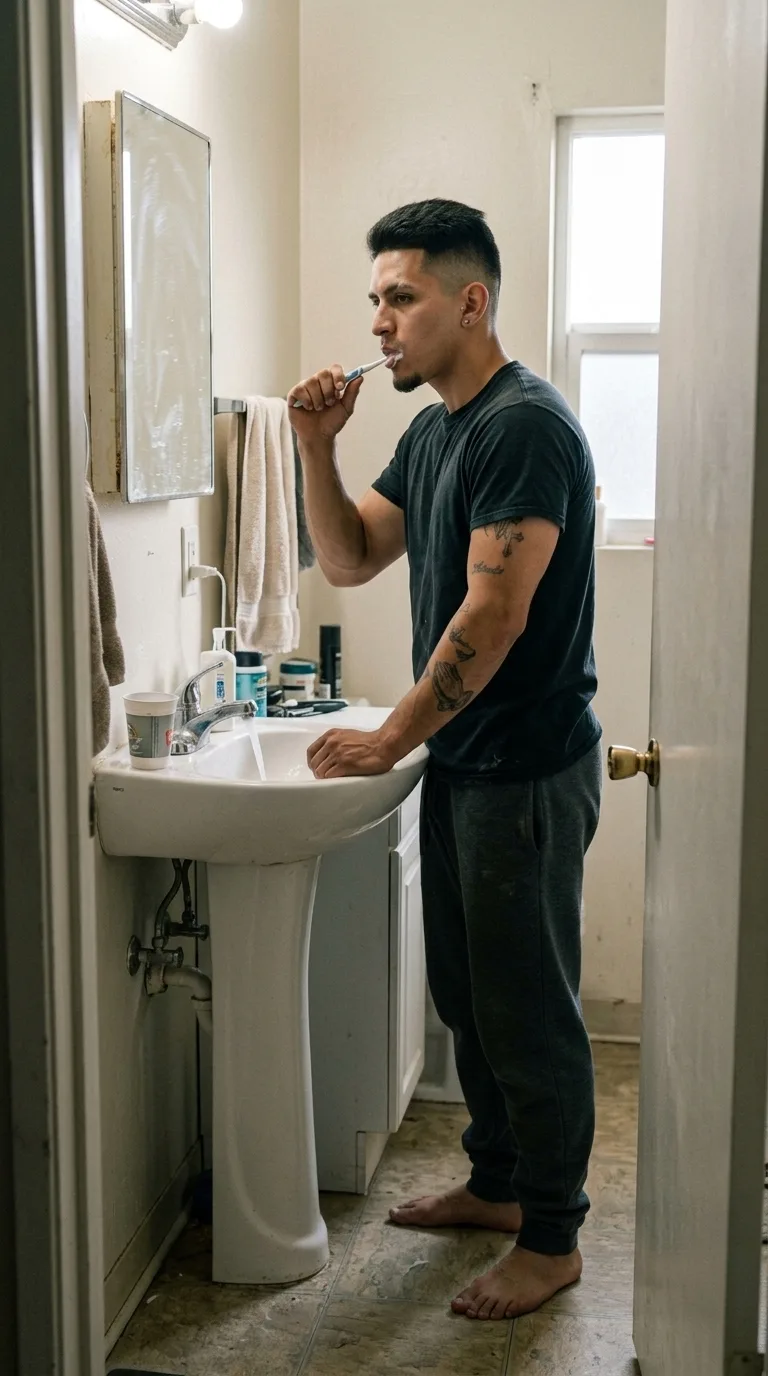
Rarest thing about him: Chinstrap — uncommon, 1 in 93
Season 1seed 2084770407 · engine v11
Character card
lineage 2NZHHJ
His body-swap story
@connor.waskiewicz, wearing Gary Lindahl, rolled the wheel on and woke up as Mateo Ybarra, spent 34 minutes in him, then spun the wheel and woke up as Esteban Rojas
Gary Lindahl's knees hurt on the stairs, and that is not why you are going back. You are standing at the kitchen counter in the Sunset house, before the fog has lifted off the street, with a mug of coffee going cold in a hand that has a wedding-ring groove and no ring. His reading glasses are pushed up in his silver hair. Four, five minutes in him, no more, and you have already learned the thing a manager's body knows: it is tired in advance. It has a calendar in its chest. A nine o'clock, a ten-thirty, a performance review he dreads. You could sit through all of it. You do not want to. You set the mug down and the phone is already in your hand, and the wheel is already turning on the page.
Then the sink.
The brush stops mid-stroke. Cold porcelain under your left palm, tap running, foam on your lip, and your own weight arrives on bare feet on cold tile. You start again on the other side, slower, working the back molars. You rinse twice. You stand the brush bristles-up in the paper cup, out of the grey water where it has always sat.
Mint, and under it the old damp of a bathroom with one small window going pale.
The sweatpants first, soft and thinned at the knee, and with them: a Tuesday, him pulling them from the dryer still warm because the heat in this apartment goes off at night. He slept in them. He sleeps in them most nights. The cotton against your thighs carries a tiredness that is not yours, the good tiredness of a body that lifts for a living.
The shirt, black, worn to a thin softness across the shoulders. It gives you a morning, the one that happened a few hours ago or maybe is about to: him reaching for the orange-yellow vest on its hook by the door, because the shift starts early, because the warehouse runs ahead of the sun. In his hands the vest is a habit, one arm and then the other, the mesh catching on the cross inked on his forearm. His mother gave him that cross, or the idea of it. A church with folding chairs, hymnals with cracked spines, her hand flat on his back in the pew. The praying hands came later, after a bad winter, after a night he doesn't tell anyone about, a night of a friend's truck and a ditch on a county road and nobody hurt. He got them done two weeks after. Mainline, plain, a Methodist hush. He goes at Christmas. He still bows his head before he eats alone.
The porcelain under your palm gives you the tap-room smell of the Friday he lets go once or twice a month, a big night, the cheap beer, the laughing, the walk home down a main street with one stoplight blinking yellow at nobody. The diner there is closed now. He used to eat eggs in it with a man who called him kid. He still looks at the dark windows.
Your fingers want to crack. They do it without asking, knuckle by knuckle, a small wet pop, a habit older than you. The body is strong in a way that makes the manager's feel borrowed from a museum. Shoulders loaded, forearms dense, a little ache in the lower back from yesterday's aisles, reaching, bending, the scanner on his wrist chirping. Somewhere in his head a forklift beeps out of sight, the sound he carries home.
The scar through the eyebrow: you touch it and get a bike, a curb, gravel, eight years old, his brother laughing and then not laughing. Blue eyes in the mirror, a stranger's, his mother's.
Twenty-four. Scraping by, a little saved, nobody waiting. The apartment is quiet in a way he has made peace with and not quite.
You turn off the tap. You look at your hands, the cross, the prayer, the scar of a knuckle, and turn them over. Then up, into the glass.
"Okay," you say, low, in a voice that is not yours. "Okay, Mateo."
Somewhere behind the wanting is already the faint hum of the page, and how long this one holds, or whether you'll be him tomorrow, is a question your thumb is already near.