Marvin Okonjo-Little
Fictional. Generated by AI — not a real person, and no likeness of one is intended.
57, delivery driver in Boston · rolled by @jaylen.okonkwo · card — no film
History
who has worn him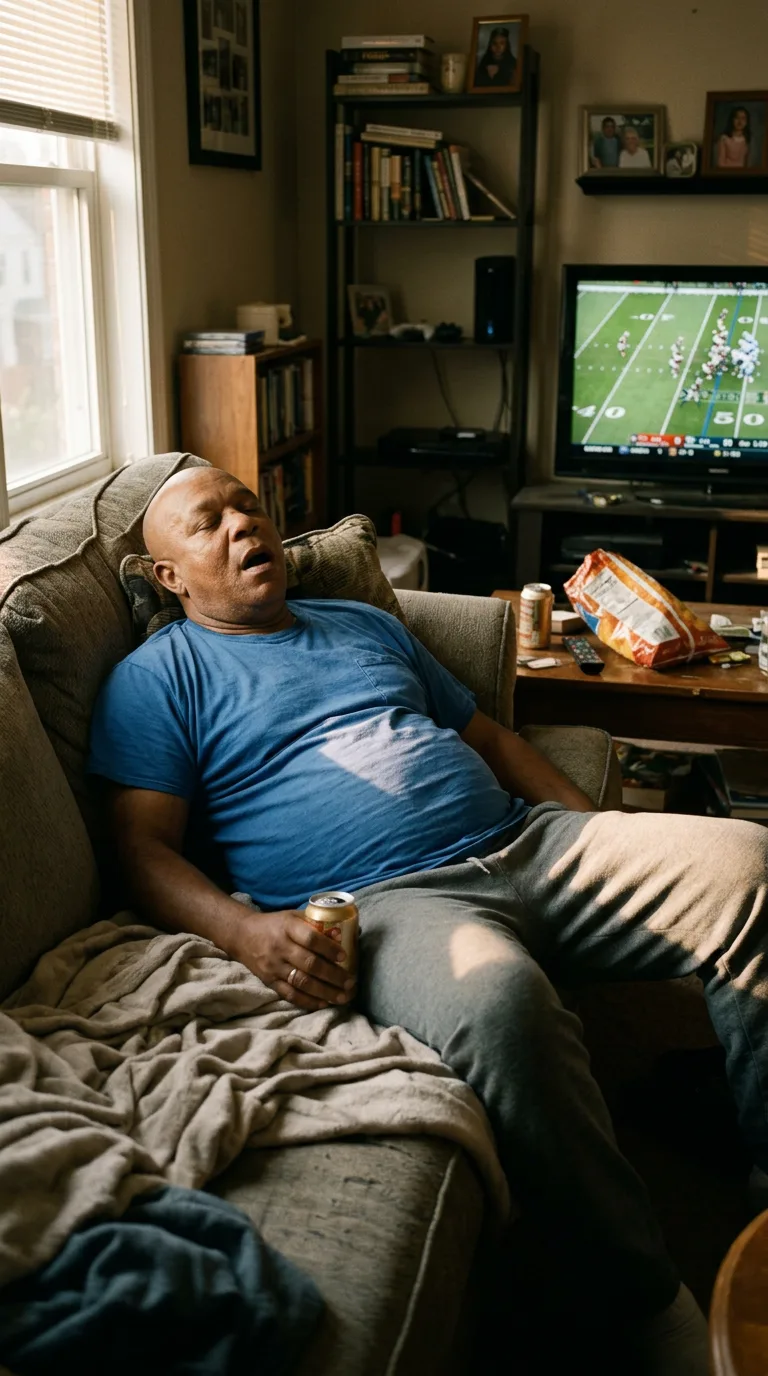
Rarest thing about him: Latter-day Saint — common, 1 in 64
Season 1seed 1337893626 · engine v11
Character card
lineage Q3AZ7V
His body-swap story
@jaylen.okonkwo, wearing Gerald Shinkle, rolled the wheel on and woke up as Marvin Okonjo-Little
---
Gerald Shinkle's hand finds his own scalp before he remembers he has hair now — stubble, not the smooth dome he spun away four minutes or four days ago, he's lost count already. The apartment is Philadelphia-bright, blinds up, a Sunday doing nothing to earn itself. He stood in this body for two days and nineteen hours and it bored him the way a borrowed coat bores you on the third wearing: fine shoulders, nothing wrong with it, just not his, never his, and underneath that the small itch he won't name, which is that a sales rep's apartment on a sales rep's income is a story he's already finished reading. He wants the part before the ending again. He wants not to know what happens. He sits on the edge of Gerald's bed, phone propped against a lamp, and pulls up the wheel on vessel.cards with the particular calm of a man who has done this enough times that his hands don't shake anymore, and some other part of him notes, distantly, that they used to.
He spins.
—
The couch takes your weight before you've finished arriving, which is backwards, which is wrong, except it isn't, because this weight was always going to be here, slumped and warm and heavier through the gut than Gerald ever got. A can tips in a loose hand. Mouth open. The room smells like dust on a radiator and whatever browned in a pan three hours ago. On the screen a kickoff return is already dying at the twenty-two, and some reflex that isn't yours yet gets the thumb moving toward the remote a half-second before the second replay, and you watch, through eyes that are not adjusting so much as arriving mid-blink, the ball cross the goal line a second time, flat and silent and already decided.
The body exhales through its nose. Settles the volume down two clicks. Doesn't know yet that it is being driven by someone who has never scored anything in it.
—
The shirt is what opens first — a soft stretched blue T-shirt, washed four hundred times, and in it there is a Tuesday from some April, pulling it over his head in the grey upstairs bathroom with the fan that doesn't vent right, Denise's hairdryer going in the next room, him catching his own crooked nose in the mirror and not minding it the way he used to not mind it, the way a man stops auditing his own face somewhere in his forties. The nose: broken by a cousin's elbow in a driveway basketball game in 1986, set a little off at the walk-in clinic by someone's uncle who used to be a corpsman, and never fixed because fixing it felt like vanity and vanity wasn't a thing Marvin Okonjo-Little spent money on.
The can in the hand — warm, half her brand because the store was out of his — brings back a whole year of Sundays he didn't know he'd kept: two kids loud in the kitchen before they were a nurse in Providence and a kid still figuring himself out in a dorm in Amherst, and him on this same couch, this same slump, this same game on, because Sunday was the one day the truck stayed in the lot and his body got to just be a body instead of a tool with a barcode scanner holstered to it. The scanner isn't on him now — that lives in the other life, the Monday-through-Saturday one, six years at it after the warehouse let him go, his knees audibly unhappy about every flight of porch stairs in this city, his lower back a conversation he has with himself every morning instead of with God, though he has that conversation too, daily, on his knees before the shift, because the Church asked that of him before the job ever did and he never saw a reason to drop one for the other.
The ring. Left hand, plain band, decades thin from being touched. Denise, nineteen-eighty-something, a chapel wedding, her hand shaking worse than his because he'd never once in his life been less than sure. No drink at the reception because he's never had one, not once, not out of judgment of anyone, just a boy who grew up watching what it did and decided young he didn't want the demonstration repeated in his own house. No cigarette ever between these fingers either — the hand that's holding the can has never held anything that burned down to nothing on purpose.
The couch under him, the blanket half over his legs, the window's grey Boston light on the blinds — all of it says afternoon, says day off, says a man who worked nights all week catching the only daylight sleep he's going to get before Monday starts the loop again, and some other knowledge arrives with that, foreign and quiet: this is morning for him by the body's clock even as the sun outside argues otherwise, a man's whole week bent sideways by a schedule that doesn't care what the sky is doing.
—
Your hand — his hand — comes up on its own first, the old unthinking habit, palm dragging once over the bald scalp like checking it's still there. Then you notice you did it. You turn the hand over in front of your face, studying the ring, the thick fingers, the nick of an old box-cutter scar along the side of one knuckle that isn't written down anywhere but is real all the same, because this hand has opened ten thousand packages that weren't his.
You lift your eyes to the dead black mirror of the turned-off phone on the armrest, close enough to catch a reflection, and you hold there.
"Huh," you say, out loud, to no one, in his voice, flat with something that isn't quite his wonder and isn't quite your own. "Didn't feel a thing."