Marlon Etienne
Fictional. Generated by AI — not a real person, and no likeness of one is intended.
30, fisherman in New York · rolled by @marlon.etienne · card — no film
History
who has worn him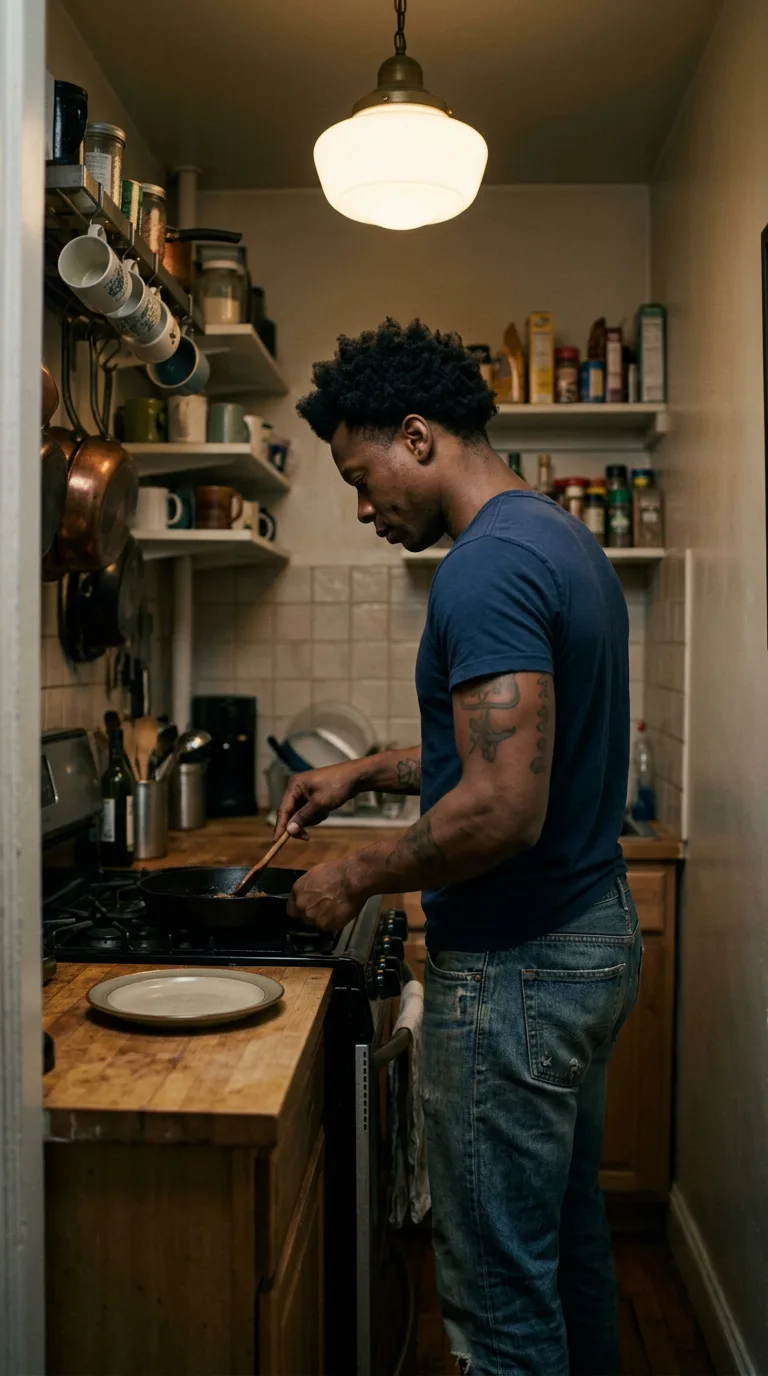
Rarest thing about him: Fisherman — uncommon, 1 in 137
Season 0seed 1363559253 · engine v10
Character card
lineage 6PRR5R
His body-swap story
@marlon.etienne, wearing Colton Vandermark, rolled the wheel on and woke up as Marlon Etienne, spent 8 minutes in him, then spun the wheel and woke up as Héctor Villagrán
The machine floor is quiet at this hour, before the shift horn, and Colton Vandermark's hands smell like cutting oil no matter how long he stands under the shower. Eighteen years old in a body that isn't the one you started with, and already the newness has worn thin the way it always does — the ache in the lower back from the lathe, the boredom of a face that gets carded at the liquor store and laughed at for it. You spun the wheel seventeen times looking for something that would hold your attention past a week. This one didn't even last that. You are standing in his kitchenette at five in the morning, Colton's shift starting soon, and instead of getting dressed you open the laptop balanced on the microwave and go to the page with the wheel on it, because the wanting came back the way it always does — quiet, and then all at once, like hunger you didn't notice building.
You pay. You spin. There is no drumroll, no ceremony, just the small download-chime the site always makes, and then —
You are stirring. Your own arm, brown-skinned, corded with a fisherman's muscle, is moving a wooden spoon through a pan of something that smells like garlic and peppers, and it is your back that is turned to the room, and the stirring stops mid-circle. You start it again the other way, as if some part of him is still trying to finish the motion he was in. You salt the pan without tasting it. Then, without deciding to, your hand goes up to the cabinet and brings down a second plate, white, chipped at the rim, and sets it down next to the first one on the counter, side by side, close enough to touch.
The overalls aren't on you — they hang somewhere off a hook by the door, you'll learn that in a second — but the gray thermal is, sleeves shoved to the forearm, and it's the shirt that gives you the first flash: a woman's hands smoothing this same collar down, laughing, the smell of her shampoo, a name you don't have yet sitting behind your teeth like a held breath. Marlon. You are Marlon Etienne, thirty years old, and the shirt remembers her before you do.
The rest comes in through your palms. The spoon handle, worn smooth where his grip always falls, gives you four in the morning on the boat, the deck lit orange, hauling net heavy enough to drop a man twice his size, and the particular satisfaction of muscle doing what it's built for — this body strong in a way Colton's never was, compact, low to the ground, made for balance on a pitching deck rather than for looking tall. Your knees know a hundred mornings of cold spray. Your shoulders know the rope. There's a rosary somewhere in a drawer you haven't opened yet, and just thinking toward it gives you a flash of his mother's kitchen in Flatbush, incense and Sunday Mass and her hand flat on his back saying you'll be fine, baby, everybody's sad sometimes — the pills in the medicine cabinet, taken quietly, on schedule, a small daily discipline nobody at the dock would guess he needed.
The counter under your other hand gives you her — Danielle, six months gone now, the smell of her perfume ghosting through this kitchen for weeks after she took her toothbrush and left the ring behind on the windowsill like it was something he should feel guilty about, which he did, for a while. You feel, distantly and not your own, the specific loneliness of cooking a meal built for two out of habit, muscle doing what love used to do, before either of you noticed the plate had come down twice.
The apron string looped over the oven handle gives you the morning he put this shirt on, sleeve by sleeve, humming something off the radio, the curl of his hair still damp, dimples showing in the mirror before he'd even smiled at anything — they show at rest, they always have, people mention it before they mention his name. Your face is doing that right now, dimpled and slack and unaware, over a stove that has gone quiet under the pan.
You look down. These hands are shorter than Colton's, darker, calloused hard across the palm in a way that has nothing to do with any gym, nicked white in one place along the thumb from a hook that got away from him once. They are not shaking. They know how to tie a bowline without looking and you do not, yet, and that gap between what the hands hold and what you know feels like the truest thing about him you've been given.
You set the spoon down on the little ceramic rest by the stove. You turn, slow, toward the two plates sitting side by side, close enough to touch, waiting on a counter for someone who packed a toothbrush and is not walking back through that door tonight or any night.
"Guess I'm still setting two," you say, out loud, to no one, in his voice, and it comes out sounding like it surprised him too — and somewhere under that, unspoken, is the other math already running: how long you'll let this one cook before the wheel calls you back.