Marcus Whitfield
Fictional. Generated by AI — not a real person, and no likeness of one is intended.
60, manager (mid-level) in Miami · rolled by @colin.hasbrook · card — no film
History
who has worn him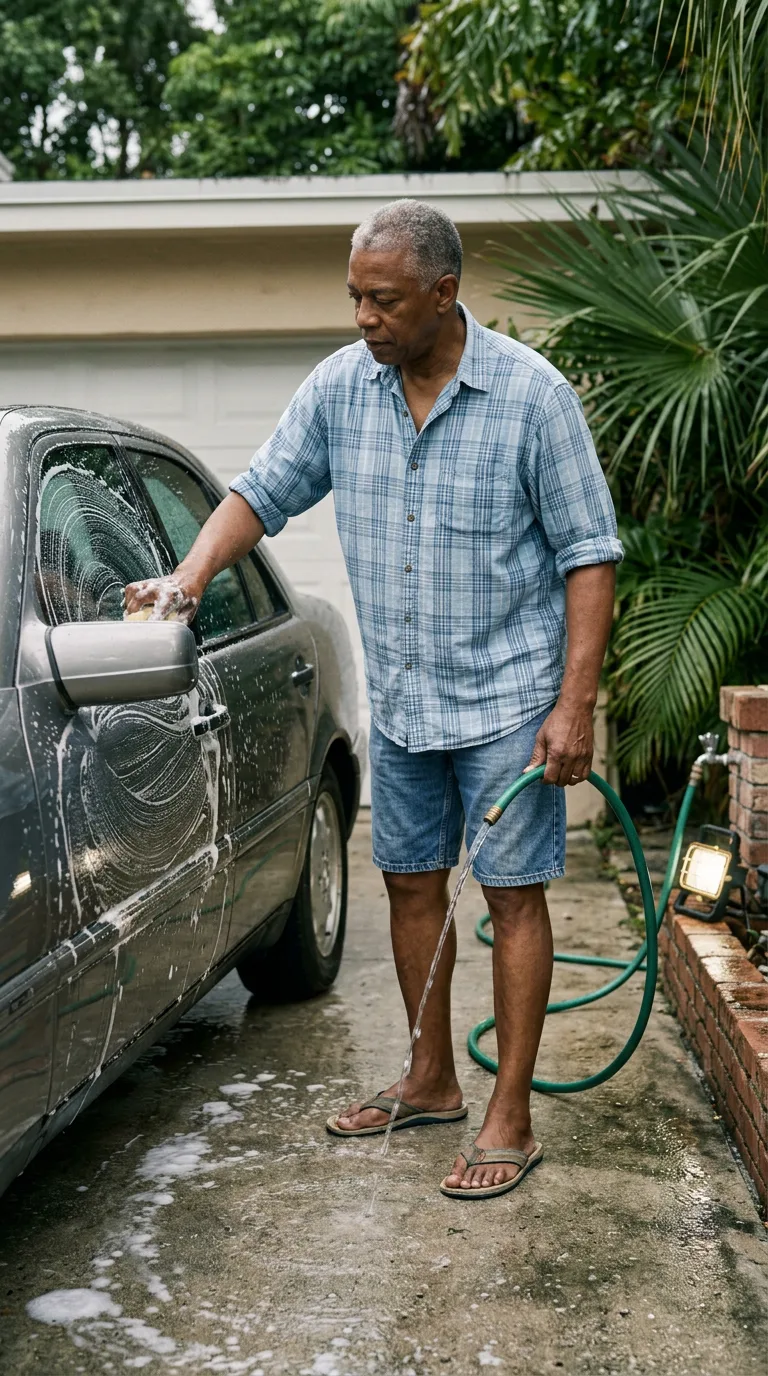
Rarest thing about him: Washing the car — uncommon, 1 in 37
Season 0seed 3617087 · engine v10
Character card
lineage 2NZHHJ
His body-swap story
@colin.hasbrook, wearing Dennis Okabe, rolled the wheel on and woke up as Marcus Whitfield, spent under a minute in him, then spun the wheel and woke up as Gary Truskowski
The pipe wrench is still in Dennis Okabe's hand when you decide, and that's the thing that does it — not the ache radiating up through his shoulder, not the crawl space smell still in his sinuses from the job an hour ago, but the fact that his hand, thick-fingered, calloused, has been holding this exact tool in this exact grip for thirty years and will hold it for thirty more if you let it. Under a High-desert Nevada sun at a job site that smells like caliche dust and cut PVC, you feel how little of him is left to want anything. He is a good body. He is not a body you want at eleven in the morning on a Monday with four more calls on the sheet and a knee that clicks on the second stair every single time. You set the wrench down on the tailgate. You already have the site pulled up on the phone in his shirt pocket — his phone, his cracked screen, his thumbprint that isn't yours ghosting the sensor anyway because the wheel doesn't care about locks. You spin because you always spin, because six hundred and fifty-six men were never going to be the number where you stopped, and because something in you, wearing this particular ache, wants — badly, plainly — to not hurt for a while.
The wheel gives you soap sliding down glass in wide gray arcs and a hose hissing against concrete.
You are standing. That registers first — standing straight, spine long, no crawl-space crouch in it, and where Dennis's knee clicked there is only a low humming stiffness low in the back, old and familiar to somebody, not yet to you. Your hand is closed around a sponge. Foam runs off it in ropes. The window under your palm is a car door, silver-gray, mid-wipe, and your wrist is already doing something particular — small circles, thumb tucked under against the sponge's edge — like a signature written a thousand times until the hand stopped needing the rest of you for it. The swirl marks stop behind you. You didn't tell the wrist to stop making them. It just already knew this stroke was the last one before you noticed you existed.
Humidity first — that's the room, if a driveway is a room. Air with weight to it, salt somewhere under the cut-grass and hose-water smell, a mugginess Nevada never gave you. Palm trees at the edge of vision, fanned and dripping from something other than the hose. Afternoon light, flat and white through cloud, nothing like the desert glare you left. Then the shirt — a plaid cotton button-down gone soft at the elbows from washing, sleeves rolled to mid-forearm — and through the fabric against your back, sun-warm, a memory arrives unbidden: this exact shirt, six years ago, a woman's hand smoothing the collar down before a work dinner, her laugh, *you always leave this one crooked*, and the sting under it that isn't about the collar at all — Renata, whose name comes with the shirt somehow, whose leaving still sits in this man like weather. Not his wife. The other one. The one he still runs into at conferences and pretends is easy.
The wedding band on your left hand is warm from the sun and the water both, and it brings the other memory, the one that outlasts the first — a ceremony on a rooftop, his wife's mother crying too hard, the ring a little tight now on a finger that's swelled some with the years, sixty pressing at it gently every morning when he showers. Two kids arrive with it, sideways — a daughter's wedding, a son's voice on the phone last week, businesslike, *you doing okay, Dad*, the particular loneliness of being the reason nobody worries about you anymore.
The flip-flops under your feet, wet rubber, give you this morning: standing in the closet doorway, the office already done with for the day though it's barely past noon back home — an early one, a good one, glass walls he propped his door open on like always, a boy on the team, twenty-six years old and terrified, and Marcus telling him *nobody remembers your first bad quarter, they remember whether you showed up for the next one* — dressing after, cargo shorts because Saturday-brained even on a Monday off, this shirt because it was clean and on top, the flip-flops because his feet have hated shoes since the back started going, since the third disc, since the specialist with the diagrams. Chronic, the word the doctor used, like it was a job title. It sits low and dull right now, this instant, a familiar tenant in the lumbar curve, and your body — his body, six-one, still solid enough in an average, unremarkable way, sixty-year-old muscle over a frame that used to run track — knows exactly how to stand so it complains less.
The hose in your other hand is cool where the wrench's ghost-heat isn't anymore. Water still runs. Somewhere past the garage a gull complains at the sky, wrong sound entirely for a Nevada job site, right sound for here.
You look at the hand holding the sponge. You turn it over — soap threading down between the fingers, the ring catching gray light, calluses in different places than Dennis's, a life spent signing things and shaking hands and once, apparently, laying brick for a father who's long gone now, that flash arriving off the rough pad at the base of the thumb and gone again before you can hold it.
You lift your eyes to find nothing looking back but the wet driveway, the dripping palms, whatever's watching from a phone mounted somewhere close, and you say, out loud, in a voice that isn't Dennis Okabe's gravel and isn't quite settled into being anyone else yet either:
"Well — look at that."