Dennis Okabe
Fictional. Generated by AI — not a real person, and no likeness of one is intended.
54, plumber in High-desert Nevada · rolled by @colin.hasbrook · card — no film
History
who has worn him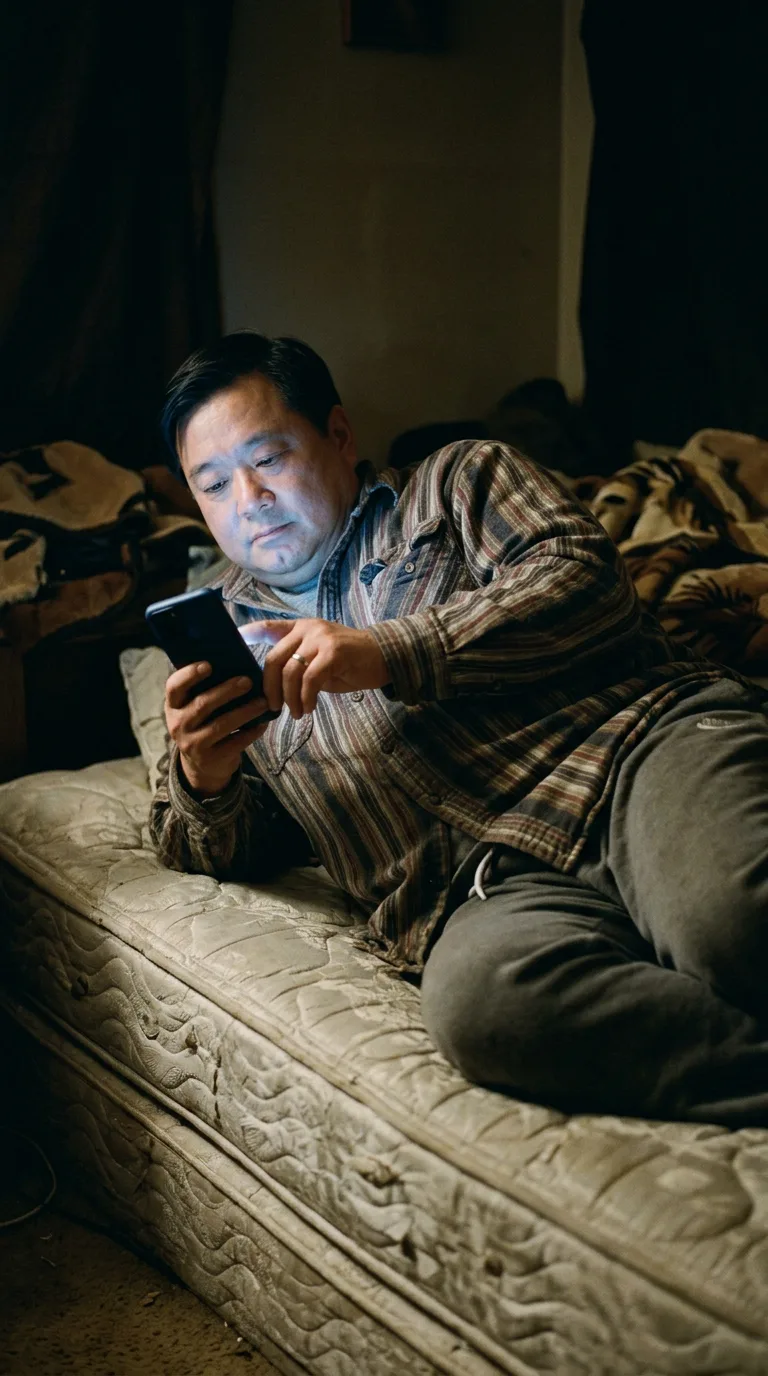
Rarest thing about him: A cleft chin — rare, 1 in 25
Season 0seed 2140318221 · engine v10
Character card
lineage 2NZHHJ
His body-swap story
@colin.hasbrook, wearing Peter Nagarkar, rolled the wheel on and woke up as Dennis Okabe, spent under a minute in him, then spun the wheel and woke up as Marcus Whitfield
Peter Nagarkar's hands are wrong and you have known it since the first minute in them — a contractor's hands, sure, but soft where they should be hard, thirty-six years old and already going pale and stringy at the wrist, skinny fat, that phrase the wheel seems to have picked just to insult you both. It is not that Anchorage is bad. It is eleven in the morning and gray outside and you have been standing in his kitchen looking at a coffee maker he does not know how to descale and thinking, not for the first time, that this one has no weight to him. Six hundred and fifty-five men and you have learned to feel it inside a minute: whether a body sits in a room like it owns the air or whether it apologizes for being there. Peter apologizes. You did not spin for boredom exactly. You spun because you picked up his phone to check a text and his thumb hovered over it like it wasn't sure it had the right, and something in you said, not this one, not today, and your other hand was already reaching for the laptop.
The wheel spins the way it always does, a length of color and then a stop, and you do not choose, you never choose, and this time it gives you weight.
You are on your side on a mattress with no frame, and the weight arrives first — heavy through the hip, heavy through the gut, a body that has learned to fold itself onto furniture that gave up being comfortable years ago. Blue light on your cheek. A phone six inches from your face, thumb stopped mid-scroll on something you didn't finish reading and will never read. Your thumb starts again on its own, faster now, flicking past a text thread, a photo of a dog that is not yours, a listing for a used water heater, and none of it stops you because none of it is yours yet.
Then the shirt gets you. Flannel, soft at the elbows from wear, a snap at the collar instead of a button, and touching it brings back a hand — his hand — buttoning it that same morning, standing in front of a mirror with a crack across one corner, in a bathroom smaller than the one he'd been kneeling under six hours later in some stranger's house forty miles south. Dennis Okabe. The name comes with the shirt, the way his own name always sits in a man's clothes like a label sewn into the collar. Dennis, pulling the flannel over a gray undershirt already gone see-through at the shoulders from washing, tucking nothing in because nothing gets tucked in anymore, not since the weight settled where it settled. His hands know this shirt. They know it the way they know a slip-joint plier, the way they know the particular give of a compression fitting right before it seats. Fifty-four years in this body and the hands are the youngest thing about it — quick, sure, callused along the pads where a pipe wrench rides, and utterly unhesitant even now, even mid-scroll, because that's what hands are for him: instruments that work while the rest of him aches.
The mattress under you — bare, no sheet tonight, he'd meant to change it and hadn't — gives you the trailer whole: the hard blue shadow the single-wide throws across the gravel at five in the afternoon, sagebrush close enough to the step that Marisol complains about the smell after rain, three kids' names stacked on a whiteboard on the fridge with chores nobody does, a fourth grown and out and calling on Sundays only. You feel the marriage arrive through the ring before you even look for it — plain band, worn smooth, and under it a groove in the skin that never goes away even when the ring comes off for a shower. Twenty-six years of Marisol laughing at him for wearing overalls to the grocery store because he never has time to change. Twenty-six years of her hand finding his face the way his own hand finds his face now, unbidden, thumb dragging along the cleft in his chin like he's checking it's still there, an old tell she teases him about and he's never once noticed himself doing.
The job comes in through the callus and the ache in both knees at once — decades of kneeling on other people's tile, other people's cold concrete, the particular smell of slow drain water and pipe dope that never fully leaves the cuticles no matter how hard Dennis scrubs. He is good at it. He is proud of being good at it in the quiet way men are proud of things nobody thanks them for — a shutoff valve he can find blind, a leak he can diagnose by the sound of it dripping through a wall. He is also, this exact hour, supposed to be on a job, and instead he is horizontal at midday because the crew got rained off a slab pour up the highway and he came home to sleep off a blood sugar crash that scared him a little this time, more than he told Marisol, sugar low enough that his hands shook on the wheel driving back. He is thinking, underneath the scrolling, about the meter on the nightstand he hasn't touched today. He is thinking about his youngest asking for cleats. He is thinking about nothing, really, the particular nothing of a tired heavy man lying on his side letting his thumb do what it wants.
You look at the hand holding the phone. Thick fingers, a college class ring's ghost of a tan line that isn't there because he never went, a wedding band catching the blue light. You turn it over slowly, watching it not be Peter's hand, watching it be a stranger's hand that already, somehow, knows exactly how to hold this exact phone.
"Hey," you say, to no one, to the empty side of a bed that will have someone in it again by dinner, your new voice landing low and a little rough, a voice that has said this exact word ten thousand times and never once to you. "Okay."