Marcus Etheridge
Fictional. Generated by AI — not a real person, and no likeness of one is intended.
45, sales rep in New York · rolled by @marco.villagrana · card — no film
History
who has worn him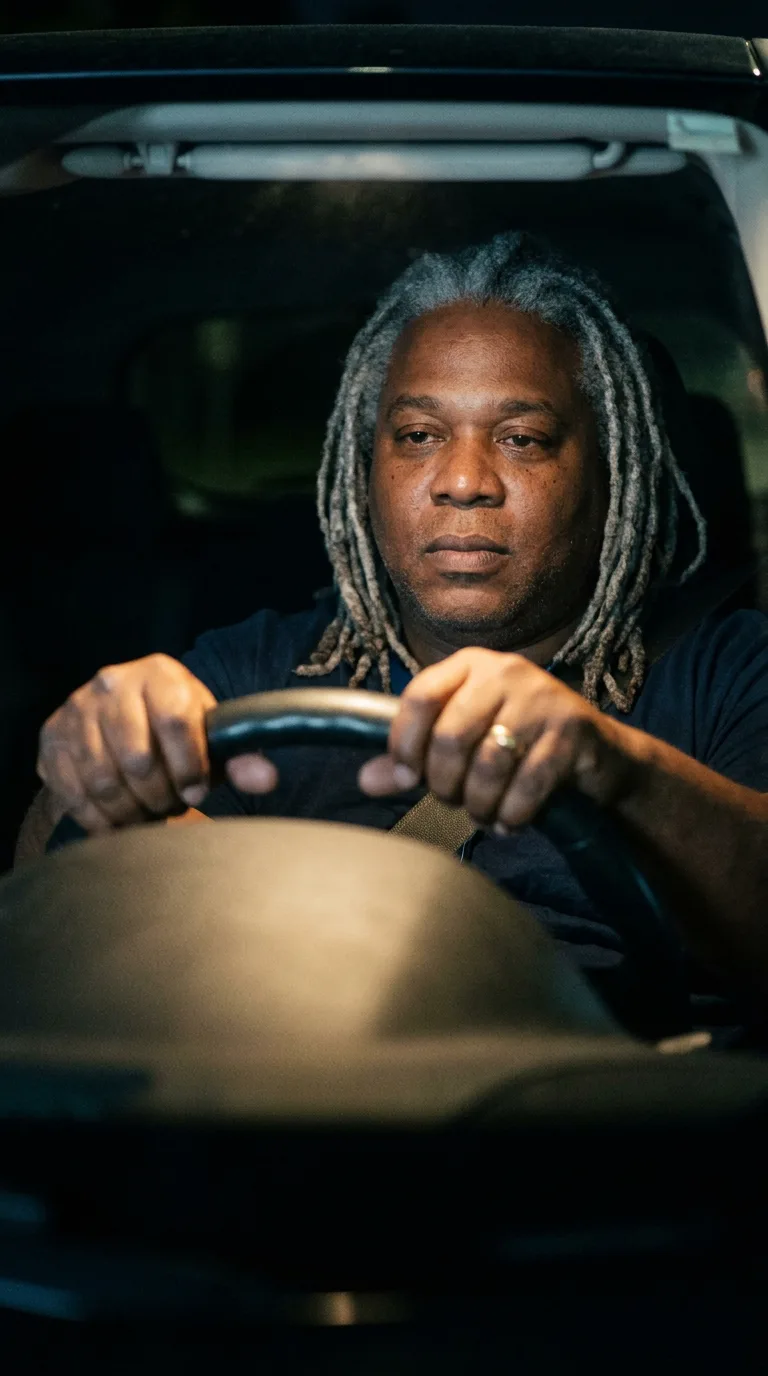
Rarest thing about him: Driving home — uncommon, 1 in 27
Season 0seed 1207332077 · engine v10
Character card
lineage LJL8SV
His body-swap story
@marco.villagrana, wearing Dean Kovacevich, rolled the wheel on and woke up as Marcus Etheridge, spent 3 minutes in him, then spun the wheel and woke up as Terrence Boykin
Dean Kovacevich's hands are small on the armrests of his own recliner, and you have been sitting in them for three minutes, and it is already not enough.
You know this feeling. Fifty-five times now you have known it — the settling-in that turns, almost before it finishes, into a kind of itch under a stranger's skin. Dean is soft-handed, a dentist, the kind of man who alphabetizes his spice rack and has not raised his voice since Clinton. Bald, green-eyed, comfortable in every sense the word allows. He should be plenty. He is early evening in Las Vegas, a Tuesday winding down outside his window in long gold light, and there is nothing wrong with him at all, and that is exactly the trouble — there is nothing to be in him. You spun for Dean's calm and got it and now his calm is a room with no other door. Your thumb finds the armrest's seam and worries it. Somewhere behind Dean's mild face, you are already gone.
You do not decide so much as notice that you have already opened the site on his phone, the wheel spinning its bright wedges under your — his — thumb, and you think, only once, of Vincent. Two days and two hours ago you were Vincent Paladino, a card dealer in Philadelphia with a beauty mark and a bad hip, and for two minutes you stood at his table and felt what it was to deal to men who called you by name. There was a coworker there. Big man, quiet, gray locs, a lanyard he never took off even at the tables, there for a friend's birthday hand at a table Vincent wasn't even working. You didn't think about him again until his face comes up now, mid-spin, the way an old room comes back when you smell its paint. Fine. Somebody who knew Vincent, even a little. Close enough to interesting.
The wheel stops.
—
The car is already drifting when you arrive, a foot toward the yellow line and then pulled dead straight, smooth as breath, and his hands are heavy and dark on the wheel at ten and two, ring cold-warm against the leather, and there is dash light lying along his knuckles like something poured. You did not travel to get here. You were Dean's recliner a half-second ago and now you are the whole solid weight of another man, thighs against upholstery, seatbelt cutting a diagonal into a soft gut, gray-silver locs brushing a collar you can feel but not yet name. Both hands come off the wheel on their own, without asking you, and resettle lower, wider, more his than yours, and the turn signal clicks on for an exit that is not his exit. Somewhere behind that error the man himself is simply gone, the way a held breath is gone once it's out. Wet street ahead, sodium lights smearing on the windshield, three miles from a house that is, you understand with no memory yet to back it, close.
The shirt is the first thing that talks. Navy polo, damp under the arms with a day's driving, and the story comes up through the fabric before you've thought to ask it anything: him buttoning-that-isn't-buttoning, pulling this exact collar over his head in a hotel room that morning, the mirror fogged at the edges from someone else's shower, lanyard already looped and waiting on the doorknob like a leash he puts on willingly. Marcus Etheridge, his own hands supply, the way a man's name arrives when you touch his ID badge and not before. Forty-five years old. Sales rep, medical supply, eleven years with the company, a territory that eats highways for breakfast.
The wedding band is warmer than the rest of the wheel, worn smooth on the inside, and it gives you a marriage in one long unbroken pull — Renee, seventeen years, an argument that morning over nothing, over a dish towel left wet on the counter, the kind of fight married people have instead of the fight they mean. Under it, older, softer: an ex named Danielle who still texts on his birthday, whom he has never told Renee mattered as much as she did, whom he thinks about exactly as often as guilt requires and no more. Two kids upstairs of this memory, a boy who plays trumpet badly and beautifully, a girl who has just discovered eyeliner and opinions in the same season. He loves them so plainly that it sits in the chest like weather, not thought.
The steering wheel itself gives up his body — this is a big man's body, heavy through the middle, forty-five and feeling every year of it in the lower back, the left knee that clicks on stairs, the shoulders that used to play something in college and haven't since. Strong hands, though, hands that know a car engine's rattle from a bad tire without looking, that drum without being told to, a rhythm against the wheel-rim that isn't nervousness, just a body keeping its own time. He quit drinking nine years ago after a Tuesday not unlike this one, quit smoking longer ago than that, prays some mornings and means it about half of them. Comfortable, not rich — a house with a mortgage he understands, a 401k he checks too often.
And under the lanyard, threaded thin and recent: a birthday, a casino floor in Philadelphia, a coworker's retirement do that took him out of state for two nights, a skinny gray-haired dealer named Vincent who dealt him a good hand and a better story, who complained about his hip and made everybody at the table laugh once, hard, the kind of laugh you remember the sound of longer than the joke. Marcus liked him. Marcus thought, driving home after, that he should keep in touch with people like that more than he does.
You sit inside all of it — the ache in the knee, the ring's small weight, the smell of rain starting on glass — and for the first time in three minutes you are not itching to leave.
The wheel is under your hands now, really yours, or as good as. You lift them off it — the car already correcting itself, steady, three miles out — and turn them over in the dashboard light, palms up, the way a man checks for something he dropped.
"There he is," you say, out loud, to no one, in a voice that isn't quite settled into being his yet — and behind the words you can already feel it starting, small and familiar, the wanting that never waits its full turn: how long is this one for.