Marcus Deveraux
Fictional. Generated by AI — not a real person, and no likeness of one is intended.
37, contractor in El Paso · rolled by @colin.hasbrook · card — no film
History
who has worn him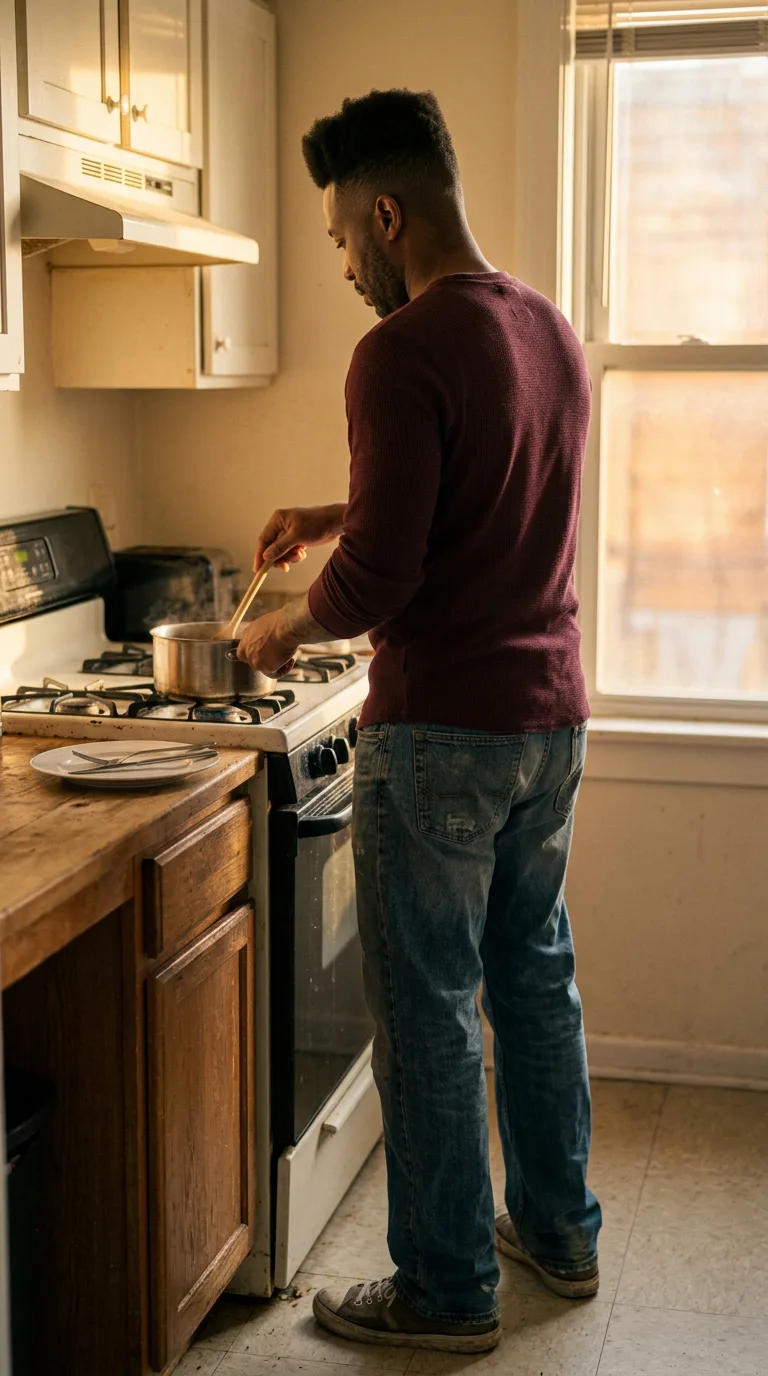
Rarest thing about him: A high-top fade — uncommon, 1 in 304
Season 1seed 478615444 · engine v11
Character card
lineage 2NZHHJ
His body-swap story
@colin.hasbrook, wearing Ruben Castellanos, rolled the wheel on and woke up as Marcus Deveraux, spent under a minute in him, then spun the wheel and woke up as Weston Kirchner
Ruben's mouth still tastes like someone else's dinner, and that's the problem.
You've been him less than a minute — the beard rough when you rub a hand across it out of a habit that isn't yours yet, the dad-bod weight settling wrong at the hips, the smell of the operatory still on his scrubs even though he's home, off the clock, standing in his own kitchen having apparently already decided, before you were even inside him, to reheat something his wife left in the fridge. That's the thing. His wife. Twenty-six years of a marriage sitting in this body like sediment, and you dropped into it forty seconds ago mid-argument that hasn't happened yet, mid-life that was never yours to finish. You didn't choose Ruben Castellanos. Nobody chooses; the wheel chooses. And Ruben, whoever he actually was before you, is gone all the way down — there's nothing left in there to resent you for it.
You stand at his counter. Somewhere behind these borrowed ribs there's a low, specific itch that has nothing to do with him and everything to do with you: the itch of a body that has already stopped being interesting. A dentist's hands. A dentist's evening. Thursday, the practice closed at five, and this is what's left of the day — a beard that itches, a marriage that is, by every account you've absorbed in these forty seconds, a good one, stable, kind, boring in the specific way that means nothing is going to happen in it tonight worth having. You did not spin again out of hatred for him. You spun again because good is not the same as alive, and because some worn-smooth part of you, 836 men deep, has started needing the drop more than the destination. You pull out your phone with his hand, thumb still finding the passcode like it's known it forever, and you open the page with the wheel on it, and you pay, and you spin.
—
The spoon is already turning the other way.
You feel it before you see anything — the wrist doing a thing wrists do, small and unthinking, stirring a pot of something dark and fragrant, and then it reverses, circles back against its own motion, and that reversal is the first thing that is yours. Not his. Yours, arriving.
The room comes up around you like a photograph developing: a narrow kitchen washed gold with early evening, blinds throwing bars of light across an old white stove, a window with the desert going orange-violet behind it. Steam off the pan. A wooden spoon warm and worn smooth in a right hand marked with ink to the elbow — color faded, lines still bold, a skull half-hidden under a maroon sleeve pushed to the forearm.
You salt the pan. Don't taste it. Reach up instead and bring down a second plate, and set it next to the first one on the counter, the ceramic click of it landing loud in a kitchen built for one man and, apparently, tonight, for the idea of two.
—
The spoon is the first key.
It turns in your hand and gives you the callus that holds it — a callus built by a caulking gun and a trowel handle and eleven years of drywall dust, not by cooking, though he does that too, every night, for one. The kitchen exhales an afternoon at you: framing a house out on Loop 375 in hundred-degree light, the smell of cut pine and somebody's radio playing conjunto too loud, the particular ache low in his lower back from bending over a chalk line since seven a.m. His hands know stud spacing the way your borrowed dentist hands knew a drill — automatic, unbothered, correct without having to check.
The shirt against your back gives you this morning. Gray work shirt, second button stuck, the little private ritual of rolling the left sleeve twice because the cuff catches on the tattoo otherwise — the half sleeve, a swallow and a rose and a dagger done cheap and good fifteen years ago in a shop off Alameda, redone once when the color went the color of a bruise. Putting the shirt on this morning he'd been thinking about Danny. Not fondly, not bitterly — just thinking, the way you think about weather that's already passed. Danny who he was with six years, Danny who moved to Austin and still, sometimes, texts on a Thursday for no reason either of them will name. There'd been a text today. He hadn't answered it yet. He was going to, after dinner, the way you answer someone you've stopped needing to answer quickly.
The belt gives you church — this Sunday's, and a hundred before it, a congregation that has never once made him feel unwelcome and has also never once been told the whole truth of him, and how he holds both of those facts in the same hand without it costing him as much as people would guess. The boots by the door, when you glance at them, give you a bank statement he doesn't think about because he doesn't have to — a business good enough that money stopped being the thing that wakes him up at night years ago.
The second plate is the last key, and it's the deepest one. It comes with a name he isn't thinking in words but in shape: a man's specific laugh, a man who used to eat at this counter across from him most Thursdays before the wanting between them thinned out into something more like habit and then, eventually, into nothing at all, except this — some nights, some Thursdays, his hands set two plates down before his mind catches up to correct them. He always fixes it. He always eats alone at the one place, quietly, and doesn't examine it too hard, because examining it is worse than just clearing the extra plate back into the cabinet like it never happened.
You are standing in thirty-seven years of a body that carries none of that as weight — broad through the shoulders, easy in the knees despite the job, a small ready strength in the forearms from lifting lumber all day, gum going soft and forgotten in one back tooth, a gap in his front teeth that his tongue finds without being told to, like it's checking that it's still there.
You don't fix the second plate.
You look down at the hand holding the spoon — his hand, wide-knuckled, ink-marked, capable of things your last hand never learned — and you turn it over slowly, palm up, like you're checking it for a seam.
"There you are," you say, to no one, to the empty side of the counter, and you don't know yet if you mean him or the man the plate was for or just yourself, freshly arrived, already wondering how long the wheel intends to let you stay in something this warm before it calls you back to spin again.