Marcos Feliciano
Fictional. Generated by AI — not a real person, and no likeness of one is intended.
37, security guard in Boston · rolled by @colin.hasbrook · card — no film
History
who has worn him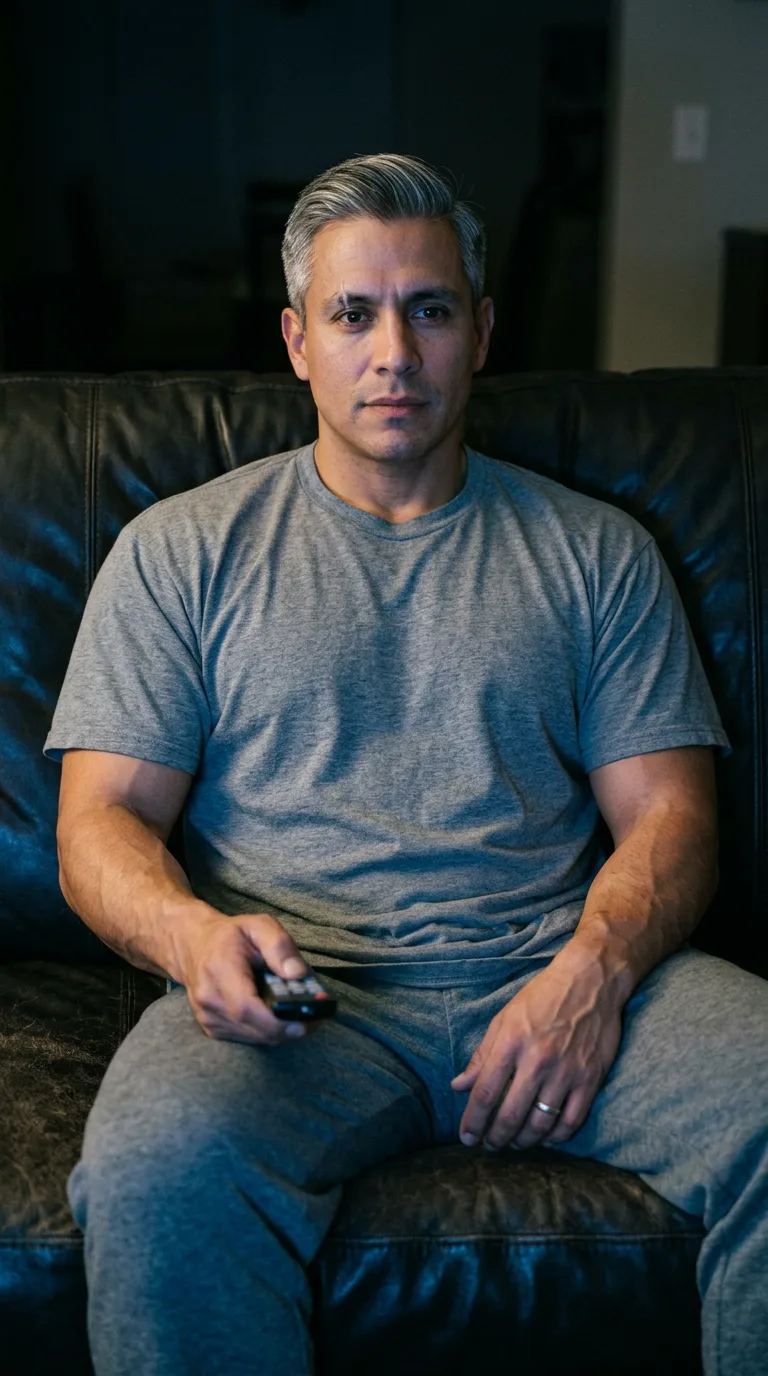
Rarest thing about him: Mainline Protestant — rare, 1 in 26
Season 0seed 304866906 · engine v10
Character card
lineage 2NZHHJ
His body-swap story
@colin.hasbrook, wearing Russell Prentiss, rolled the wheel on and woke up as Marcos Feliciano, spent under a minute in him, then spun the wheel and woke up as Sammy Nassar
Russell Prentiss has been sitting in his own driveway for forty seconds, engine off, keys still in his hand, and that is the whole problem. Forty seconds of being nobody in particular. Houston noon-light coming flat through the windshield, a Sunday route finished, and nothing in him wants to go inside and be a bus driver's body doing bus driver things for the rest of the day. You have worn three hundred and twelve men to get to him and he was supposed to feel like more than this — six-two, muscled, gray at thirty-five, a face women look twice at — but he drives a route on the east side and comes home to an apartment that smells like other people's cooking, and today that is not enough. You want the version of this where it isn't a route. You take the phone out of his pocket with his own thick fingers, already impatient with them, and open the page with the wheel on it before you have decided you are going to.
The wheel spins on a screen in a driveway in Houston and lands somewhere else entirely.
The remote is already loose in the hand, and the hand does not startle, because there was no *before* to fall out of — there is only this: a couch, leather cool through a t-shirt, a television throwing blue light across a dark room, and a body that was already sitting exactly like this, weight settled back, the last half-second of somebody else's laugh still arranged on a face that is now yours to use differently. You sit up straight. You set the remote down on the arm of the couch, deliberately, the way a man does when he has decided, mid-show, that the show isn't worth slouching for anymore. On the screen something happens that used to be funny. It is not funny now. Nothing about the timing disturbs the room; the room does not know anything has visited it.
The shirt is what opens first — gray cotton, worn soft, and it comes with a Sunday morning that is not this one: a woman's hands smoothing the collar down flat before he left the bedroom, her saying *you'll sweat through it by three anyway,* and him laughing, actually laughing, the sound this face hasn't made since you arrived in it. Marisol. The name comes attached to the shirt like a label sewn in wrong side out. Married nine years. Two kids who are, right now, at her sister's, which is the only reason this room is this quiet on a Sunday afternoon.
The couch gives you the rest, cushion by cushion, because his weight has spent so many hours sinking into exactly this spot. Overnights. The lobby desk downtown, the marble floor, the bank of elevators that go still and silent after eleven, his flashlight tapping a rhythm against his own thigh on the walk-throughs, the particular ache that lives now in his lower back and his knees from twelve years of standing on that floor waiting for nothing to happen. He gets home near dawn, eats standing at the counter, sleeps through the school-bus noise, wakes in the early afternoon into a house already going without him — and this, right here, an hour or two of television in the dark before he has to get dressed again and go be watchful for eight more hours, is the whole quiet center of his day. You feel how tired that makes a man, in a specific, low, permanent way, and under the tiredness, how the diabetes sits like a second job — the number he checks before he leaves the house, the small careful math of what Marisol packs him to eat at 3 a.m. so his hands don't start shaking at the desk.
The wedding band is warm from his own skin. It brings her whole face up at once — not young, not old, just present, the two of them on a porch that isn't this couch, storm door banging behind the kids, her laughing at something he said that wasn't that funny. And under her, quieter, someone else: Renata, from before, the one who left for Chicago when he wouldn't, the one he still thinks of exactly twice a year and tells no one, not confession, not therapy, nothing — just a closed door he touches sometimes to check it's still shut. It's shut. It has been shut a long time. He chose the storm door and the two kids and the overnight shift and he has never once, sober, regretted it out loud.
The scar through his eyebrow comes last, from nothing he's touching — just the memory sitting in the muscle of his own face, a bar fight at twenty-two he barely remembers except for the stitches and his mother's fury, and how Marisol traces it sometimes with her thumb like it's a story she likes better than the true one.
You look down at his hands — thick through the knuckles, a working man's hands that have never worked with them, forty years old, steady, the ring catching the last blue flicker off the screen. You turn one over like you're checking it came with everything it should have.
"Didn't even laugh," you say, to the empty room, to nobody, in his voice, and it comes out flatter than you meant, already thinking about how many Sundays are stacked up behind this one before you get bored enough to spin again.