Marco Bautista
Fictional. Generated by AI — not a real person, and no likeness of one is intended.
21, student in Houston · rolled by @colin.tarwater · card — no film
History
who has worn him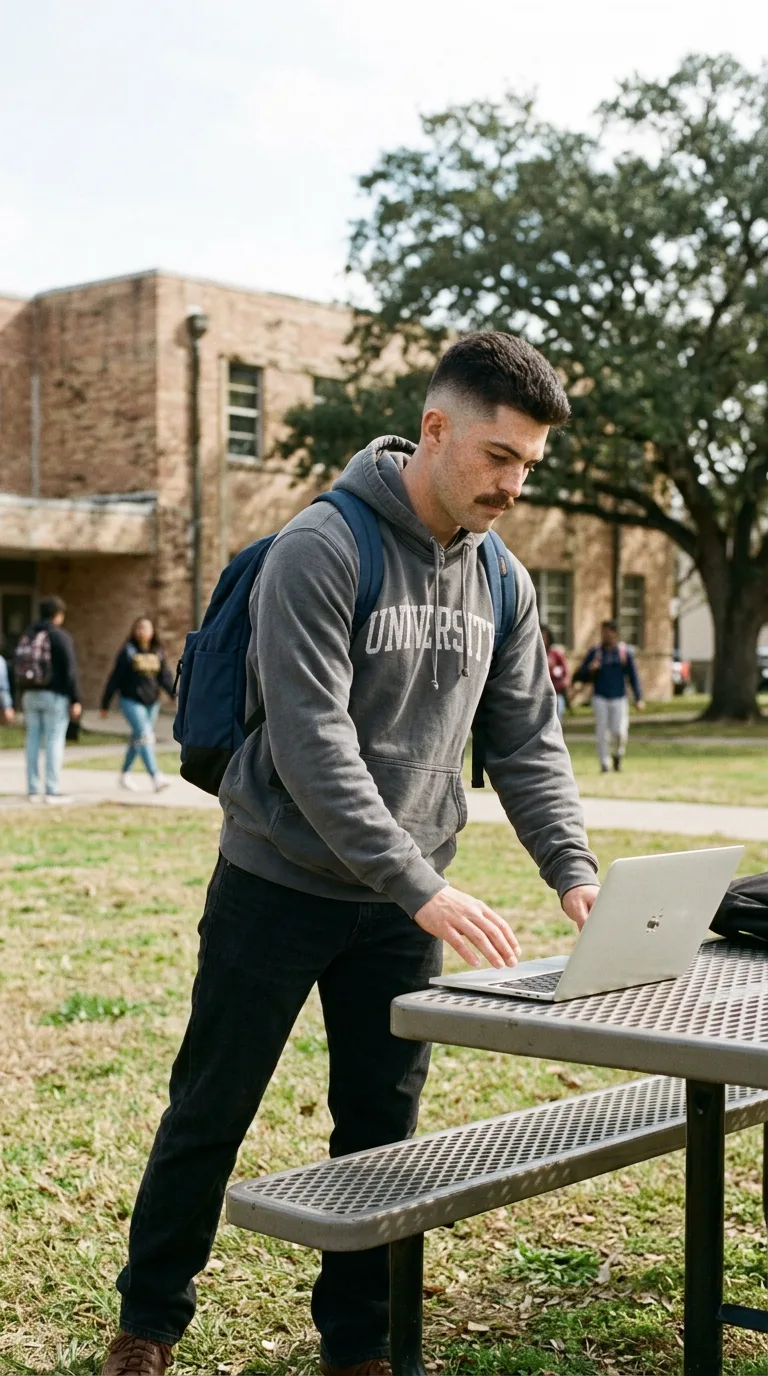
Rarest thing about him: Moustache — common, 1 in 16
Season 1seed 593313332 · engine v11
Character card
lineage COEU7T
His body-swap story
@colin.tarwater, wearing Emilio Casares, rolled the wheel on and woke up as Marco Bautista, spent 4 minutes in him, then spun the wheel and woke up as Terrence Okafor-Boyd
The telescope is fine. That's the problem.
You've had Emilio Casares less than a minute and already you know the shape of the next forty years of him: grant applications, a dead marriage he mentions like weather, a body that aches getting out of a car. He is standing in an observatory hallway in Nashville with a coffee going cold in his soft hand, and somewhere behind his sternum is the flutter that always comes before you go back to the wheel — not boredom exactly, something closer to hunger arriving on a schedule. Eighty-one times you have felt this. You have stopped pretending it means anything except that it is time. You set the coffee down where Emilio will never drink it and you take out the phone that isn't yours and go to the page with the wheel on it.
You spin.
—
Your hand is wrong before you know why. It goes to tighten a bolt that is already tight, and something in the wrist — this wrist, not the one you had half a second ago — stutters, overcorrects, comes back slow and careful like a hand relearning itself. You are standing under a hood vent in a heat that has weight to it, tools laid out in a line on a rag, and the motion you were about to make — you were about to make it for the ten-thousandth time — arrives instead like a question. You do it again. Correctly. Slowly. The next one you check. And the one after that, though there is no reason to, though this body has done this exact turn of a wrench a thousand nights without once looking down to confirm it.
It is dark outside except for the sodium lights over a strip-mall lot, buzzing orange through a bay door propped with a paint can. Your back is damp under a shirt that smells like motor oil and fabric softener both, like someone who does laundry properly even when nobody's checking. Two in the morning here, which does not fit anything except that a lot of people work nights and don't get asked why.
The shirt gives it to you first — the collar against the back of your neck, worn soft there, and under it a whole morning: a small apartment off Bellaire, blinds doing nothing against the light, laying the shirt out on the bed the night before because if you don't decide ahead you decide wrong and show up looking like you don't take the job seriously even though the job is changing brake pads at a shop that smells like this one. Pulling it over your head. The particular ordinariness of a Tuesday that was, for him, actually a Thursday-that-feels-like-Monday, because his shift rotates and his sleep never really catches up, and he has stopped explaining that to people who ask why he's yawning at a two p.m. lecture.
Because there was a lecture. The backpack strap is not on your shoulder now but you feel where it usually sits anyway, a callus of habit more than skin, and it opens a whole different day: a picnic table on a lawn gone half yellow in Houston's fake winter, laptop lid catching glare, an email about a scholarship renewal that needs one more signature by Friday, and the small relief of realizing you have it, you have the document, it's in the folder, you didn't lose it this time. Green eyes narrowing at a login screen. A moustache he grew at nineteen on a whim and kept because his mother told him it made him look like his tío Beto and he liked that more than he expected to.
The wrench is warm from his own last grip on it. Calluses along the base of the fingers, not thick, still building — this is a body twenty-one years old, quick to recover, a little sore across the lower back from bending into engine bays for six hours, nothing that won't be fine by morning because at twenty-one everything is fine by morning. There's a girl he liked for one semester of Intro to Statistics and never said anything to, and that whole small ache surfaces and recedes, unimportant, replaced by the smell of brake cleaner and the particular satisfaction — his, not yours, but you feel it like weather moving through you — of a bay that's clean, a boss who trusts him with the harder jobs now, a paycheck that covers rent and books both if he's careful. Freckles across his nose that his little sister used to count out loud at breakfast, dead serious, like a census. A GPA he's proud of and doesn't mention. A father back in Pasadena, Texas, who fixes AC units and taught him to hold a wrench like it owed him nothing.
None of it is very large. That's what gets you — eighty-two men in and you still notice when one of them is just decent, just tired in a normal way, saving for a car that isn't held together with prayer, going to school in the day and turning wrenches at night because that's what it costs and he's paying it without complaint. There's no wound in him to go looking for. Just hours, stacked carefully, one on top of the next.
You look down. The hand is olive-brown, nicked at one knuckle, oil worked into the lines of it in a way that won't fully wash out until Sunday. You turn it over once under the buzzing orange light, like checking it's real, like checking it's yours.
"Wrong hand," you say, out loud, to no one, in a voice with a moustache's shadow over it — and you don't know yet if you mean the wrench or the whole of him, or how long you intend to keep either.