Manuel Cabezas
Fictional. Generated by AI — not a real person, and no likeness of one is intended.
36, operations manager in New Orleans · rolled by @colin.hasbrook · card — no film
History
who has worn him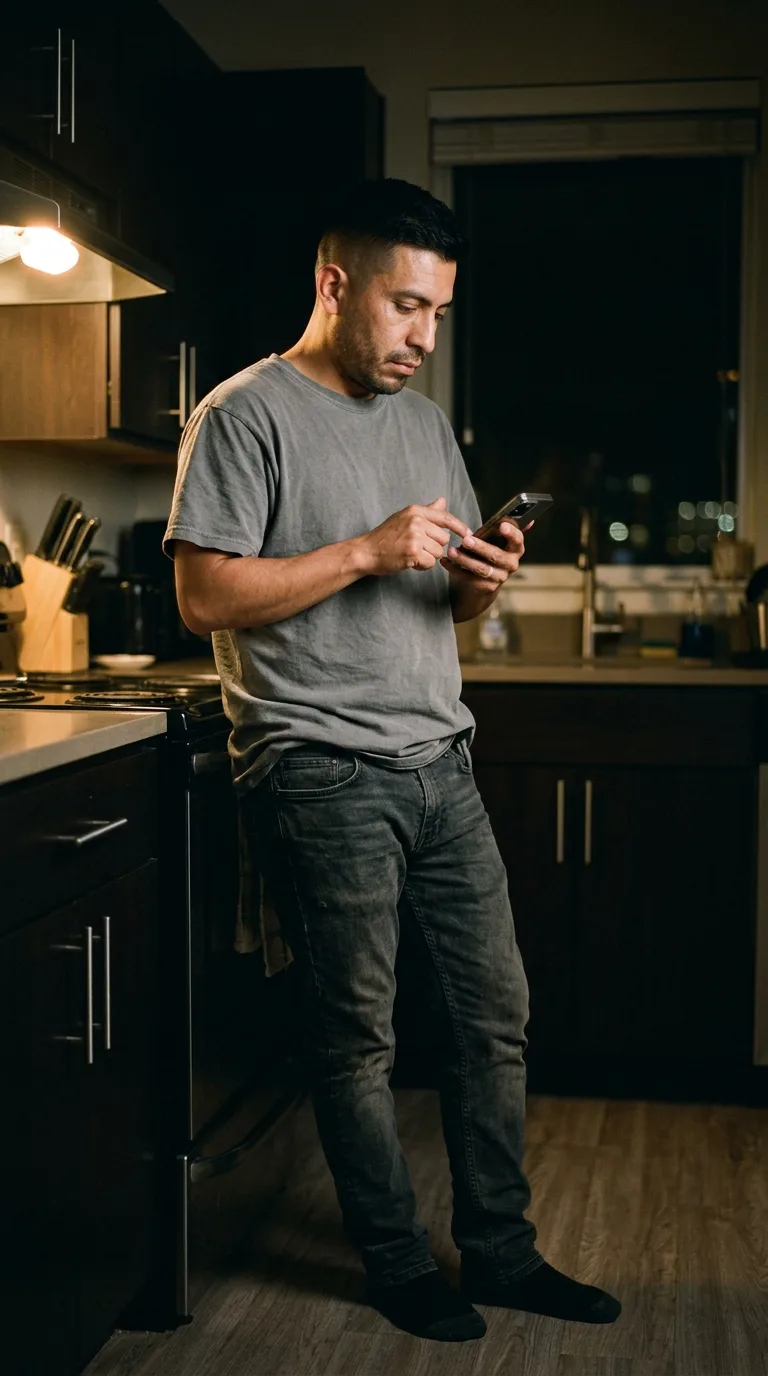
Rarest thing about him: Scrolling a shop he cannot afford — common, 1 in 54
Season 1seed 241206951 · engine v11
Character card
lineage 2NZHHJ
His body-swap story
@colin.hasbrook, wearing Warren Puskarich, rolled the wheel on and woke up as Manuel Cabezas, spent under a minute in him, then spun the wheel and woke up as Yusuf Haddad
Warren Puskarich's hand is cramping. That's the first thing you notice, sitting in his recliner with the plant's shift schedule still glowing on the laptop, because Warren has been at that keyboard for forty minutes fixing a scheduling error some kid on second shift made, and the knuckles ache in a way that isn't yours and never will be, no matter how long you keep him. Warren's wife left him too, a long time before you took him, and there's a photo on the side table of two grown daughters who don't call enough, and none of it is bad, exactly. He's fifty-one and gray and decent and rich enough. He is, if you are honest with yourself in the particular way the wheel makes you honest, a little boring. You have had eight hundred and seventy-nine other men and most of them wore off like this — not badly, just thin, the way a coin thins from being carried. You told yourself an hour ago you would not spin again tonight. You are telling yourself that right now, closing the laptop, and your thumb is already on your phone finding the site, because the telling and the doing have stopped talking to each other a long time ago. Somewhere past spin four hundred you stopped needing a reason. You just need the wheel to still say yes.
It says yes.
The kitchen isn't your kitchen. It's dim, cabinets dark, one light on over a stove nobody's cooking on, and there's a phone in your hand, warm from your own grip, thumb still lifted an inch off the glass where a watch that costs more than a mortgage payment sits paused mid-load. The weight is wrong before you even think about it — shorter, softer through the middle, five-five of a man who runs meetings, not laps. You feel your own shoulder blade against the edge of the counter you're leaned on, feel a dish towel slung there brush your hip. The screen is still lit. Your thumb comes down, slow, and sets the phone face-down on the counter, and the hand just stays there, flat on the cold granite, not because you decided that but because some part of him already had.
Then it starts coming in, the way it always does, through what's touching him.
The countertop under your palm: cold, faintly gritty with crumbs from the toast he had that morning before his shift meeting, and with it the mezzanine — the walkway railing under both his hands at seven a.m., forty feet up, the whole floor moving under him in forklifts and conveyor hum, a headset crackling somebody's shortage in his ear, and the specific pleasure, small and real, of a schedule he built himself holding together for once. Manuel Cabezas likes that walkway. Likes being above it and part of it at the same time. Nobody up there asks him to be anything but competent, and he is; he's good at this, has been for eleven years, longer than the marriage lasted.
The shirt against your back — a soft gray tee, worn thin at the collar — gives you the closet it came out of, and the closet gives you the whole morning: him sitting on the edge of a bed that's only ever his half now, in a shotgun house one room wide where you can hear the street through the wall, pulling the shirt over his head one-armed because the other hand's holding a coffee mug that says WORLD'S OKAYEST DAD, a joke gift from his kids two Father's Days ago that he has never once found not funny. Belt through the loops of khakis he irons himself, badly, the crease always a little off. Clipboard by the door, ID clipped to it, ready for the floor. He likes getting dressed for a job. It's one of the only rituals he kept after the house.
The tan line on your ring finger doesn't need touching to speak. It's just there, pale, permanent-looking though it isn't, three years since the band came off and the finger still remembers its shape. Her name arrives with it, uninvited, the way the good ones and the bad ones both arrive — a fight about money that was really about something else, two kids in a car seat aisle at a Target, a laugh of hers he can still hear clearer than he can picture her face anymore. The divorce didn't ruin him. It just took the shine off things, the way it takes the shine off a floor that used to be new.
Under the sock on the tile floor — cold linoleum, faint hum of a refrigerator — his feet ache a little from standing all day on concrete, an old, low, familiar ache, the ache of a body that carries more softness than muscle now and knows it, thirty-six going on tired. Stubble under your own jaw when your hand drifts up without meaning to: two days unshaved, the itch of it, the memory of a razor he keeps meaning to use before church on Sunday, keeps not using.
And under all of it, faint but persistent as a low hum in the walls: the watches. The scrolling. Not shame, exactly. Just a man totaling up, at the end of another Thursday, everything a good job and a decent income and eleven years of showing up on time still can't quite buy him, and doing it anyway, because it's easier to price a want than to feel it.
You lift your hand off the counter and look at it — shorter fingers than you're used to, a faint white ghost of a ring, black hairs on the back of the knuckles catching the one kitchen light. You turn it over once, like it might not hold. It holds.
You look up, into whatever is watching — the dark window, your own faint reflection in it standing in for a lens you can't name but always feel — and you say, quiet, almost apologetic about it:
"Sorry, man. You had it good."