Manny Corvello
Fictional. Generated by AI — not a real person, and no likeness of one is intended.
55, house painter in Atlanta · rolled by @colin.hasbrook · card — no film
History
who has worn him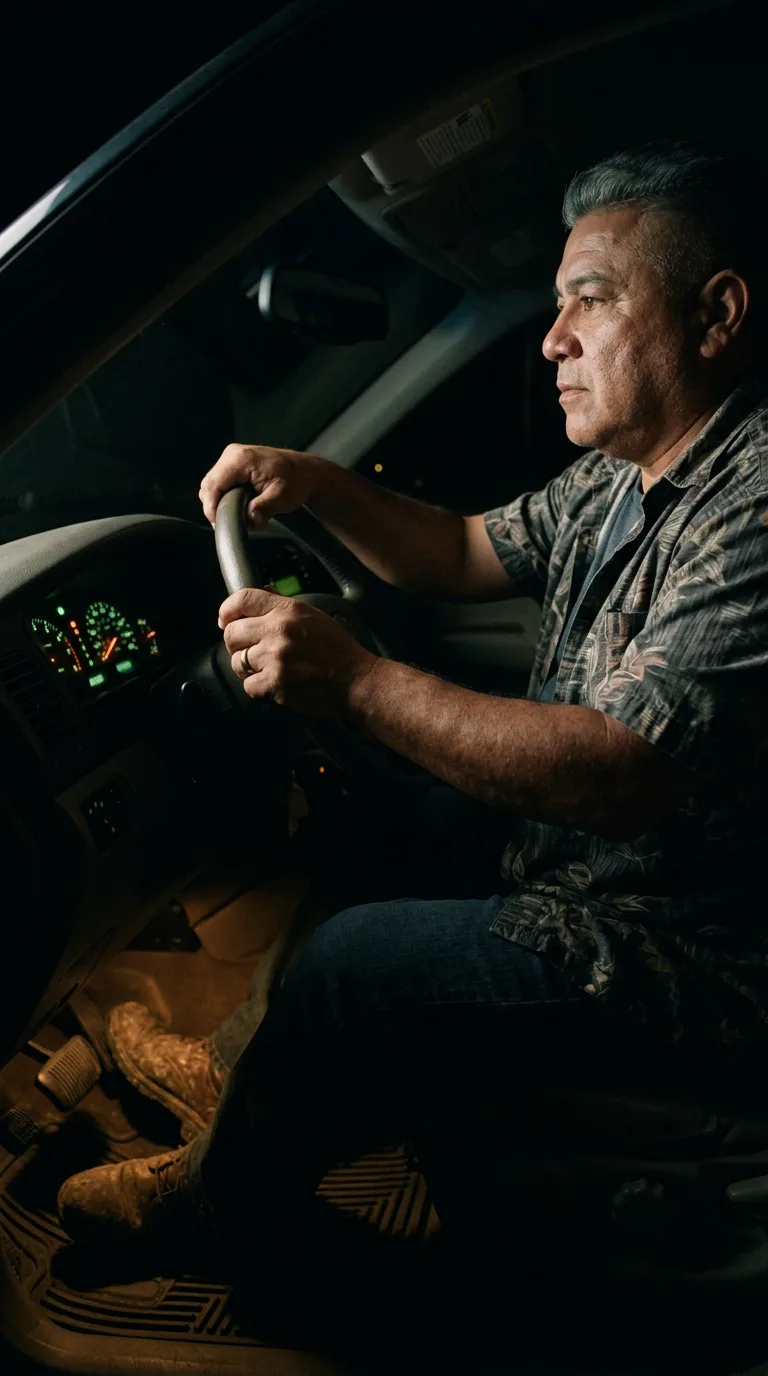
Rarest thing about him: Mixed — rare, 1 in 26
Season 0seed 703265665 · engine v10
Character card
lineage 2NZHHJ
His body-swap story
@colin.hasbrook, wearing Gregory Oschner, rolled the wheel on and woke up as Manny Corvello, spent under a minute in him, then spun the wheel and woke up as Darnell Whitcomb
Gregory Oschner has been standing in his own kitchen for forty seconds when you decide you're done with him.
It's the dimples that finally do it. You catch them in the microwave door's reflection, mid-laugh at nothing, at a joke his own mouth is still finishing, and you realize this is a face built for being liked, and you have already used up everything likeable does for you. Fifty-eight years old, a sales rep's soft gut, blue eyes that photograph well. Miami rent he doesn't have to think about. A minute ago you spun into him standing at his own counter, and the minute was enough. There's a particular flatness to a body that has never had to want anything hard, and it turns out that's worse than pain. You want friction. You want a life with a callus on it.
You go back to the site with his hand — soft, a little damp, a class ring loose on one finger — and you spin.
The wheel doesn't ask if you're sure.
—
Three miles from an exit that isn't yours, both hands come off a steering wheel at the same time, and you feel them land lower and wider than you left anything, thick through the palm, a hard ridge of callus at the base of each finger. The dash light is green-gold on brown knuckles. There's a wedding band, plain, worn thin on the inside where you can't see it but can already feel it, a groove in the skin like the finger grew around it. Your foot is already easing off the gas without you telling it to. The blinker is ticking for a turn three miles too early and you don't know that yet, you only know the sound of it, patient, wrong, going on ticking in the dark like it knows something you don't.
—
The shirt is what opens first. Short sleeves, a tropical print gone soft from washing, and it comes back to you sleeve by sleeve — not your memory, his, arriving through the cotton against your back like heat through a wall. This morning. Standing in a bedroom with the blinds already bright, and a woman's voice from the bathroom saying he'd better not get paint on that one, and him saying he wouldn't, and both of them knowing he would, eventually, the way he always eventually did, one fleck of trim white on a green leaf that she'd find in the wash and hold up without a word, and he'd shrug, and that would be the whole conversation, twenty-six years running on shrugs like that.
The wedding band gives you more, all at once, too much: a courthouse in July, her mother crying for the wrong reasons, a daughter born nine years later than either of them planned who is grown now and calls on Sundays, mostly, when she remembers, and it's enough, it's always been enough, that mostly.
Your feet find the gas pedal on their own, brake, the small motions of a man who has driven this road four thousand times and trusts his hands more than his eyes. Fifty-five years old in this body and you can feel every one of them — the low ache in both knees from decades of ladders, a tightness across the shoulders that never fully lets go, the specific exhausted density of a muscular man carrying fat over it like a second job. Your mouth tastes faintly of the syrup he takes for the sugar, a taste that comes with its own small dread, a doctor's voice saying words like manage and watch, and Manny nodding like a man agreeing to weather.
The steering wheel gives you the room he was painting today — emptied, drop cloths taped at the baseboards, a smell of fresh cut-in paint drying at the edges of the trim, and under it a whole life of rooms like it: a kid's bedroom turned nursery turned office as the kid aged up and out, a hallway he did twice because the first color made her cry, quietly, for reasons that had nothing to do with paint. Work that is nobody's idea of a career and everything of a living — five figures a year if the year is kind, a truck that needs a transmission, a wife who works the register at a pharmacy and doesn't complain about either.
There is nothing remarkable about any of it. That is the thing the shirt keeps handing you, gently, over and over: an ordinary man driving an ordinary three miles home to a house with the porch light already on, thinking about nothing sharper than whether there's enough milk, whether his knees will let him do the second coat tomorrow, whether she's still up.
—
You bring both hands up off the wheel and look at them in the green dash light — the calluses, the paint ground so far into the creases of the knuckles it will never fully come out, the ring worn to a thin bright line.
The blinker keeps ticking for the wrong exit, patient as a clock, and you reach over and switch it off yourself, and let the car roll on, three miles, toward a porch light that isn't your decision yet to walk to.
"Almost missed my turn," you say to the windshield, in his voice, in the dark, to no one.