Manny Cardosa
Fictional. Generated by AI — not a real person, and no likeness of one is intended.
50, bus driver in High-desert Nevada · rolled by @colin.hasbrook · card — no film
History
who has worn him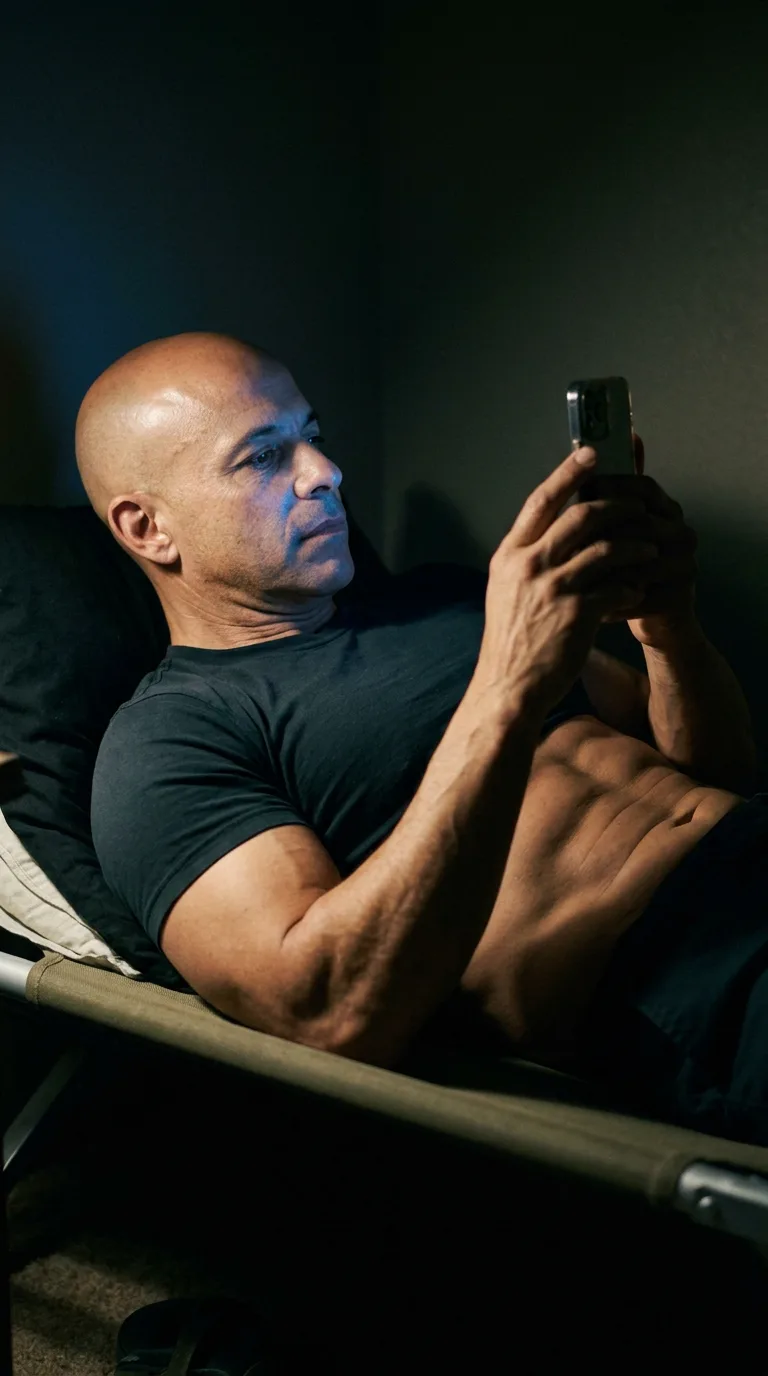
Rarest thing about him: Mainline Protestant — rare, 1 in 26
Season 0seed 2110765610 · engine v10
Character card
lineage 2NZHHJ
His body-swap story
@colin.hasbrook, wearing Randall Dietz, rolled the wheel on and woke up as Manny Cardosa, spent under a minute in him, then spun the wheel and woke up as Kevin Marchetti
—
The furniture mover's name doesn't matter to you anymore, not really, even after six weeks of being him. His shoulders ache from a dresser he carried down three flights on Friday, and the ache is honest, and that's the problem. You're standing in his kitchen at lunch, in Larned, Kansas, gray-brown light through a window over a sink full of one man's dishes, and you already know you're going back. It isn't boredom exactly. It's that this body does one thing extremely well — it lifts — and you have felt every version of lifting there is to feel. The wanting comes up in your throat like a swallowed coin. You set his sandwich down half-eaten. You open the site on his phone with his thick, careful thumb, the wheel already spinning before you've decided anything, because deciding stopped being a real step around spin forty.
The wheel gives you Nevada. Gives you a man on his side in the dark of a room that shouldn't be dark at eleven in the morning — and that wrongness is the first thing you feel, before you feel anything else, a held breath in a body that isn't confused so much as tired down to the marrow, a night-shift tired, a driving-since-3-a.m. tired, home now and trying to wind down enough to sleep through daylight. His thumb was slowing on the phone. Now it isn't. It picks up speed, snapping past a video of someone's dog, past a news headline, faster and steadier than the hand that was holding it a half-second ago, and somewhere behind the eyes the blinking stops keeping its rhythm.
You are 5'5" and dense with muscle in a way the mover's body only wished it was, shoulders wide for the height, forearms cut from twenty-some years of a wheel and a lever and a door lift. Bald head warm against a pillow that smells like the inside of a trailer — hot vinyl and coffee grounds and the particular mineral smell of well water. The phone in your hand is warm from his palm. That's the first thing that opens: not a memory yet, just the shape of his grip on it, a groove worn into the way his hand already knows to hold a phone, a wheel, a coffee cup, in that order, every day.
Then the shirt. Black cotton, soft from washing, snug across a chest that lifts more than it needs to just from getting through a shift, and the shirt gives you this morning — no, gives you last night, four-something in the morning, him pulling it over his head in a trailer lit only by the bathroom bulb, one arm through the sleeve, the fabric catching for a second on his ear the way it always does because his head is a shape shirts don't expect. He'd stood in front of the mirror for a second longer than necessary, the way he does most nights, running a palm once over the bare scalp — not vanity, just checking it's still there, a habit older than the baldness itself. Named Manny Cardosa in that mirror, though nobody in the room calls him that; the dispatcher calls him Cardosa, his kids call him Dad, his ex-wife, on the good days, still calls him Manny like she means it.
The mattress under you — a cot, really, camp-style, metal frame creaking, because the real bed's frame cracked two winters ago and he never got around to replacing it, and that unfinished errand comes with a small flush of familiar shame, the same shame as the water heater that runs cold after six minutes and the skirting under the trailer that the wind keeps peeling back. He drives Route 12 out past the middle school and back, six times a day, five days a week, and he is good at it, genuinely good, the kind of good where the kids on the route know him and the old woman at the Sinclair stop always has a wave ready. He likes the driving. He does not like going home to a trailer with sagebrush right up against the step and nobody in the second bedroom anymore.
His kids: a girl at UNR he calls on Sundays, a boy in Sparks he doesn't call enough and knows it. The ex-wife's name comes up through the pillow somehow — Denise — not with anger, just the specific ache of a marriage that ended reasonably, no villains, which is somehow worse than one that ended badly, because there's nothing to be righteous about, just two people who ran out of reasons. He still has her number saved under Denise ❤ and has never changed it and doesn't examine why.
There's a heat behind his sternum, low and familiar — the reflux, always worse lying down, worse after the gas station burrito he ate at three a.m. between the depot and home, and his stomach kicks once, a small fire he's stopped noticing the way you stop noticing a dripping faucet. His hand, still moving on the phone, is not the hand of a man thinking about anything. It's a hand that runs over his own scalp forty times a day without him clocking it once, and it wants to do that now, wants to reach up, except it's holding a phone, and for a second the two wantings argue in the muscle and go still.
Then you lift the phone away from your face, slow, and look at your own hand in the thin light — not his light, your looking. Thick fingers. A city's worth of steering wheel calluses across the palm. No ring, no scars, no tattoos, just forty years of Nevada sun baked into the backs of both hands in two different shades.
You turn the hand over once, like checking it for a leak.
"There you are," you say, to the ceiling, to nobody, and your palm goes up on its own to the bare scalp and rests there a second, already at home.
—