Malik Freeman
Fictional. Generated by AI — not a real person, and no likeness of one is intended.
44, butcher in Los Angeles · rolled by @marlon.etienne · card — no film
History
who has worn him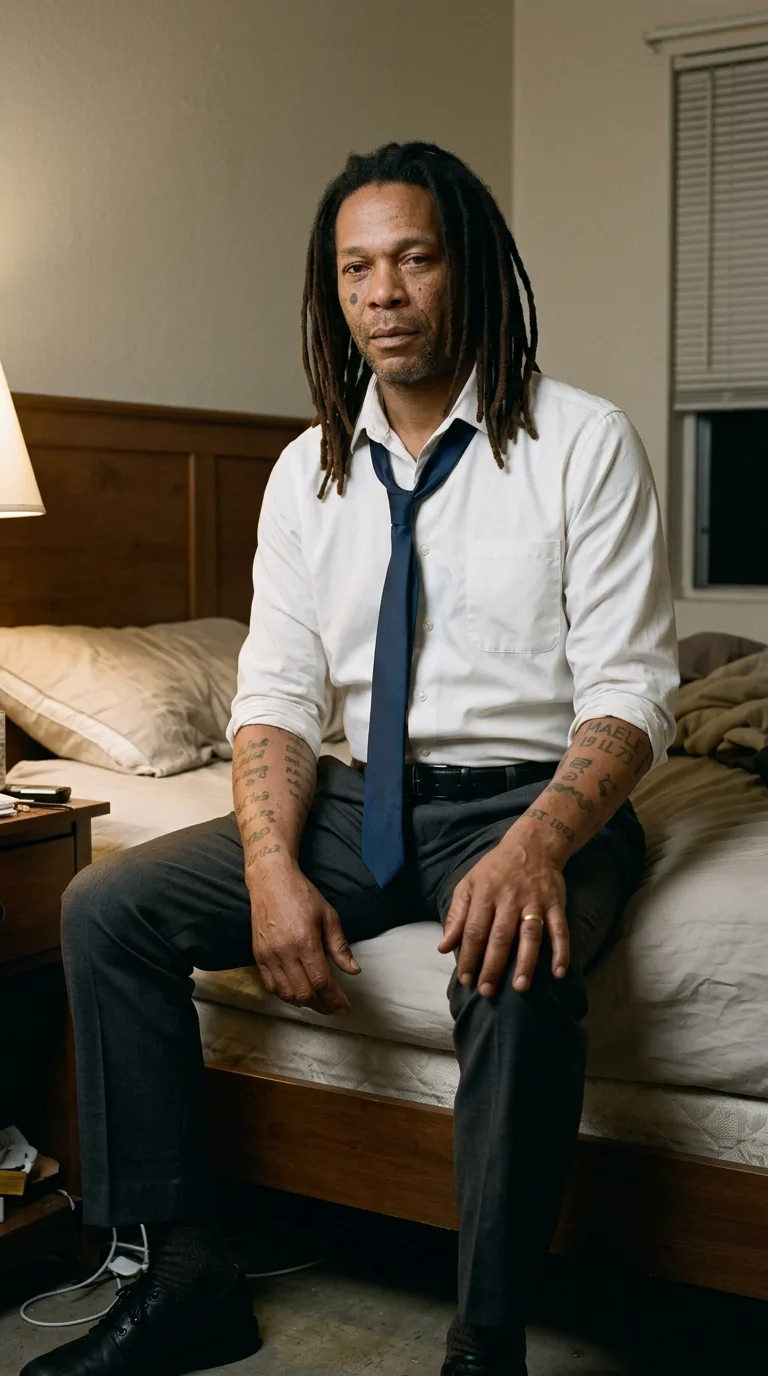
Rarest thing about him: Smokes when he drinks — rare, 1 in 33
Season 0seed 1701300193 · engine v10
Character card
lineage 6PRR5R
His body-swap story
@marlon.etienne, wearing Douglas Pinsker, rolled the wheel on and woke up as Malik Freeman, spent 3 minutes in him, then spun the wheel and woke up as Walter Prussick
You are sitting in a gallery's conservation lab that isn't yours, in a body that isn't yours, at a folding table at six in the morning, and Douglas Pinsker's soft hands are shaking so badly you can't hold the loupe steady. Less than a minute ago you were nobody in particular, and now you are a man who has spent fourteen mornings before this one waking up disgusted with whatever face was in his mirror. This one is worse than most. The fat sits on him like a coat he never asked to wear, his knees complain when he stands, and his eyes — his actual eyes, hazel, watery — can't focus close-up without the loupe, which is its own small humiliation you inherited along with everything else. Somewhere down the hall a Vermeer is drying under glass and none of it belongs to you, none of it ever did. You did not come back for boredom. You came back because you are already bored, in the first ninety seconds, of a man whose whole personality turns out to be caution. You want out of him the way you want out of a coat that's too warm in a room that isn't. You open the site on your phone with his soft trembling thumb. The wheel spins. It always spins the same, no matter whose hand does it.
The shirt is already buttoned wrong, and your hand — his hand, a stranger's hand, six-three of frame you did not bring with you — is flat against your own sternum, feeling ribs you've never owned, and something in the wrongness of the buttons offends you before you've even decided to care. You undo them. You redo them, correctly this time, without being taught, the way muscle does what muscle has always done regardless of who's asking. The tie hanging loose around your collar gets picked up next and knotted in a shape no closet in this apartment has seen — not the four-in-hand this man ties every weekday of his working life, some other knot, yours, foreign, done before you know you're doing it. Your hands are dark and long-fingered and there is a wedding band on the left one that was not there in the gallery. You stand at the foot of a bed that is not a hospital bed, not a cot, an actual double bed with a nightstand and a phone charger snaking off it, low morning light coming sideways through the blinds the way it does before a city has decided what kind of day it's going to be.
Then the shirt gives you the rest of it, sleeve by sleeve, because the shirt was the one that was there first.
It comes as his hand smoothing the collar flat: a Tuesday four years back, ironing this same shirt on the counter because the board was buried under a crib mattress they hadn't set up yet, Aliyah two weeks old and finally asleep in the next room, and him doing it quiet so the iron's hiss wouldn't wake her, and feeling — this feeling, not yours, his, arriving whole and unearned — something so far past tired it had turned into a kind of peace. It comes as the cuff button, small, mother-of-pearl, going through its hole the way it's gone through a thousand mornings: the shop smell underneath it always, no matter how many showers, the bleach-and-iron smell of the aprons hung on their pegs, the particular cold of the walk-in that gets into a man's shoulders by December and never fully leaves by June. It comes as the collar against the back of his neck, and that gives you the counter itself, trays of it under the light, the saw quiet on its rest because Fridays start slow before they don't, Hassan at the register already, the two of them not needing to talk to know what the day is. It comes as the tie's silk sliding through his fingers, and that gives you your father's voice, older, patient, teaching a fourteen-year-old how to break down a shoulder without wasting the cheek meat, teaching him the bismillah before the knife ever touches the throat because some things you do right or you don't do them, and the shop is Freeman's now with his own name over the door and his father's name still on the wall in a photograph nobody's ever suggested taking down.
It comes as the mattress under what are now your knuckles, and that one is soft and it hurts a little going down: Renée's voice through the bathroom door twenty minutes ago, sleep-thick, asking did you eat something before you left the shop last night, you smelled like a whole cow, and him laughing at the sink, and some old low guilt underneath the laugh about the drink he quit nine years ago and the cigarette he still sometimes has anyway on the bad nights, one, never in front of her, never enough to call a habit, just enough to still call it something. It comes as the ring, plain, cheap when he bought it, and that gives you the wedding itself, small, at her sister's place, his mother crying not from sadness, and the two dates on his forearm under his sleeve that this shirt is currently covering — a name, a day — that he has never once had to explain to anyone who asked twice.
Your knuckles want cracking. You let them, both hands, without deciding to, the way his body has always done it when his mind wanders off without him, and the sound of it in the quiet room is the loudest thing that's happened yet.
You look down at your hands — his hands, wide, dark, a mole high on your borrowed cheek you can't see but can feel like a fact — and you turn the right one over slowly, palm up, like you're checking it for something the last man left behind. Then you lift your eyes to whatever's watching, and you say, in a voice this apartment has also never heard shaped quite this way:
"Man's got somewhere to be."